


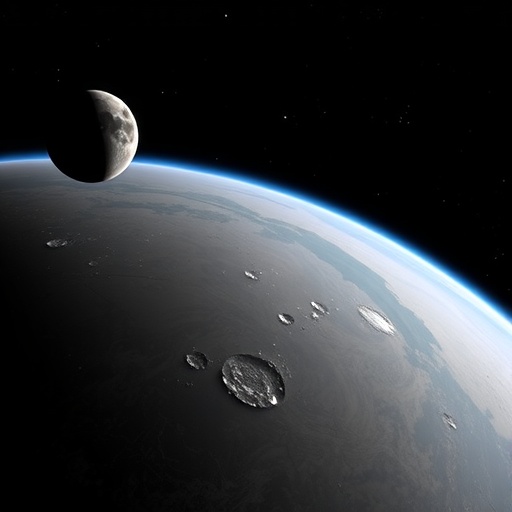
A groundbreaking mathematical method spearheaded by an international team of researchers promises to revolutionize space travel between Earth and the Moon by optimizing fuel consumption. Leveraging the theory of functional connections, their approach enables more accurate and computationally efficient calculations of spacecraft trajectories. This advancement has led to the identification of a transfer route that conserves significantly more fuel than any prior paths recorded in scientific literature, marking a milestone in astrodynamics and mission planning.
Traditional methods of plotting spacecraft journeys have involved numerous complex simulations that often demand extensive computational resources and time. In contrast, the method introduced by this research team drastically reduces these costs, permitting the simulation of millions of possible trajectories rather than hundreds of thousands. By simulating over 30 million distinct routes — a volume order of magnitude higher than typical studies — the team succeeded in uncovering solutions that escape conventional assumptions, thereby achieving fuel economy gains previously thought unattainable.
Fuel efficiency in spaceflight is remarkably critical as the amount of propellant required directly influences a mission’s financial and engineering feasibility. The newly identified orbit transfer requires approximately 58.80 meters per second (m/s) less change in velocity, or delta-v, than the best-known earlier transfers, which cumulatively demand around 3,343 m/s. While this may seem incremental, each meter per second of saved delta-v translates into exponentially less fuel and weight, drastically cutting costs and increasing payload capacities for lunar missions.
At the heart of this innovative trajectory planning is the Earth-Moon L1 Lagrange point, a gravitationally stable location situated between the two celestial bodies where their gravitational forces equilibrate. The researchers propose segmenting the journey into two phases: initially transitioning the spacecraft from Earth’s orbit into an orbit around the L1 point, and subsequently propelling it towards lunar orbit. This approach provides both fuel benefits and tactical advantages, including uninterrupted communication with Earth — an improvement over existing trajectories like those used in the Artemis 2 mission, which encountered temporary communication blackouts.
A key revelation from the simulations defies earlier models, which posited that spacecraft should approach the L1 variate— a set of natural orbits leading to the Lagrange point— from points closest to Earth for maximum efficiency. Instead, the optimized path discovered by the team approaches from the side nearer the Moon. This nontrivial insight emerged only because the researchers deployed systematic, high-volume simulation analyses supported by the theory of functional connections, permitting exploration beyond conventional intuition or simplified assumptions.
Functional connections theory, although a relatively new mathematical framework, enables the reduction of complex boundary condition problems into more manageable forms. Applied to the context of celestial mechanics, it simplifies the calculation of optimal control trajectories for spacecraft transfer, allowing for a broader and deeper search within the multidimensional space of possible orbits. The theory’s computational efficiency empowers the exploration of subtle trajectory nuances that yield substantial mission advantages.
Further, the proposed orbital maneuver utilizes a controllable system to maintain the spacecraft in a quasi-stable orbit around the L1 point indefinitely if necessary, allowing mission planners flexibility in timing the subsequent trip to lunar orbit. This control-based “parking orbit” can facilitate precise coordination with mission schedules and maximize scientific or strategic objectives while preserving communication links, an ever-critical factor in real-time mission management and safety.
Despite the promising results, the researchers acknowledge that their simulations considered solely the gravitational influences of Earth and the Moon. Factoring in other celestial bodies, particularly the Sun, could yield even more fuel-efficient trajectories. However, such considerations inherently restrict the launch window to specific dates when celestial alignments favor these trajectories, complicating mission logistics. Nonetheless, the robust computational framework established by the team can accommodate such complex simulations in the future to optimize launch timing alongside fuel efficiency.
The collaborative effort behind this advancement includes institutions across Portugal, France, and Brazil, highlighting the importance of international cooperation in tackling the intricate challenges of space exploration. By marrying expertise in mathematics, physics, and aerospace engineering, the team’s interdisciplinary approach exemplifies the benefits of cross-border scientific initiatives geared toward humanity’s next giant leap into space.
Beyond the immediate implications for Earth-Moon transfers, the mathematical methodologies applied have potential relevance across a broad spectrum of astrodynamics problems. As missions venture deeper into the solar system and seek more cost-effective pathways, the capacity to rapidly analyze exhaustive trajectory alternatives will become indispensable. This study sets a precedent for harnessing advanced mathematical tools to unlock new operational paradigms in space travel.
As space agencies and private enterprises alike intensify their ambitions for lunar settlement and exploration, fuel savings on the order demonstrated here could meaningfully influence mission architecture. Lower propellant requirements translate into lighter launch masses, reduced costs, and enhanced payload capabilities. Such gains could accelerate the development of sustainable lunar infrastructures, robotic explorers, and even crewed missions beyond Earth’s orbit.
This pioneering research, recently published in the journal Astrodynamics, stands as a testament to how fundamental theoretical advances can translate into practical, impactful solutions for the space industry. Future work expanding on these methods to incorporate additional celestial influences and mission constraints is poised to further refine spacecraft routing, potentially setting new standards for economical and reliable space exploration.
News Publication Date:
10-Apr-2026
Web References:
DOI: 10.1007/s42064-025-0297-x
Keywords
Classical mechanics, Analytical mechanics, Electron transfer, Astrodynamics, Functional connections theory, Lagrange points, Space mission trajectory optimization, Fuel-efficient space travel
Cite Scienmag News
Bethany Barker. (May 14, 2026). New Method Finds More Efficient Route Between Earth and Moon Than Ever Before. Scienmag. https://scienmag.com/new-method-finds-more-efficient-route-between-earth-and-moon-than-ever-before/
Bethany Barker. "New Method Finds More Efficient Route Between Earth and Moon Than Ever Before." Scienmag, 14 May 2026, https://scienmag.com/new-method-finds-more-efficient-route-between-earth-and-moon-than-ever-before/. Accessed 3 September 2026.
Bethany Barker. "New Method Finds More Efficient Route Between Earth and Moon Than Ever Before." Scienmag. May 14, 2026. https://scienmag.com/new-method-finds-more-efficient-route-between-earth-and-moon-than-ever-before/


