

Thursday, July 16, 2026
Science
No Result
View All Result
  • Login
  • HOME
  • SCIENCE NEWS
  • CONTACT US
  • HOME
  • SCIENCE NEWS
  • CONTACT US
No Result
View All Result
Scienmag
No Result
View All Result
Home Science News Chemistry

Cold Radioactive Molecules Prepared for Next Physics Breakthroughs

July 16, 2026
in Chemistry
Reading Time: 2 mins read
0
Cold Radioactive Molecules Prepared for Next Physics Breakthroughs

Cold Radioactive Molecules Prepared for Next Physics Breakthroughs

65
SHARES
587
VIEWS
Share on FacebookShare on Twitter
ADVERTISEMENT

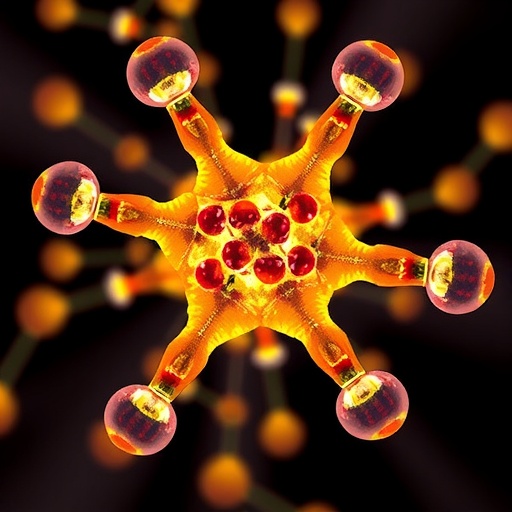
For the first time, researchers have produced radium-containing molecules in a cold, laser-ready state, enabling high-precision tabletop measurements. The work opens a new experimental route for probing how the universe became dominated by matter rather than antimatter.

In the early universe, matter and antimatter were expected to form in nearly equal amounts. Yet when an electron meets its antimatter counterpart, the positron, both annihilate into energy—so the persistence of ordinary matter today hints at an unknown asymmetry generated during the cosmos’s earliest moments.

To explore that asymmetry, a team led by Nick Hutzler at Caltech turned to radium. Its nucleus has a rare “pear-shaped” deformation, which amplifies subtle signals that could arise from previously unseen particles or forces. When such nuclei are embedded within molecules, laser spectroscopy can reveal tiny energy shifts tied to fundamental physics.

Radium is notoriously difficult to work with: it is radioactive, chemically reactive, and available only in minute quantities. The central challenge was therefore not only forming radium-bearing molecules, but doing so in a controlled way that preserves the atoms long enough to study them precisely.

The researchers designed a strategy that begins by stabilizing radium in a viscous medium produced through a process inspired by candy-making. Instead of sugar, they optimized conditions using xylitol to avoid problematic caramelization while creating a workable “goo” that can be handled safely and reproducibly.

Once prepared, the material was placed onto a gold foil inside a compact cryogenic apparatus. The chamber was cooled to roughly minus 450°F using helium gas. Radium atoms were then excited by lasers into a reactive state so they could form the target molecular species.

Finally, additional laser systems were used to detect and characterize the newly created molecules at quantum-relevant energies. The result is a method that yields cold radioactive molecules suitable for precision experiments, and it can be extended to other heavy atoms with similarly favorable nuclear structure.

Hutzler’s group is already pursuing next-generation measurement concepts, including “engineered molecular clocks,” designed to reduce sensitivity to noise and decoherence. In future experiments, these tools will be applied to the radium nucleus as the collaboration searches for evidence of new symmetry-violating physics.

Subject of Research: Matter–antimatter asymmetry via cold radium molecular spectroscopy
Article Title: Production and spectroscopy of cold radioactive molecules
News Publication Date: 16-Jul-2026
Web References: http://dx.doi.org/10.1126/science.aea9413 ; https://arxiv.org/abs/2508.06787
References: 10.1126/science.aea9413
Image Credits: Ella Maru Studio

Keywords

Antimatter, Quantum mechanics, Atomic physics, Nuclear physics, Subatomic particles

Tags: antimatter researchcosmology and particle physicsearly universe physicsfundamental particle searcheslaser spectroscopymatter-antimatter asymmetryprecision measurement techniquesquantum measurement methodsradioactive molecule productionRadioactive moleculesradium nuclear deformationradium-containing molecules
Share26Tweet16
Previous Post

Immune Cell Interaction Breakdown Drives Aging, New Study Finds

Next Post

Scientists Discover Immune Cells Form Cancer-Fighting Hubs Within Tumors

Related Posts

Forest Rivers Remove Nitrogen as Natural Processes Shift Throughout Seasons
Chemistry

Forest Rivers Remove Nitrogen as Natural Processes Shift Throughout Seasons

July 16, 2026
Bioengineered Bacterial Spores Found for Broader New Applications
Chemistry

Bioengineered Bacterial Spores Found for Broader New Applications

July 16, 2026
New experiment maps multiple isotopes showing pygmy excitations
Chemistry

New experiment maps multiple isotopes showing pygmy excitations

July 16, 2026
Coordination Chemistry Enables Stable Wide-Bandgap Perovskites for Efficient Tandem Solar Cells
Chemistry

Coordination Chemistry Enables Stable Wide-Bandgap Perovskites for Efficient Tandem Solar Cells

July 16, 2026
Air-Stable Ru/BaSiN2O: Floating Electrons Power New Catalyst
Chemistry

Air-Stable Ru/BaSiN2O: Floating Electrons Power New Catalyst

July 16, 2026
Frog Protein Shows Promise as First Antidote to Fatal Red Tide Toxin
Chemistry

Frog Protein Shows Promise as First Antidote to Fatal Red Tide Toxin

July 16, 2026
Next Post
Scientists Discover Immune Cells Form Cancer-Fighting Hubs Within Tumors

Scientists Discover Immune Cells Form Cancer-Fighting Hubs Within Tumors

  • Mothers who receive childcare support from maternal grandparents show more

    Mothers who receive childcare support from maternal grandparents show more parental warmth, finds NTU Singapore study

    27656 shares
    Share 11059 Tweet 6912
  • University of Seville Breaks 120-Year-Old Mystery, Revises a Key Einstein Concept

    1061 shares
    Share 424 Tweet 265
  • Bee body mass, pathogens and local climate influence heat tolerance

    682 shares
    Share 273 Tweet 171
  • Researchers record first-ever images and data of a shark experiencing a boat strike

    546 shares
    Share 218 Tweet 137
  • Groundbreaking Clinical Trial Reveals Lubiprostone Enhances Kidney Function

    531 shares
    Share 212 Tweet 133
Science

Embark on a thrilling journey of discovery with Scienmag.com—your ultimate source for cutting-edge breakthroughs. Immerse yourself in a world where curiosity knows no limits and tomorrow’s possibilities become today’s reality!

RECENT NEWS

  • Biochar Enables Earthworms to Survive Copper and Glyphosate Pollution
  • Early inflammation signal fuels oral cancer, suggests immunoprevention strategy
  • Forest Rivers Remove Nitrogen as Natural Processes Shift Throughout Seasons
  • LIG1 Loss Reveals Targetable Weakness Against Chemotherapy-Resistant Triple-Negative Breast Cancer

Categories

  • Agriculture
  • Anthropology
  • Archaeology
  • Athmospheric
  • Biology
  • Biotechnology
  • Blog
  • Bussines
  • Cancer
  • Chemistry
  • Climate
  • Earth Science
  • Editorial Policy
  • Marine
  • Mathematics
  • Medicine
  • Pediatry
  • Policy
  • Psychology & Psychiatry
  • Science Education
  • Social Science
  • Space
  • Technology and Engineering

Subscribe to Blog via Email

Enter your email address to subscribe to this blog and receive notifications of new posts by email.

Join 5,146 other subscribers

© 2025 Scienmag - Science Magazine

Welcome Back!

Login to your account below

Forgotten Password?

Retrieve your password

Please enter your username or email address to reset your password.

Log In
No Result
View All Result
  • HOME
  • SCIENCE NEWS
  • CONTACT US

© 2025 Scienmag - Science Magazine

Discover more from Science

Subscribe now to keep reading and get access to the full archive.

Continue reading
