


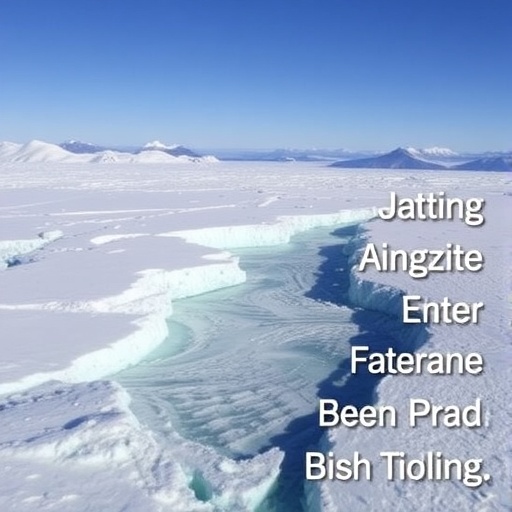
In recent years, the hydrological dynamics of the Earth’s most glacierized regions have become a focal point of climatological and environmental research, with particular emphasis on the Third Pole basin — an area encompassing the expansive Tibetan Plateau and adjacent high mountain ranges. New research published in Communications Earth & Environment in 2026 by Liu, Wang, Chen, and colleagues has brought to light alarmingly increased unpredictability in river floods originating from this critical and sensitive region. The study’s integration of cutting-edge climatological models and glaciological data unveils a shifting paradigm in the timing, magnitude, and frequency of riverine flood events, raising red flags about the sustainability of water resource management and disaster preparedness across downstream communities.
The Third Pole basin, often dubbed the “Water Tower of Asia,” supports over a billion people relying on its meltwater to sustain agriculture, industries, and ecosystems. Characterized by an extensive network of glaciers, high-altitude snowpacks, and perennial rivers, this basin’s hydrological balance has historically been somewhat predictable through seasonal melting and precipitation trends. However, the research team’s analysis reveals that ongoing climatic warming is destabilizing this balance, leading to abrupt and less forecastable flood events. Their study blends detailed satellite observations with sophisticated hydrodynamic simulations, capturing the complex feedback mechanisms between glacier retreat, snow cover loss, and precipitation variability under a warming climate.
One of the principal insights centers on how accelerated glacier melt, occurring unevenly across the basin, disrupts the temporal patterns of runoff. Unlike in previous decades when meltwater contributions followed relatively steady seasonal cycles, present-day melt processes are characterized by premature melting bursts during warmer weeks interspersed with colder spells that retard flow. These episodic melt events interlace with intensified and often erratic monsoonal precipitation to generate flood pulses of unprecedented volatility, placing immense pressure on river channel capacity and floodplain absorption. The interplay of these factors reduces opportunities for traditional flood forecasting models to accurately anticipate river discharge volumes.
Moreover, the researchers highlight a marked increase in “compound flooding” phenomena at lower elevation river basins fed by Third Pole glaciers. Compound flooding refers to the simultaneous occurrence of multiple flood drivers — in this case, glacier melt plus heavy precipitation — that amplify flood severity beyond the sum of individual influences. Using high-resolution hydrological timelines, the team traced successive flood surges linked to this synergetic effect, which are proving more damaging and destructive compared to isolated events. Such compound events undermine early warning systems that often assume independence between rainfall-runoff processes and glacier hydrodynamics, necessitating a paradigm shift in flood risk assessment.
In addition to hydrological unpredictability, the researchers point to emerging geomorphological hazards. Increasing flood variability is accelerating riverbank erosion, sediment loads, and debris flows downstream, particularly in steep mountainous channels. The sediment transport alterations not only affect aquatic habitat health and biodiversity but also threaten critical infrastructure such as bridges, roads, and hydroelectric facilities. Field measurements and remote sensing revealed ever-escalating turbidity spikes during flood peaks, suggesting that riverbeds are increasingly unstable as the input of glacial meltwater fluctuates abruptly rather than progressively.
The implications of this research extend far beyond physical hydrology, touching on socioeconomic dimensions. Communities that have historically adapted to predictable flooding patterns find themselves grappling with harder-to-anticipate disasters that severely constrain agricultural productivity and water supply management. The researchers emphasize that downstream urban centers, which are growing in population density, may face heightened risks of catastrophic flood damage—with smaller lead times for evacuation and disaster mitigation. Water resource planners and policymakers must, therefore, incorporate these newfound complexities into their resilience frameworks to avoid humanitarian crises.
Climate change projections for the region predict continued warming trends coupled with increased precipitation variability, particularly intensified monsoonal flows. Liu and colleagues modeled flood frequency scenarios through 2100 under multiple emission trajectories, consistently showing upward trends in river flood irregularity. These projections underscore an urgent need for real-time monitoring networks that integrate glacier melt dynamics with atmospheric and hydrological data streams. The current research paves the way towards these integrative approaches, proposing multidisciplinary collaborations between climatologists, glaciologists, hydrologists, and disaster risk managers.
Technically, the study leverages novel algorithmic approaches to glacier mass balance monitoring, incorporating radar and optical satellite data fusion to detect subtle glacier volume changes and meltwater runoff patterns at high spatial and temporal resolution. Additionally, the hydrological models employed incorporate dynamic glacier melt parameterization coupled with advanced precipitation downscaling methods, which sharpen flood timing and volume predictions. This methodological innovation represents a leap forward compared to earlier models that often treated glacier melt as static inputs or relied on coarse spatial resolution data.
The research also discusses the critical role of cryospheric feedback loops in modulating flood unpredictability. Thinning glaciers expose dark rock and soil surfaces, reducing albedo and accelerating local warming — a phenomenon that further intensifies melt rates and runoff variability. Moreover, the loss of glacial ice reservoirs diminishes the buffering capacity of the basin during dry spells while simultaneously increasing flood peak discharges during melt pulses. Thus, the cryosphere not only contributes water to the system but also governs the timing and distribution of meltwater inputs, profoundly influencing river flood dynamics in a warming world.
Furthermore, the study illuminates the role of snowpack processes in flood variability. Snowfall and accumulated snowpack serve as critical regulators of seasonal water release, with delayed melting traditionally smoothing river flows. However, today’s warming climate delays snowfall and alters snow wetting, increasing variability in snowmelt onset and intensity. The researchers note that this unpredictability contributes significant noise to flood regimes, challenging existing hydrological operational models that often rely on regular snowmelt timing assumptions.
On a broader scale, this increased flood unpredictability within the Third Pole basin is entwined with complex atmospheric teleconnections. The study delves into interactions between local melting and larger-scale climatic phenomena such as the Indian monsoon oscillations and the westerly jet stream fluctuations. These large-scale atmospheric patterns influence precipitation variability and temperature cycles in the basin, thereby shaping meltwater runoff patterns and flood occurrences. Understanding these teleconnections is essential for refining medium to long-term flood forecasts and developing targeted adaptation strategies.
Looking forward, Liu and colleagues advocate for an integrative management framework that harnesses this emerging knowledge to mitigate flood risks. They argue that investments in adaptive infrastructure, such as improved flood defenses and sustainable watershed management practices, must be complemented by enhanced community-based disaster preparedness informed by real-time data. This integrated approach will help buffer vulnerable populations against the increasingly erratic hydrological realities imposed by climate change.
The study’s urgency resonates as other glacierized mountain regions globally, from the Andes to the Alps, report similar trends of increasing river flood unpredictability. The Third Pole’s vast scale and critical water resource provisioning make its trends particularly consequential for international environmental and climatic policy conversations. As river flooding unpredictability cascades downstream along some of the world’s major river systems, transboundary cooperation on flood risk management and climate adaptation becomes even more imperative.
In sum, this groundbreaking research elucidates the emerging challenges posed by climate-driven hydrological uncertainties within the Third Pole basin, raising awareness about the profound transformations underway in glacier-fed river systems. It calls for a new era of flood forecasting, monitoring, and disaster resilience enhanced by multidisciplinary perspectives and cutting-edge technologies. Only by embracing this complexity can societies dependent on these vital mountain water sources navigate the mounting risks ahead with foresight and resilience.
Cite Scienmag News
Violet Maxwell. (May 14, 2026). Unpredictable Floods Surge in Glacierized Third Pole Basin. Scienmag. https://scienmag.com/unpredictable-floods-surge-in-glacierized-third-pole-basin/
Violet Maxwell. "Unpredictable Floods Surge in Glacierized Third Pole Basin." Scienmag, 14 May 2026, https://scienmag.com/unpredictable-floods-surge-in-glacierized-third-pole-basin/. Accessed 3 September 2026.
Violet Maxwell. "Unpredictable Floods Surge in Glacierized Third Pole Basin." Scienmag. May 14, 2026. https://scienmag.com/unpredictable-floods-surge-in-glacierized-third-pole-basin/


