


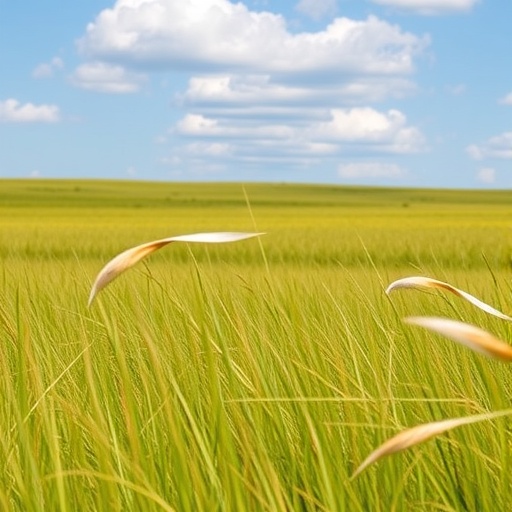
Grasslands constitute an expansive biome, covering approximately 40% of the Earth’s vegetated surface and serving as pivotal regulators in the global carbon cycle. These ecosystems, though integral to sequestering carbon dioxide and supporting biodiversity, are increasingly imperiled by the intensifying threats posed by climate-driven water scarcity. Recent groundbreaking research published in the esteemed journal Science Advances elucidates a hitherto underappreciated climatic phenomenon—known as “terrestrial stilling,” or the widespread decline in near-surface wind speeds—and its profound implications for grassland water-use efficiency (WUE). This phenomenon has been identified as a crucial buffering mechanism, potentially enhancing grasslands’ ability to thrive despite the mounting stresses of global warming.
Spearheaded by Professors FU Congsheng and YANG Guishan at the Nanjing Institute of Geography and Limnology, under the aegis of the Chinese Academy of Sciences, this study represents a highly interdisciplinary collaboration. It incorporates expertise and data from institutions across the globe, including Sun Yat-sen University, France’s Laboratory for Climate and Environmental Sciences, and prominent American national laboratories such as Lawrence Berkeley and Oak Ridge. Their collective efforts aimed to comprehensively understand how declining wind velocities modulate the interplay between carbon assimilation and water conservation in grassland ecosystems.
To tackle this multifaceted problem, the research team integrated a wealth of observational datasets encompassing over a thousand geographically disparate grassland sites worldwide. This was supplemented by the application of robust climate reanalysis data, satellite-derived vegetation and soil moisture metrics, and projections generated by six independent Earth-system models. The fusion of these observational and predictive tools allowed the researchers to analyze patterns extending longitudinally from the early 1980s into potential climatic futures projected through 2100. Central to their methodology was the coupling of statistical analyses with innovative wind-manipulation experiments designed to isolate the causal links between wind speed variations and ecosystem water-use efficiency.
Their findings reveal a pronounced and consistent pattern: as wind speeds decline, long-term water-use efficiency across more than 80% of global grasslands improves significantly. This discovery is not only statistically robust but also ecologically consequential. The analysis determined that under both historical warming trends and multiple future warming scenarios, wind speed constitutes the second most influential driver augmenting water-use efficiency. It is surpassed only by rising atmospheric CO₂ concentrations, which are well-documented to promote photosynthetic carbon fixation.
Mechanistically, the study delineates how diminished wind speeds enact a dual advantage by decreasing water loss through evaporation and bolstering soil moisture retention. Wind is a potent driver of evaporative demand; as wind speed drops, the vapor pressure gradient is reduced, leading to lower transpiration rates. Enhanced soil moisture availability prompts stomatal conductance adjustments in plant leaves, allowing them to remain open longer, thereby maximizing the uptake of carbon dioxide without incurring proportional water loss. This physiological optimization enables grasslands to increase carbon gains per unit of water expended—a critical adaptive trait under water-limited conditions.
Intriguingly, the research identifies an intensification of the wind effect under conditions of decreasing soil moisture. This implies that terrestrial stilling disproportionately benefits grasslands facing frequent drought episodes, which are projected to escalate in both intensity and frequency due to anthropogenic climate change. By ameliorating the hydraulic constraints on vegetation, slower winds may confer increased drought resistance and stability to these water-limited ecosystems, enhancing their resilience and capacity for carbon sequestration.
The broader implications of these findings extend into global biogeochemical cycles, underscoring wind speed as a key regulatory factor in terrestrial carbon and water fluxes. Prior to this study, wind dynamics often received less attention relative to temperature, precipitation, and atmospheric CO₂ when modeling ecosystem responses to climate change. The revelation that wind-speed decline significantly improves water-use efficiency offers a paradigm shift in ecosystem modeling and highlights a previously overlooked feedback mechanism within the Earth system.
Moreover, the study provides valuable insights for environmental policymakers and conservationists tasked with safeguarding grassland biomes. These findings suggest that grasslands may possess intrinsic resilience exceeding prior estimations, empowering better-informed adaptation strategies. Recognizing terrestrial stilling’s role could inform land management policies oriented towards enhancing soil moisture retention, reducing evapotranspiration losses, and optimizing vegetation carbon uptake under an evolving climate regime.
Methodologically, the study’s strength lies in its comprehensive approach, combining extensive datasets with controlled wind manipulation experiments. These experiments simulate real-world declines in wind speed and measure consequential physiological and ecological changes, thereby corroborating statistical inferences with empirical evidence. This amplifies the confidence in the causal relationships identified and opens avenues for further experimental research on biome-specific wind-vegetation interactions.
As climate dynamics continue to evolve, the interplay between physical atmospheric forces and terrestrial ecological processes gains increasing prominence. The phenomenon of terrestrial stilling not only modifies local microclimates but also exerts systemic influences on global carbon budgets and water cycling. Understanding such complexities is essential for advancing predictive ecological models and for realizing the multifaceted nature of biosphere-climate feedbacks.
In summary, this seminal research published in Science Advances reframes the scientific understanding of how shifting wind regimes influence grassland ecosystems worldwide. By elucidating the positive effect of slowing winds on maximizing carbon sequestration efficiency while conserving critical water resources, the study contributes a compelling narrative of ecosystem resilience in the Anthropocene. It calls for a nuanced appreciation of atmospheric dynamics in ecological studies and underscores the imperative of integrating such variables into global climate adaptation frameworks.
News Publication Date: 13-May-2026
Web References: http://dx.doi.org/10.1126/sciadv.aee4995
Cite Scienmag News
Margaret Porter. (May 13, 2026). Gentle Winds Boost Grasslands’ Carbon Uptake and Water Conservation. Scienmag. https://scienmag.com/gentle-winds-boost-grasslands-carbon-uptake-and-water-conservation/
Margaret Porter. "Gentle Winds Boost Grasslands’ Carbon Uptake and Water Conservation." Scienmag, 13 May 2026, https://scienmag.com/gentle-winds-boost-grasslands-carbon-uptake-and-water-conservation/. Accessed 6 September 2026.
Margaret Porter. "Gentle Winds Boost Grasslands’ Carbon Uptake and Water Conservation." Scienmag. May 13, 2026. https://scienmag.com/gentle-winds-boost-grasslands-carbon-uptake-and-water-conservation/


