


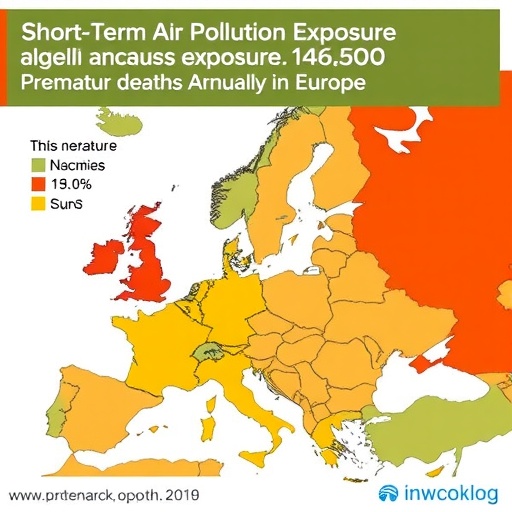
A groundbreaking study spearheaded by the Barcelona Institute for Global Health (ISGlobal), in concert with the Barcelona Supercomputing Center–Centro Nacional de Supercomputación (BSC-CNS), has unveiled the first Europe-wide assessment of short-term mortality attributed to the intertwined effects of multiple air pollutants. Covering a vast demographic of over 530 million people across 31 European countries and spanning from 2003 to 2019, this comprehensive research has delineated a more intricate picture of how daily exposure to air pollution triggers immediate health crises and mortality risks.
Fine particulate matter (PM₂.₅) emerged as the foremost culprit, implicated in an estimated 79,000 preventable premature deaths annually when considered in isolation. These minute particles, with aerodynamic diameters less than 2.5 micrometers, possess the extraordinary ability to infiltrate deep lung tissues and cross into the bloodstream, inciting systemic inflammation, autonomic nervous system imbalances, and enhanced coagulability that can precipitate acute cardiovascular and respiratory events. In comparison, coarser particulate matter (PM₂.₅-₁₀) predominantly impacts the upper respiratory tract due to its larger size, while nitrogen dioxide (NO₂) and ozone (O₃) damage the respiratory epithelium and exacerbate susceptibilities to lung diseases.
Significantly, this landmark investigation challenges previous paradigms that predominantly appraised fine particulate matter alone when quantifying short-term air pollution burden. By integrating data on PM₂.₅, PM₂.₅-₁₀, NO₂, and O₃ simultaneously, the study presents a more precise and nuanced gauge of the daily mortality toll, with a combined estimate of around 146,500 premature deaths annually across Europe. These estimates underscore the overlapping presence and synergistic toxicity of pollutants, cautioning against simplistic additive calculations.
In advancing the methodological frontiers, the researchers exploited a sophisticated exposure modeling framework that assimilated data from ground monitoring stations, satellite remote sensing, land-use characteristics, and meteorological parameters. The resulting pollutant distribution maps were calibrated with population density metrics, effectively assigning heterogeneous exposure burdens at the regional scale. This approach enabled a granular inspection across 653 contiguous regions, bridging gaps left by earlier studies that focused primarily on major urban centers and neglected rural and peri-urban zones.
A compelling demographic dimension of the study is the differential vulnerability patterns revealed by sex and age stratification. Intriguingly, young men exhibited heightened susceptibility to air pollution-induced mortality compared to their female counterparts, possibly reflecting behavioral and occupational factors such as increased outdoor work and smoking rates. However, this vulnerability gradient reverses in the elderly population, particularly beyond 85 years of age, where women bear a disproportionate risk. Furthermore, particulate matter showed stronger associations with cardiovascular mortality in women, whereas ozone had a more pronounced effect on men, pointing toward complex pathophysiological interactions modulated by sex-specific factors.
The implications for public health policy and early warning strategies are profound. As Europe contemplates refined air quality standards, this evidence advocates for tailored, impact-based forecasting systems that integrate epidemiological data stratified by demographic risk profiles. Initiatives like the Forecaster.Health platform represent pioneering efforts to deploy such sophisticated models, potentially enabling proactive interventions aimed at the most vulnerable subpopulations.
Moreover, the study’s revelations place emphasis on the acute physiological consequences of short-term pollution spikes, including systemic immune activation and vascular dysfunction, which may magnify risks within days following exposure. This time sensitivity accentuates the necessity for robust real-time monitoring and responsive public health advisories.
Notably, the research dispels the notion that prior global assessments of PM₂.₅’s short-term effects are directly transferable to the European context. The observed disparities suggest regional differences in pollutant toxicity, demographic characteristics, and underlying health conditions, reinforcing the need for localized data-driven policies rather than one-size-fits-all global models.
The magnitude of the dataset—nearly 89 million deaths catalogued—and the methodological rigor underscore the study’s authority. Its findings illuminate the multifactorial pathogenetic mechanisms by which air pollutants mediate mortality risk, providing crucial insights for scientists, clinicians, and policymakers alike, underscoring air pollution as a dynamic and multi-agent threat to public health.
In conclusion, this novel Europe-wide analysis vividly demonstrates that short-term exposure to a constellation of air pollutants exerts a substantial, immediate toll on human longevity, modulated by age, sex, and cause of death. The multifaceted nature of these associations necessitates a paradigm shift in air pollution risk assessment, accentuating personalized and region-specific approaches for prevention and mitigation.
News Publication Date: 13-May-2026
Web References:
– https://diccionario.isglobal.org/en/particulate-matter/
– https://diccionario.isglobal.org/en/no2/
– https://diccionario.isglobal.org/en/ozone/
– https://diccionario.isglobal.org/en/air-pollution/
– https://forecaster.health/
– http://dx.doi.org/10.1038/s44360-026-00124-y
References:
Chen, Z.-Y., Achebak, H., Petetin, H., Huang, W., Méndez Turrubiates, R. F., Beltrán, N., Peyrusse, F., Guo, Y., Pérez García-Pando, C., & Ballester, J. (2026). Short-term sex-specific, age-specific and cause-specific mortality from particulate matter, nitrogen dioxide and ozone: European-wide analysis of 653 contiguous regions. Nature Health. Doi: 10.1038/s44360-026-00124-y.
Cite Scienmag News
Russell Cooper. (May 13, 2026). Short-Term Air Pollution Exposure Causes 146,500 Premature Deaths Annually in Europe. Scienmag. https://scienmag.com/short-term-air-pollution-exposure-causes-146500-premature-deaths-annually-in-europe/
Russell Cooper. "Short-Term Air Pollution Exposure Causes 146,500 Premature Deaths Annually in Europe." Scienmag, 13 May 2026, https://scienmag.com/short-term-air-pollution-exposure-causes-146500-premature-deaths-annually-in-europe/. Accessed 3 September 2026.
Russell Cooper. "Short-Term Air Pollution Exposure Causes 146,500 Premature Deaths Annually in Europe." Scienmag. May 13, 2026. https://scienmag.com/short-term-air-pollution-exposure-causes-146500-premature-deaths-annually-in-europe/


