


The domestication and taming of the horse represent one of the most transformative chapters in human history, fundamentally reshaping societies across vast periods and continents. Recent interdisciplinary research integrating genetic analyses, osteo-zoological studies, and archaeological evidence has painted a more intricate and nuanced portrait of how horses evolved from wild animals into indispensable companions and tools of human civilization. Contrary to earlier assumptions of a sudden domestication event, the process was gradual and complex, unfolding over millennia across different Eurasian regions.
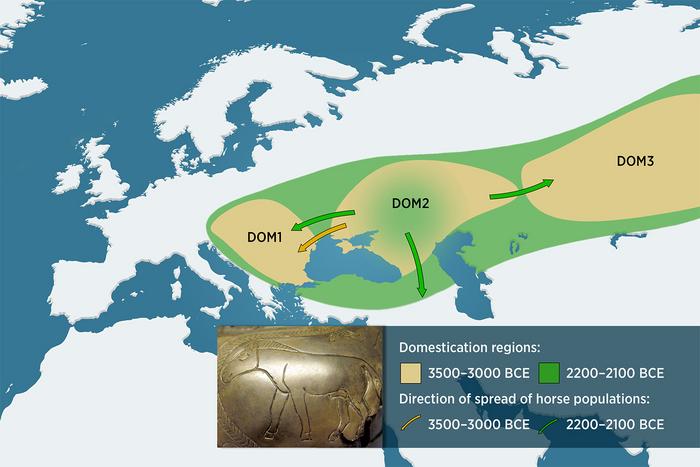
Emerging evidence identifies three genetically distinct horse populations—DOM1, DOM2, and DOM3—that roamed from western Siberia to Central Europe during the late Neolithic and early Bronze Age period. Independent taming experiments occurred within these populations as early as 3500 to 3000 BCE, suggesting parallel yet region-specific domestication pathways rather than a single cradle of horse domestication. Of these, the DOM2 population gained prominence through its association with the Yamnaya culture, a mobile, pastoralist society famed for pioneering horseback riding shortly before 3000 BCE.
The Yamnaya people’s adoption of DOM2 horses was a pivotal development, marking the transition toward full domestication. Genetic and archaeological signals pinpoint the timeframe of this complete domestication between 2200 and 2100 BCE. Horses from the DOM2 lineage spread swiftly across Eurasia, carried by nomadic groups whose mobility enabled far-reaching cultural diffusion. This lineage eventually became the progenitor of all modern domestic horses, consolidating horse domestication into a dominant and enduring evolutionary trajectory.
Horse domestication’s significance transcends mere animal husbandry; it serves as a lens into the broader patterns of human history. Early horses were used in numerous sophisticated ways well before full domestication was realized, including traction, riding, and potentially warfare, although the full spectrum of their role only crystallized with the establishment of stable breeding populations. These findings challenge previously held notions by highlighting the lag between initial taming and comprehensive domestication, underscoring the protracted, iterative nature of human-animal relationships in the pre-industrial era.
The harnessing of horses catalyzed unprecedented mobility, fundamentally altering human social structures and geopolitical landscapes. The steppe populations’ east-west migrations across Eurasia, carrying pets, technologies, and cultural practices, coincided with innovations such as the wheel and wheeled vehicles pulled first by cattle and subsequently by horses. While wagons revolutionized cargo transport, mounted riders dramatically enhanced speed and range, facilitating expansive trade, communication, and military campaigns that shaped the course of history.
This surge in mobility is intimately linked to the diffusion of Proto-Indo-European languages, which now underpin much of Europe and Asia’s linguistic diversity. The domesticated horse was not merely a mode of transport but a vector of cultural and linguistic transmission, facilitating the expansion of proto-languages and the intermixing of diverse communities. This intersection of genetics, archaeology, and linguistics illuminates the horse’s central role in shaping human civilization’s pastoral and cultural evolution.
The complete domestication of horses had profound implications for warfare as well. Mounted cavalry units contributed decisively to the rise and fall of empires and nomadic confederations such as the Huns, Avars, Magyars, and Mongols. This tradition of equine-based military power endured well into the modern era, demonstrating the horse’s pivotal role in conflicts from antiquity through both World Wars. Furthermore, horses were fundamental to European conquests and settlement expansions, including their transatlantic journey with conquistadors arriving in the Americas.
Despite the undeniable influence of horses on human societies, truly wild equine populations no longer exist. Even the Przewalski’s horse, once assumed to be a wild relict species, is now understood through genetic research to descend from early domestic ancestors. This revelation highlights the extensive anthropogenic shaping of horse genetics over millennia, reinforcing the intertwined evolutionary paths of humans and horses where the wild gene pool has been largely supplanted by domestic lineages.
Technological advancements facilitated by horses and wheeled vehicles were revolutionary. The convergence of these innovations around the mid-fourth millennium BCE introduced new logistical capabilities. Horses, with their unparalleled stamina and speed, complemented wagons pulled by oxen in transforming human mobility, enabling communities to traverse and settle across wider territories, thus accelerating social complexity and cultural exchange.
The partnership between humans and horses exemplifies a unique form of mutualism, reshaping ecological, cultural, and economic landscapes across Eurasia. This relationship, evolving from tentative first interactions to a fully domesticated bond, underpins much of the infrastructure of ancient human societies, from herding and agriculture to transport and warfare. The horse’s domestication period marks a major evolutionary milestone not only in the species itself but in human societal development.
Understanding the detailed timeline and mechanisms behind horse domestication enriches our study of the Anthropocene’s earliest phases, revealing how early human actions exerted selective pressures that have reverberated through millennia. It underscores the importance of integrating genetic, archaeological, and linguistic data to reconstruct the intricate tapestry of early human-animal interactions and their broader historical impacts.
Today, horses hold a different but no less significant place in human culture, often symbolizing companionship, freedom, and the spirit of adventure. Reflecting on their origins offers deeply valuable insights into how this ancient partnership emerged, providing a window into the complex interplay between humans and animals that continues to shape our world.
Cite Scienmag News
Gavin Prescott. (May 13, 2026). 6,000 Years of Domesticated Horses: Unraveling a Complex Evolutionary Journey. Scienmag. https://scienmag.com/6000-years-of-domesticated-horses-unraveling-a-complex-evolutionary-journey/
Gavin Prescott. "6,000 Years of Domesticated Horses: Unraveling a Complex Evolutionary Journey." Scienmag, 13 May 2026, https://scienmag.com/6000-years-of-domesticated-horses-unraveling-a-complex-evolutionary-journey/. Accessed 3 September 2026.
Gavin Prescott. "6,000 Years of Domesticated Horses: Unraveling a Complex Evolutionary Journey." Scienmag. May 13, 2026. https://scienmag.com/6000-years-of-domesticated-horses-unraveling-a-complex-evolutionary-journey/


