


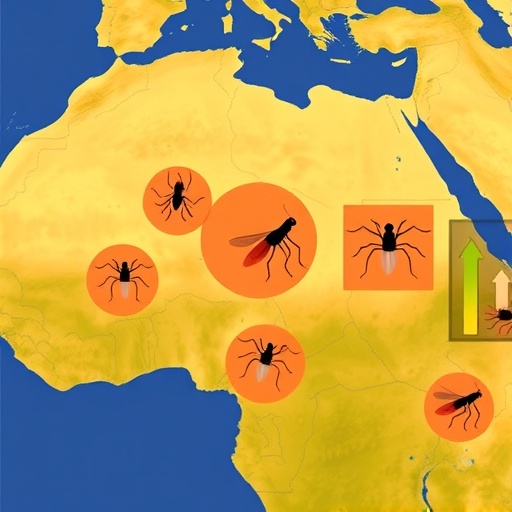
In a groundbreaking advancement poised to reshape malaria surveillance and control initiatives across Africa, researchers have harnessed the power of rapid nanopore sequencing to conduct a continental-scale genomic analysis of Plasmodium falciparum, the deadliest malaria parasite. This study, recently published in Nature Communications, marks a significant leap in our ability to monitor malaria’s genetic landscape in near real-time, enabling more agile responses to emerging drug resistance and transmission patterns across sub-Saharan Africa. The ambitious effort employs cutting-edge technology to decode parasite genomes on an unprecedented scale, offering a window into the intricate evolutionary dynamics that underpin malaria’s persistence on the continent.
Traditional malaria surveillance efforts often rely on clinical case data and microscopy, which, while valuable, can leave critical gaps in understanding the parasite’s genetic shifts over time. However, the deployment of nanopore sequencing — a portable, relatively low-cost genomic technology — provides the resolution necessary to track mutations and structural variations in P. falciparum populations with remarkable speed and accuracy. By applying this technique widely from West to East Africa, the research team overcame the logistical and infrastructural barriers that have long hindered comprehensive, region-wide genetic studies of malaria parasites.
This continental-scale endeavor amassed thousands of clinical samples from a diverse cross-section of endemic regions, ranging from high-transmission zones in West Africa to areas with fluctuating malaria burdens in southern and eastern parts of the continent. The sequencing data revealed crucial insights into parasite population structure, gene flow, and the geographic distribution of genetic markers linked to drug resistance. One of the pivotal findings highlighted the emergence and expansion of artemisinin-resistant strains in regions previously thought to be less affected, signaling early warnings for malaria treatment policies.
Nanopore sequencing’s portability and real-time data generation capabilities are central to the study’s impact. Unlike conventional sequencing platforms that require well-equipped laboratory infrastructures and longer processing times, nanopore devices can be deployed directly in field sites, providing immediate genetic reads as samples are processed. This accessibility and speed empower local health authorities and researchers to conduct ongoing genomic surveillance tailored to their specific epidemiological contexts, enhancing responsiveness to outbreaks and resistance patterns.
The research also illuminated the complexities of P. falciparum’s genetic diversity — a factor that profoundly influences both transmission dynamics and the efficacy of interventions such as vaccines and antimalarial drugs. By parsing detailed genomic data, the study mapped how specific parasite populations have adapted to selective pressures imposed by widespread drug use and host immune responses. This understanding is vital for refining strategies to curb malaria spread, including the strategic deployment of frontline therapeutics and the design of next-generation vaccines targeting conserved parasite epitopes.
Importantly, the study underscores the transformative potential of integrating genomic surveillance with existing malaria control frameworks. The data generated from widespread nanopore sequencing offers a dynamic picture of malaria’s shifting genetic landscape that can be directly linked to epidemiological trends. Such integration fosters a precision public health approach, where interventions can be continuously informed and refined based on the genetic status of parasite populations, thereby optimizing resource allocation and intervention impact.
Beyond the immediate implications for malaria surveillance, this work sets a precedent for leveraging portable sequencing technologies to address other infectious diseases in resource-limited settings. The scalability and adaptability of nanopore sequencing platforms could revolutionize pathogen monitoring, enabling continuous genomic tracking of viruses, bacteria, and parasites at the frontlines of public health challenges globally. For malaria-endemic countries grappling with infrastructure constraints, this study exemplifies how innovation can bridge the gap between state-of-the-art science and field realities.
The collaborative nature of the research was instrumental in tackling the logistical complexities inherent in a study of this magnitude. Multinational partnerships spanning governmental agencies, academic institutions, and public health organizations ensured the pooling of expertise, local knowledge, and infrastructural support necessary for sample collection, sequencing, and data analysis at scale. This model of international collaboration highlights the importance of shared scientific goals in combating diseases that respect no borders.
Additionally, by making the sequencing data openly accessible, the researchers promote transparency and encourage further research into malaria genomics. This open-data approach facilitates meta-analyses and cross-validation studies that can deepen our understanding of malaria’s evolutionary trajectories and support the development of novel diagnostics and therapeutics. In an era where data sharing accelerates scientific progress exponentially, such contributions enhance the collective capacity to respond to global health threats.
The findings from this study will likely influence policy decisions surrounding malaria treatment guidelines and surveillance protocols. Detailed knowledge about the spread of drug-resistant P. falciparum strains empowers health ministries and international bodies such as the World Health Organization to proactively update treatment regimens and prioritize high-risk areas for intensified intervention efforts. Timely genomic data serves as an invaluable early warning system, potentially averting treatment failures and disease resurgence.
Looking forward, the research team envisions expanding the genomic surveillance platform to include comprehensive monitoring of vector populations and mosquito-borne viral co-infections, thereby creating an integrated ecosystem for tackling multiple interrelated public health challenges. Such holistic surveillance is critical for understanding the interplay between parasite genetics, vector ecology, and environmental factors — a multidimensional perspective essential for effective disease control in a changing climate.
As malaria continues to exact a heavy toll on human health and economic development across sub-Saharan Africa, the innovative application of rapid nanopore sequencing stands out as a beacon of hope. By illuminating the genetic underpinnings of parasite adaptation and spread, this project provides a powerful tool to outpace malaria’s evolution and eventually disrupt its transmission cycle. The approach heralds a new era where precision surveillance drives precision interventions, bringing the global community closer to the long-sought goal of malaria eradication.
The integration of genomic data into routine malaria surveillance also has profound implications for public engagement and education. As communities become more informed about the genetic dynamics of malaria parasites and the scientific efforts underway to combat them, public trust and participation in intervention programs are likely to increase. Engaging local populations through transparent communication about genetic findings fosters a shared commitment to malaria control and supports behavior changes essential for intervention success.
The study’s success also emphasizes the importance of capacity building and training in genomic technologies within endemic countries. Empowering local scientists and health workers with the skills to operate nanopore sequencing and interpret genetic data ensures sustainability and autonomy in surveillance efforts. This capacity enhancement is vital for long-term disease monitoring and for building scientific resilience against future infectious disease threats.
The researchers acknowledge the challenges that remain, including the need to further refine sequencing protocols, reduce costs, and address bioinformatics complexities associated with large-scale genomic data analysis. However, the progress demonstrated by this expansive project provides a compelling proof-of-concept that genetically informed malaria surveillance is both feasible and indispensable. Continued technological refinement and investments will only amplify these gains, making genomic surveillance an integral component of malaria control strategies worldwide.
Ultimately, this landmark study exemplifies how technological innovation, strategic collaboration, and a commitment to scientific excellence can converge to tackle one of humanity’s most enduring infectious diseases. By illuminating the genomic footsteps of Plasmodium falciparum across an entire continent, the research opens new frontiers for disease monitoring, informs the design of targeted interventions, and energizes the global fight against malaria.
Cite Scienmag News
Juliet Wilcox. (May 11, 2026). Rapid Nanopore Genomics Tracks Malaria Across Africa. Scienmag. https://scienmag.com/rapid-nanopore-genomics-tracks-malaria-across-africa/
Juliet Wilcox. "Rapid Nanopore Genomics Tracks Malaria Across Africa." Scienmag, 11 May 2026, https://scienmag.com/rapid-nanopore-genomics-tracks-malaria-across-africa/. Accessed 4 September 2026.
Juliet Wilcox. "Rapid Nanopore Genomics Tracks Malaria Across Africa." Scienmag. May 11, 2026. https://scienmag.com/rapid-nanopore-genomics-tracks-malaria-across-africa/


