


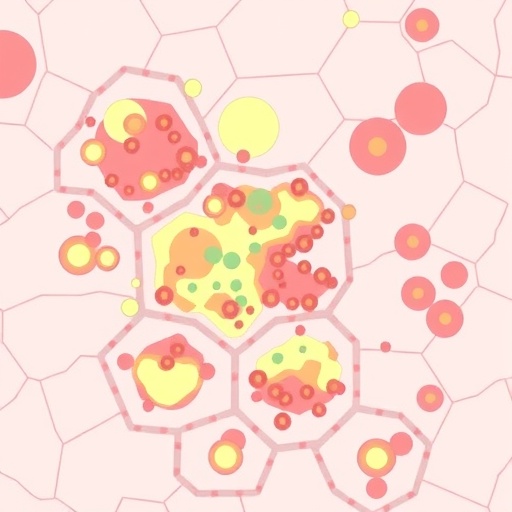
In a groundbreaking exploration of autoimmune skin disorders, a team of researchers led by Zhou, Huang, and Lei has unveiled unprecedented spatial insights into the cutaneous manifestations of discoid lupus erythematosus (DLE) and systemic lupus erythematosus (SLE). This pioneering study, published in Nature Communications in 2026, delves deep into the microenvironment of lupus-related skin lesions, elucidating pathological nuances that have long eluded clinicians and scientists alike. The implications of this research stretch far beyond mere academic interest, promising to revolutionize diagnostic strategies and therapeutic interventions for millions affected by these chronic, often debilitating conditions.
Lupus erythematosus, characterized by its hallmark immune dysregulation, presents a formidable clinical challenge due to its heterogeneous symptoms and unpredictable progression. While systemic lupus erythematosus affects multiple organ systems, including the skin, kidneys, and nervous system, discoid lupus erythematosus is primarily restricted to the skin, manifesting as chronic, scarring lesions predominantly on the face and scalp. Both disorders share underlying autoimmune mechanisms, yet their dermatological presentations and molecular characteristics differ markedly—a distinction that this latest spatial profiling study seeks to decode with remarkable precision.
At the crux of this research is advanced spatial transcriptomics, an innovative technique that maps gene expression patterns within tissue sections without losing the critical context of histological architecture. By applying this cutting-edge methodology to biopsy samples from patients with DLE and SLE, the investigators charted the molecular landscapes across inflamed and non-inflamed skin regions at unprecedented resolution. This approach enabled the identification of discrete cell populations and signaling pathways uniquely associated with lesion formation, chronic inflammation, and tissue remodeling in lupus.
What sets this study apart is the meticulous dissection of immune cell infiltration patterns within lupus lesions. Utilizing multiplex immunofluorescence combined with spatial transcriptomics, the research exposes the intricate interplay between resident skin cells—such as keratinocytes and fibroblasts—and infiltrating immune cells including T cells, B cells, macrophages, and plasmacytoid dendritic cells. Particularly noteworthy is the distinct spatial organization of these immune subsets in DLE versus SLE lesions, revealing localized immune niches that correlate with lesion severity and fibrosis.
The analysis uncovers that type I interferon signaling, long implicated in lupus pathophysiology, exhibits striking spatial heterogeneity across lupus lesions. This gradient of interferon-stimulated gene expression not only demarcates active inflammatory zones but also aligns with areas of epidermal damage and basal membrane disruption. Such compartmentalized immune activation patterns challenge previous assumptions of uniform inflammatory responses and underscore the necessity of spatial context in interpreting autoimmune processes.
Complementing these immunological insights, the study delves into the metabolic reprogramming of lesional tissues. Through spatial profiling of key metabolic enzymes and pathways, researchers observed altered energy utilization patterns in both immune cells and stromal components. These metabolic shifts appear to fuel persistent inflammation and fibrosis, suggesting potential new avenues for metabolic-targeted therapies in lupus cutaneous disease.
This comprehensive spatial characterization also reveals novel molecular markers with diagnostic and prognostic potential. For instance, differential expression of certain chemokines and adhesion molecules correlates strongly with lesion chronicity and healing propensity. By pinpointing these biomarkers within precise tissue locales, clinicians may soon be able to tailor treatments based on lesion-specific molecular signatures rather than relying on generic autoimmune markers.
The team’s comparative approach between discoid and systemic lupus lesions highlights critical differences in tissue remodeling and repair. Discoid lesions demonstrate more pronounced fibroblast activation and extracellular matrix deposition, accounting for the characteristic scarring seen in these patients. In contrast, systemic lupus lesions show elevated interferon and immune activation without extensive fibrosis, emphasizing divergent pathological trajectories stemming from shared immune dysregulation.
Beyond its immediate clinical relevance, this investigation propels the broader field of spatial biology forward, illustrating the power of integrating histology with high-dimensional molecular data. The methodology implemented here sets a new standard for studying complex diseases where microenvironmental context dictates pathology. Furthermore, by merging spatial omics with conventional dermatopathology, the research bridges the gap between molecular biology and clinical practice, fostering a translational pipeline aimed at personalized medicine.
The implications extend into drug development realms as well. Understanding how immune cells spatially organize and interact with skin cells in lupus lesions equips researchers with actionable targets for next-generation immunomodulatory drugs. Agents designed to disrupt pathogenic cell niches or inhibit localized interferon signaling could offer superior efficacy and fewer systemic side effects compared to current broad-spectrum immunosuppressants.
Moreover, this seminal study invites renewed investigation into the triggers of lupus skin pathology. Environmental factors like UV radiation are known to exacerbate lupus lesions, but their influence on spatial immune dynamics remained poorly understood until now. The spatial mapping data suggest that UV-induced cellular damage synergizes with immune cell niches to perpetuate cutaneous inflammation, opening investigative doors into preventive dermatological interventions.
On a technical front, the research exemplifies the seamless integration of multi-modal imaging and omics platforms, demonstrating how computational algorithms can distill complex data into biologically meaningful insights. The deployment of advanced machine learning models to interpret spatial gene signatures further amplifies our capacity to unravel autoimmune landscapes with clarity and depth.
This exploration of lupus skin lesions not only advances our molecular understanding but also resonates deeply with patient communities. Cutaneous manifestations of lupus significantly impact quality of life, causing pain, disfigurement, and psychological distress. By spotlighting precise disease mechanisms, this study provides hope for more effective and less invasive treatments that can restore skin integrity and patient confidence.
As the field embraces spatially resolved immunology, future research will build upon these foundational findings to explore longitudinal dynamics of lupus lesions and treatment responses. Serial biopsies combined with spatial profiling could track therapeutic efficacy in real time, tailoring interventions that adjust dynamically to lesion evolution.
In sum, the 2026 Nature Communications publication by Zhou, Huang, Lei, and colleagues charts a transformative course for lupus research. Their spatial dissection of skin lesions lays bare the cellular and molecular symphony underpinning autoimmunity and tissue damage in lupus, illuminating paths to diagnosis, therapy, and ultimately, cure. Through the lens of spatial biology, the complex tapestry of lupus cutaneous pathology emerges with newfound clarity—ushering in an era of precision immunodermatology.
Zhou, W., Huang, Y., Lei, Y. et al. Spatial characterization of skin lesions in discoid and systemic lupus erythematosus.
Nat Commun (2026). https://doi.org/10.1038/s41467-026-72720-1
Cite Scienmag News
Ophelia Keating. (May 11, 2026). Mapping Skin Lesions in Lupus Types Explored. Scienmag. https://scienmag.com/mapping-skin-lesions-in-lupus-types-explored/
Ophelia Keating. "Mapping Skin Lesions in Lupus Types Explored." Scienmag, 11 May 2026, https://scienmag.com/mapping-skin-lesions-in-lupus-types-explored/. Accessed 7 September 2026.
Ophelia Keating. "Mapping Skin Lesions in Lupus Types Explored." Scienmag. May 11, 2026. https://scienmag.com/mapping-skin-lesions-in-lupus-types-explored/


