


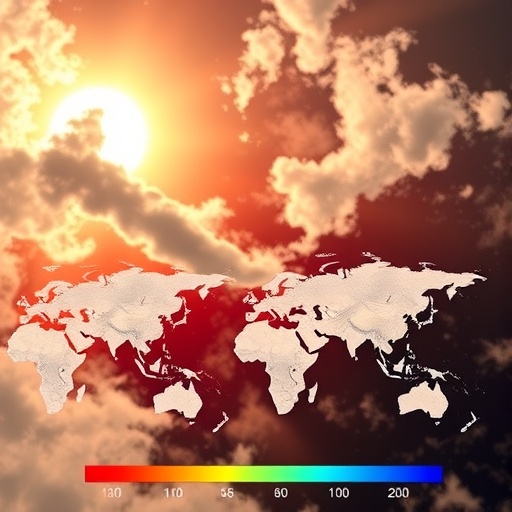
In the relentless pursuit of understanding Earth’s climate system, the role of atmospheric aerosols remains a profound yet enigmatic element influencing the global radiation budget. Recent breakthrough research by Deshmukh et al., published in Communications Earth & Environment, uncovers how the regional variability in aerosol hygroscopicity plays a pivotal and previously underappreciated role in shaping the Earth’s radiative forcing. This discovery is set to refine climate models, impacting predictions of future climate scenarios worldwide.
Aerosols—minute particles suspended in the atmosphere from both natural and anthropogenic sources—significantly affect climate by scattering and absorbing sunlight and by acting as nuclei for cloud formation. The extent to which aerosols uptake water vapor, a property known as hygroscopicity, modulates their optical properties and interaction with radiation. Historically, climate models have treated aerosol hygroscopicity as a fairly uniform parameter, largely ignoring regional discrepancies arising from varying aerosol composition and atmospheric conditions.
Deshmukh and colleagues present a comprehensive investigation into how these regional differences in aerosol water uptake alter their radiative forcing, which is a measure of their net influence on the Earth’s energy balance. By integrating detailed field measurements and advanced climate modeling, their study exploits unprecedented regional aerosol hygroscopicity data to reveal its global ramifications.
Aerosol particles’ ability to attract and retain water molecules hinges critically on chemical composition, size distribution, and ambient humidity. Hygroscopic aerosols swell through moisture absorption, thereby modifying their refractive index and scattering efficiency. This directly influences the amount of solar radiation reflected back into space, cooling the surface—a delicate balance that, when shifted, can either exacerbate or alleviate climate change effects.
In regions dominated by anthropogenic pollution such as industrialized urban centers, aerosols often exhibit heightened hygroscopicity due to sulfur and nitrogen compounds, enhancing their propensity to serve as cloud condensation nuclei. Conversely, marine and desert aerosols, rich in sea salt and mineral dust respectively, display different hygroscopic behaviors that alter their radiative impacts distinctly.
What sets this new study apart is the incorporation of spatially resolved hygroscopicity parameters into global climate models rather than relying on global averages. This nuanced approach reveals that areas with aerosols of higher hygroscopicity exert stronger cooling effects via increased scattering and cloud interactions. In contrast, regions with more hydrophobic aerosols contribute less to cooling or can even induce warming effects by absorbing sunlight.
One striking finding highlighted by the research is the complex feedback mechanism between aerosol-water interactions and cloud formation. Hygroscopic particles can boost cloud droplet number concentrations, enhancing cloud albedo and longevity—factors that intensify the Earth’s reflectivity. This phenomenon significantly modulates regional weather patterns and precipitation, linking aerosol chemistry to both climate regulation and hydrological cycles.
To capture these dynamics, the research team employed state-of-the-art remote sensing data complemented by novel in-situ measurements from ground stations spanning diverse climatic zones, from the polluted atmospheres above megacities to pristine marine environments. By fusing observational data with radiative transfer models, they quantified how regional variations in aerosol hygroscopicity translate to differences in radiative forcing on a global scale.
The implications of this work are profound. Climate models projecting future warming must now consider aerosol hygroscopicity heterogeneity to improve accuracy. Without this refinement, predictions may underestimate cooling effects in heavily polluted regions or fail to account for localized warming driven by less hygroscopic aerosols. This serves not only to recalibrate climate sensitivity but also informs policy frameworks aiming to mitigate anthropogenic emissions.
Furthermore, the study borders on a new paradigm in aerosol-climate research by linking microphysical aerosol properties directly with macroscopic climate phenomena. It signifies a crucial leap forward in atmospheric sciences, pushing the boundaries beyond bulk aerosol loading metrics towards compositionally detailed aerosol-climate interactions.
In the broader scope of Earth system science, these findings encourage an integrated approach. The interplay of aerosol chemistry, atmospheric dynamics, and cloud microphysics must be jointly considered to unravel the complexities involved in radiative forcing. Such interdisciplinary synergies have the potential to unlock more robust pathways for climate intervention strategies.
Notably, this research aligns with global efforts to refine satellite retrieval algorithms and improve ground-based monitoring networks, reinforcing the necessity for high fidelity data to reduce uncertainties. Advanced instrumentation capable of discerning aerosol hygroscopic properties in real-time becomes indispensable for ongoing climate assessments.
In terms of public and scientific communication, this breakthrough underscores the subtle yet powerful influence that microscopic particles exert on global climate systems. By highlighting regional disparities, the study helps dismantle the monolithic view of aerosol impacts and invites a more tailored investigation into pollution control, emissions reduction, and geoengineering considerations adapted to local atmospheric contexts.
In conclusion, Deshmukh et al.’s revelation about the crucial influence of regional aerosol hygroscopicity on radiative forcing represents a transformative advancement in climate science. Addressing this parameter with precision enriches our understanding of aerosol-cloud-radiation interactions and paves the way for more accurate climate predictions crucial for global environmental policy and sustainable future planning.
Cite Scienmag News
Russell Cooper. (May 8, 2026). Regional Aerosol Hygroscopicity Impacts Global Radiative Forcing. Scienmag. https://scienmag.com/regional-aerosol-hygroscopicity-impacts-global-radiative-forcing/
Russell Cooper. "Regional Aerosol Hygroscopicity Impacts Global Radiative Forcing." Scienmag, 8 May 2026, https://scienmag.com/regional-aerosol-hygroscopicity-impacts-global-radiative-forcing/. Accessed 4 September 2026.
Russell Cooper. "Regional Aerosol Hygroscopicity Impacts Global Radiative Forcing." Scienmag. May 8, 2026. https://scienmag.com/regional-aerosol-hygroscopicity-impacts-global-radiative-forcing/


