


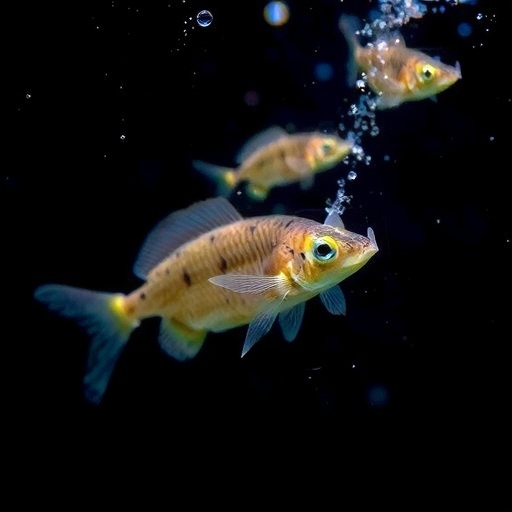
In a groundbreaking study published in Communications Earth & Environment, researchers have uncovered compelling evidence revealing the profound ecological consequences of hydropeaking on freshwater fish populations. Hydropeaking, a hydrological regime characterized by rapid, artificial changes in river flow typically resulting from hydropower operations, is shown to strand and displace larval and juvenile fish across multiple species. This phenomenon, previously understudied in the context of early life stages of aquatic fauna, poses a significant threat to biodiversity and ecosystem stability in affected riverine environments.
Hydropeaking involves the sudden release or reduction of water discharge from dams, often closely aligned with electricity demand cycles. While this practice enables renewable energy generation, its ecological footprint has increasingly come under scrutiny. The study, led by Schmutz, Hayes, Führer, and their team, provides a detailed mechanistic understanding of how these abrupt hydrological fluctuations interfere with vital developmental stages of freshwater fish, causing increased mortality rates and population declines.
The research utilizes a combination of field observations, controlled laboratory experiments, and state-of-the-art hydrodynamic modeling to assess the impact of hydropeaking on larval and juvenile fish across several species. The results clearly demonstrate that the rapid fluctuations in water levels and flow velocities during hydropeaking events lead to physical stranding, where young fish become trapped in isolated pools or stranded along riverbanks. This physical displacement compromises their ability to forage, evade predators, and ultimately survive to maturity.
Furthermore, the study reveals species-specific vulnerabilities tied to swimming capabilities, life-history traits, and habitat preferences. Delicate larval stages, relying on limited swimming strength and passive drift, are particularly susceptible to displacement and stranding, while juvenile fish show somewhat higher but still significant adverse responses. These findings highlight the necessity of incorporating species-specific data into hydropeaking management to mitigate ecological damage.
Importantly, the paper discusses the broader ecological and conservation implications of hydropeaking-induced fish strandings. Freshwater ecosystems rely heavily on the successful recruitment of larvae and juveniles to sustain healthy fish populations. Disruptions during these critical life stages cascade through trophic levels, affecting fish predators, invertebrate prey populations, and even nutrient cycling dynamics. The researchers urge policymakers and hydropower operators to reconsider flow management strategies in light of these findings.
The study also innovates methodologically by integrating hydrodynamic models with ecological parameters to predict fish stranding risks in real-time. This interdisciplinary approach bridges engineering and ecology, offering a pathway for smarter, ecologically-conscientious hydropeaking schedules that balance energy demands with conservation priorities. Such models can inform operational adjustments to minimize harmful flow fluctuations during peak fish recruitment windows.
A particularly novel aspect of the research is the attention to cumulative and synergistic effects. Hydropeaking rarely occurs in isolation; it interacts with other anthropogenic stressors such as habitat fragmentation, pollution, and climate change. The compounded pressures intensify the risks to larval and juvenile fish beyond what single-factor analyses might suggest. This nuanced perspective calls for integrated watershed management approaches as part of sustainable hydropower governance.
Moreover, this work underscores the urgent need for monitoring protocols specifically designed for early life stages of fish in regulated rivers. Standard ecological assessments often focus on adult fish populations, potentially overlooking the critical bottlenecks imposed by hydropeaking. The authors propose new field sampling frameworks that target larval and juvenile dynamics in concert with hydrological data.
Beyond ecological and management insights, the study’s findings resonate with global efforts to reconcile renewable energy expansion with biodiversity protection. As hydropower remains a cornerstone of low-carbon energy portfolios, understanding and mitigating its unintended consequences is vital. This research contributes substantially to the emerging discourse on ecohydrology, advocating for energy solutions that also foster resilient freshwater biodiversity.
In sum, the study by Schmutz and colleagues represents a milestone in freshwater ecology and environmental flow science. By elucidating how hydropeaking strands and displaces vulnerable fish early life stages across species, it establishes a compelling case for revised hydropower management. The call to action is clear: energy infrastructure must evolve with an ecosystem-aware ethos that safeguards aquatic life from the riverbed to the fish scales.
Future research directions highlighted include expanding species coverage to include less-studied taxa, assessing long-term population impacts, and refining predictive models with climate change variables. The integration of traditional ecological knowledge and stakeholder engagement is also emphasized to devise practical mitigation strategies adaptable to diverse river systems worldwide.
Given the accelerating pace of hydropower development, especially in biodiverse but vulnerable regions, the urgency of addressing hydropeaking’s ecological footprint cannot be overstated. This study sets a scientific foundation upon which regulatory frameworks and technological innovations can build to ensure hydropower’s sustainability and the conservation of freshwater ecosystems.
By advancing knowledge at the intersection of hydrology, ecology, and renewable energy, Schmutz et al.’s work exemplifies the kind of interdisciplinary science essential for meeting the grand environmental challenges of the 21st century. It is a clarion call for holistic thinking and action that embraces complexity and champions harmony between human progress and natural heritage.
Cite Scienmag News
Violet Maxwell. (May 8, 2026). Hydropeaking Disrupts Larval and Juvenile Fish Survival. Scienmag. https://scienmag.com/hydropeaking-disrupts-larval-and-juvenile-fish-survival/
Violet Maxwell. "Hydropeaking Disrupts Larval and Juvenile Fish Survival." Scienmag, 8 May 2026, https://scienmag.com/hydropeaking-disrupts-larval-and-juvenile-fish-survival/. Accessed 4 September 2026.
Violet Maxwell. "Hydropeaking Disrupts Larval and Juvenile Fish Survival." Scienmag. May 8, 2026. https://scienmag.com/hydropeaking-disrupts-larval-and-juvenile-fish-survival/


