


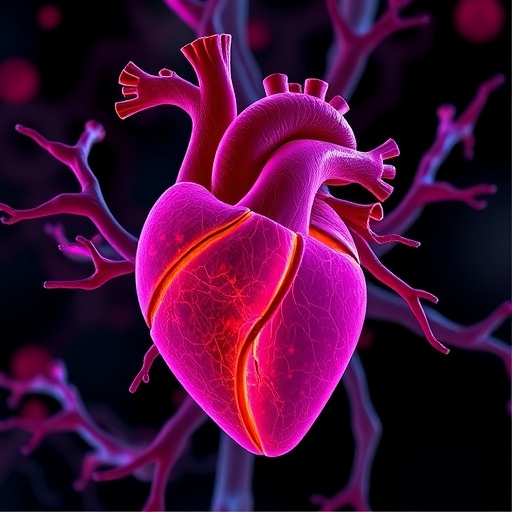
In recent years, the cell biology community has witnessed mounting evidence that biomolecular phase separation is a pivotal mechanism underpinning the organization and regulation of intracellular structures. A groundbreaking study by Meng, Zhao, Xi, and colleagues now expands this paradigm into the domain of cardiomyocyte architecture, unveiling the critical role of CCDC120 phase separation in preserving desmosomal integrity and cardiac function. Published in Nature Communications (2026), their work elucidates molecular mechanisms that may open novel therapeutic avenues for treating heart diseases linked to desmosomal defects.
Desmosomes are specialized intercellular junctions essential for mechanical coupling between cardiomyocytes, enabling synchronized contraction necessary for efficient cardiac output. These structures are composed of cadherins, armadillo proteins, and plakin family members that form a dense plaque connecting intermediate filaments across adjacent cells. The stability and dynamic remodeling of desmosomes are vital for maintaining myocardial structural integrity, especially against the continuous mechanical stress of cardiac cycles.
The authors focused on CCDC120, a coiled-coil domain-containing protein previously implicated in cytoskeletal organization but whose cardiac role remained poorly understood. Through an integrative approach combining super-resolution microscopy, biochemical assays, and cardiac functional studies, Meng et al. demonstrate that CCDC120 undergoes liquid-liquid phase separation (LLPS). This phase separation enables the assembly of dense biomolecular condensates that scaffold desmosomal components, effectively bolstering their resilience under mechanical strain.
LLPS is a biophysical process through which specific proteins and nucleic acids demix from the surrounding milieu, creating concentrated membrane-less compartments with unique biochemical environments. These condensates can rapidly form and dissolve, allowing cells to modulate structure and signaling adaptively. In cardiomyocytes, the dynamic nature of junctional complexes necessitates a finely tuned mechanism to facilitate rapid adaptation while maintaining robustness—a need elegantly fulfilled by LLPS-mediated compaction of desmosomal proteins.
Meng and colleagues first provide compelling in vitro evidence that purified CCDC120 self-associates into spherical droplets characteristic of phase-separated condensates. Intriguingly, the disordered regions of CCDC120, rich in low-complexity sequences, drive this phase behavior via multivalent weak interactions. This molecular insight into the intrinsic properties of CCDC120 expands our understanding of how coiled-coil proteins, often viewed purely as static structural staples, can exhibit dynamic assembly through LLPS.
Moving beyond in vitro assays, the study employs advanced imaging techniques to visualize CCDC120 condensates at cardiomyocyte intercalated discs—plasma membrane regions enriched with desmosomes. These condensates colocalize with hallmark desmosomal proteins such as desmoplakin and plakoglobin, indicating that phase separation is central to organizing the desmosomal plaque. Perturbations to CCDC120’s ability to phase separate, whether by mutagenesis or pharmacological interference, lead to disarray in desmosomal architecture, weakening cell-cell adhesion.
Remarkably, the functional consequences of disrupted CCDC120 phase separation extend to cardiac physiology. Utilizing transgenic mouse models engineered to express phase separation-deficient CCDC120 mutants, the authors reveal compromised myocardial contractility, arrhythmogenic phenotypes, and increased susceptibility to mechanical injury. These findings underscore how molecular-scale alterations in biomolecular condensation cascade into macroscale organ dysfunction.
Mechanistically, the authors propose that CCDC120 condensates act as adaptive hubs that modulate desmosome composition in response to changing biomechanical cues. By forming and dissolving condensates, cardiomyocytes can tune intercellular adhesion strength dynamically during the cardiac cycle. This adaptive remodeling provides a safeguard against excessive mechanical strain that could trigger cytoskeletal rupture or cell death, ultimately protecting cardiac tissue integrity.
In-depth proteomic analyses of CCDC120 condensates identified numerous interacting partners involved in cytoskeletal linkage, signaling, and membrane trafficking. These interactions enrich the notion that phase separation not only stabilizes structural elements but also orchestrates signaling networks critical for cardiomyocyte survival under stress. Importantly, the findings hint at a broader landscape of phase-separated condensates regulating cellular junctions beyond the heart, suggesting a universal organizing principle for cell adhesion.
The implications of this work are profound in the context of cardiomyopathies linked to desmosomal protein mutations, such as arrhythmogenic right ventricular cardiomyopathy (ARVC). Many pathogenic mutations perturb protein interactions and stability. The discovery that CCDC120-driven phase separation maintains desmosomal cohesion introduces the possibility that impaired condensate formation exacerbates disease progression. Therapeutic strategies aimed at restoring or stabilizing phase separation dynamics may thus represent a novel paradigm to combat heart failure rooted in junctional defects.
Moreover, this study contributes to a refined conceptual framework for understanding the biophysics of cell junctions. Traditional models regarded desmosomes as static, crystalline-like arrays. In contrast, the identification of LLPS as a fundamental organizing principle redefines desmosomes as dynamic, responsive supramolecular assemblies continuously sculpted by cellular cues. This perspective fosters new avenues of interdisciplinary investigation bridging cell biology, biophysics, and cardiology.
The authors also address potential limitations and future directions. While the evidence for CCDC120 phase separation is compelling, the precise biochemical triggers within the cardiac microenvironment that regulate condensate assembly remain to be fully delineated. Additionally, the interplay between CCDC120 condensates and other junctional complexes warrants deeper exploration, particularly whether cooperative or competitive phase separation mechanisms govern broader intercalated disc organization.
In conclusion, Meng, Zhao, Xi, and colleagues have unveiled a previously unrecognized layer of regulation in cardiac tissue architecture whereby CCDC120 phase separation sustains desmosomal integrity and functional cardiac performance. This landmark study elegantly marries molecular biophysics with systems physiology, illuminating how dynamic protein condensation underpins essential mechanical and signaling functions within the heart. As LLPS continues to emerge as a ubiquitous cellular organizing principle, its mechanistic characterization in diverse biological contexts holds great promise for advancing both fundamental biology and translational medicine.
The findings also provoke broader contemplation of phase separation’s roles beyond the heart. For example, similar molecular principles could govern epithelial barrier function, neural synapse stability, or cancer cell adhesion. Such cross-disciplinary extrapolation may catalyze transformative insights across biomedical fields, bolstered by technological advances in live-cell imaging, single-molecule tracking, and biomolecular engineering.
Ultimately, the intricate choreography of CCDC120 condensate dynamics offers a compelling example of nature’s ingenuity—crafting flexible yet robust macromolecular architectures to meet the relentless demands of life’s most vital organ, the heart.
Cite Scienmag News
Ophelia Keating. (May 7, 2026). CCDC120 Phase Separation Supports Heart and Desmosomes. Scienmag. https://scienmag.com/ccdc120-phase-separation-supports-heart-and-desmosomes/
Ophelia Keating. "CCDC120 Phase Separation Supports Heart and Desmosomes." Scienmag, 7 May 2026, https://scienmag.com/ccdc120-phase-separation-supports-heart-and-desmosomes/. Accessed 3 September 2026.
Ophelia Keating. "CCDC120 Phase Separation Supports Heart and Desmosomes." Scienmag. May 7, 2026. https://scienmag.com/ccdc120-phase-separation-supports-heart-and-desmosomes/


