


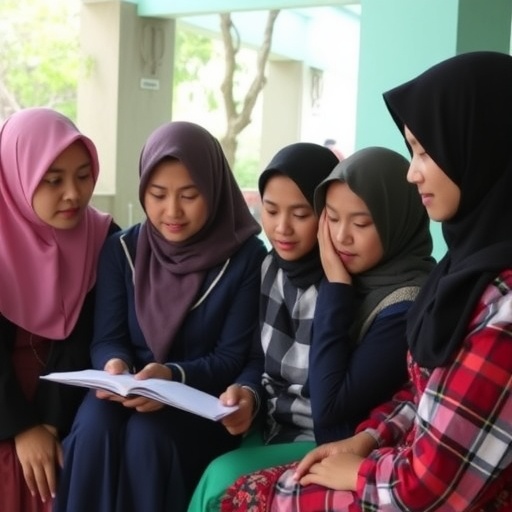
In recent years, Indonesia has faced a stark and urgent mental health crisis among its youth, particularly adolescent females, with suicide statistics painting a deeply concerning picture. Globally, the World Health Organization estimates that over 700,000 individuals die by suicide each year, making it a critical issue demanding immediate attention. What sets Indonesia apart, specifically the Gorontalo province in its eastern region, is the disproportionately high incidence of suicide recorded among young women, exacerbated by socio-cultural and economic pressures unique to this locale. This alarming trend has propelled an interdisciplinary team of researchers from Hasanuddin University, led by Dr. Sudirman Nasir, to initiate a groundbreaking, qualitative study protocol aimed at co-designing and co-creating targeted community-based mental health interventions that are both culturally informed and sustainably actionable.
Gorontalo offers a distinctive social landscape shaped by its tightly woven community networks and profound religious identities, elements that profoundly influence the lived experiences of its adolescent female population. Existing interventions largely depend on top-down clinical models which inadequately address the intricate mesh of societal factors influencing mental health in this region. These generic approaches often fail to resonate with or be accessible to those they intend to serve. Recognizing this vital gap, the research led by Dr. Nasir goes beyond traditional clinical paradigms by embracing a co-creation framework that merges academic rigor with the lived realities of community members themselves, thereby enabling the design of interventions that are not only relevant but also embraced by the community.
At the core of this innovative protocol is the methodological integration of a “quadruple helix” stakeholder framework, an engagement model that unites government entities, academic researchers, private sector actors, and civil society. This holistic approach ensures diverse voices contribute to both understanding the root issues and shaping possible solutions, thereby fostering interventions grounded in local context and community endorsement. The study’s qualitative design involves detailed interviews with adolescent females who have experienced mental health challenges or suicidal ideation, alongside focus group discussions with mental health stakeholders, academics, and female entrepreneurs, all collaboratively working toward intervention co-development.
Phase one of the study delves deeply into adolescent females’ personal narratives surrounding emotional distress, the obstacles they encounter in accessing mental health services, and their perceptions of the community support systems—or lack thereof—that play a crucial role in their well-being. This qualitative exploration is critical as it captures the nuanced socio-cultural determinants of mental health that quantitative data alone might miss. Concurrently, input from government officials and academics provides a broader policy and research-driven perspective, while insights from female entrepreneurs highlight opportunities for leveraging community economic empowerment and resilience in mental health frameworks.
The subsequent phase forms the crux of the intervention development process. Engaging all stakeholder groups in co-creation workshops, this stage translates qualitative findings into concrete, actionable mental health programs tailored to Gorontalo’s socio-cultural environment. Proposed initiatives include peer support networks, the establishment of safe communal spaces, structured crisis response pathways, and vocational mentoring initiatives designed to empower young women. The deliberate involvement of stakeholders ensures that these programs are not only culturally congruent but also pragmatically designed for sustainability and long-term community ownership.
Dr. Nasir underscores the significance of blending professional expertise with grassroots knowledge, asserting that co-creation and co-design overcome the limitations of conventional top-down health interventions by fostering genuine responsiveness to community needs. This paradigm aligns with contemporary public health strategies that prioritize participatory approaches, recognizing that the integration of lived experiences enhances the efficacy and acceptance of health programs. Moreover, this participatory methodology contributes to the formation of interventions capable of adapting over time to evolving community dynamics and challenges.
Beyond its immediate focus, this research carries broader implications for mental health policy and intervention design in other low-resource and culturally complex settings across Indonesia and Southeast Asia. By providing a replicable model rooted in community empowerment and qualitative insight, the study advances the discourse on sustainable mental health care, advocating for models that account for social determinants, gender-specific vulnerabilities, and the indispensable role of local stakeholders. This approach challenges researchers and policymakers to reconsider how mental health challenges are conceptualized and addressed in regions where care infrastructure remains limited.
Integral to aligning with global development goals, this study contributes to the advancement of the United Nations Sustainable Development Goals, particularly SDG 3 (Good Health and Well-Being) and SDG 5 (Gender Equality). By explicitly focusing on the mental health of adolescent females—a demographic often marginalized in mental health discourse—it tackles intersectional issues relating to gender, youth empowerment, and health equity. The embedding of community-led processes ensures that interventions resonate with cultural realities, thereby augmenting both their relevance and effectiveness.
The funding support from Indonesia’s Center of Higher Education Funding and Assessment (PPAT) and the Indonesia Endowment Fund (LPDP) highlights the growing recognition within governmental sectors of the necessity for evidence-based, community-sensitive mental health initiatives. Dr. Nasir’s research is a testament to persistent efforts to bridge academic inquiry and practical implementation, employing rigorous qualitative research tools to map the multifaceted layers of suicidal behavior risk factors among adolescent girls.
At the procedural level, the study employs in-depth interviews and focus group discussions as qualitative tools to unearth rich, contextualized data from participants, acknowledging that numbers alone cannot encapsulate the full spectrum of mental health determinants. The strategic use of these methods ensures a comprehensive understanding of both individual and collective experiences, which feeds directly into the co-design phase where stakeholders collaboratively define intervention priorities and execution pathways.
This pioneering work by Hasanuddin University not only addresses a critical local health concern but also sets a benchmark for participatory research methodologies in mental health. By actively involving adolescents, government representatives, academics, and entrepreneurs, the study creates a microcosm of societal collaboration that could redefine how mental health services are conceived, delivered, and maintained in Indonesia’s diverse sociocultural landscape.
In conclusion, the protocol designed by Dr. Sudirman Nasir and his team represents a transformative shift towards community-based, culturally grounded mental health care solutions. Such an approach illuminates the potent synergy between qualitative research, stakeholder engagement, and intervention co-design—offering a sustainable blueprint for tackling the complex challenge of suicide prevention among vulnerable adolescent populations. Through these efforts, young women in Gorontalo and potentially beyond are afforded not only hope but practical pathways toward improved mental health and well-being.
News Publication Date: 6-Feb-2026
References:
DOI: 10.1177/16094069251414504
Cite Scienmag News
Courtney Benton. (May 7, 2026). Hasanuddin University Develops Community-Based Protocol to Prevent Suicide Among Adolescent Girls. Scienmag. https://scienmag.com/hasanuddin-university-develops-community-based-protocol-to-prevent-suicide-among-adolescent-girls/
Courtney Benton. "Hasanuddin University Develops Community-Based Protocol to Prevent Suicide Among Adolescent Girls." Scienmag, 7 May 2026, https://scienmag.com/hasanuddin-university-develops-community-based-protocol-to-prevent-suicide-among-adolescent-girls/. Accessed 3 September 2026.
Courtney Benton. "Hasanuddin University Develops Community-Based Protocol to Prevent Suicide Among Adolescent Girls." Scienmag. May 7, 2026. https://scienmag.com/hasanuddin-university-develops-community-based-protocol-to-prevent-suicide-among-adolescent-girls/


