


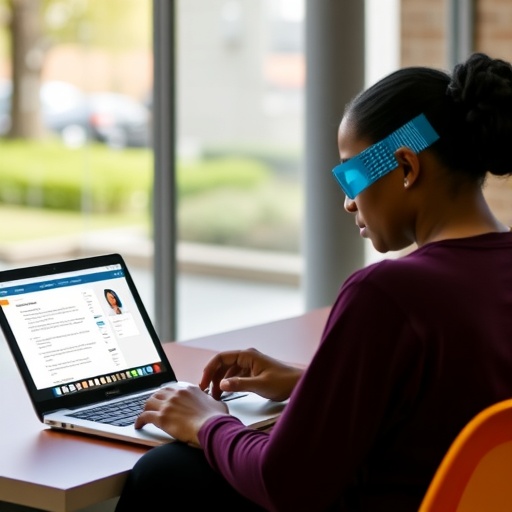
In a groundbreaking multi-institutional study that addresses one of the most pressing mental health crises among college populations, researchers have demonstrated the remarkable efficacy of digital cognitive-behavioural therapy guided self-help (D-CBTgsh) as a scalable intervention for anxiety, depression, and eating disorders. This randomized clinical trial, which spanned 26 universities across the United States, marks a pivotal moment in mental health care, showing that technology-enhanced, accessible therapeutic self-help can mitigate the growing treatment gap in young adults facing mental disorders.
The study enrolled an extensive population-level sample of nearly 40,000 college students who underwent initial mental health screening, identifying over 6,200 individuals presenting clinical or high-risk profiles for anxiety, depressive disorders, and eating disorders. These students were distributed randomly into two groups: one receiving the novel combined model of screening plus digital cognitive-behavioural guided self-help, and the other subjected to screening with referral to traditional college-provided mental health care. The longitudinal assessment across several critical intervals highlights the sustained benefits and impact of this digital intervention.
At the six-week, six-month, and two-year benchmarks, students in the D-CBTgsh group consistently demonstrated reduced prevalence of any mental disorder, with odds ratios firmly favoring the intervention across all time points. Specifically, the odds of having a mental disorder at six weeks were 20% lower than those receiving standard referral care, a trend that strengthened slightly to a 23% reduction at six months, and remained significant at 18% lower prevalence after two years. These statistics underscore the intervention’s potential for meaningful, durable change in mental health outcomes among college students.
Integral to the success of this initiative was its augmentation of service uptake and engagement. The study data revealed an astounding 74.4% service uptake rate in the D-CBTgsh group at six months, compared to only 30.2% among controls, highlighting how accessible digital platforms may circumvent traditional barriers to care, such as stigma, wait times, and scheduling challenges. Even after two years, engagement remained significantly higher, evidencing the intervention’s capacity to foster sustained help-seeking behaviors that can profoundly affect long-term wellbeing.
Critically, the benefits of D-CBTgsh transcended demographic boundaries, proving effective across diverse populations, including those from minoritized groups historically facing greater obstacles to mental health care. This inclusiveness not only illustrates the intervention’s broad applicability but also sheds light on promising strategies to alleviate systemic inequities in mental healthcare delivery on college campuses.
Beyond the primary binary measure of disorder prevalence, this digital guided self-help approach elicited notable improvements across a range of symptom dimensions. Assessments targeting generalized anxiety, social anxiety, depression severity, and eating disorder symptoms all indicated meaningful amelioration, with the intervention group reporting enhanced mental health functioning. Such broad-spectrum efficacy reinforces the transdiagnostic utility of this model, meaning it can address multiple overlapping psychopathologies without needing discrete, disorder-specific treatments.
The study’s methodology also heralds a shift in clinical research aimed at large-scale mental health interventions. By proactively screening a vast swath of the student population and employing randomized controlled trial designs at multiple campuses, the researchers set a precedent for scalable, population-based approaches that yield granular data on intervention efficacy and real-world implementation challenges.
Importantly, the D-CBTgsh model leverages the synergistic advantages of cognitive-behavioural therapy techniques—rooted in decades of clinical science—while harnessing digital platforms that facilitate flexible, user-driven, and confidential engagement. This amalgamation has the potential to democratize access to evidence-based treatment modalities, particularly relevant as colleges grapple with staff shortages, rising mental health demand, and limited physical resources.
With mental health disorders climbing to epidemic proportions on college campuses worldwide, interventions that combine accessibility, effectiveness, and cost-efficiency are urgently needed. This study’s findings suggest that digital platforms delivering guided cognitive-behavioural self-help could fill this void, offering scalable solutions aligned with the preferences and lifestyles of tech-savvy younger generations.
Nevertheless, the research acknowledges complexities and caveats, including the preservation of user privacy, the need for ongoing adaptation of content for cultural and contextual relevance, and ensuring digital literacy among diverse student populations. Furthermore, while the intervention improved symptoms across several domains, it is not posited as a panacea; some individuals will still require intensified, clinician-led care.
Future directions for this research trajectory include dissecting mechanisms of change within digital frameworks, optimizing guidance intensity to balance autonomy and support, and integrating artificial intelligence tools to personalize content dynamically. Additionally, exploration of hybrid models combining digital self-help with periodic clinician contact may yield even greater clinical benefit and engagement.
This trial also prompts broader considerations surrounding institutional investment in digital mental health infrastructures, data security protocols, and the ethical deployment of technology in healthcare delivery. Policymakers and university administrators are encouraged to view these findings as compelling evidence for integrating D-CBTgsh interventions into existing mental health service arrays.
In conclusion, this large-scale, rigorously conducted randomized clinical trial substantiates digital cognitive-behavioural therapy guided self-help as a viscerally promising and empirically validated approach to curbing anxiety, depression, and eating disorders among college students. Its capacity to increase treatment uptake, reduce disorder prevalence, and improve a spectrum of psychiatric symptoms establishes a new paradigm for scalable mental health interventions in educational settings. This innovation arrives at a crucial crossroads, poised to reshape the future landscape of mental health care by harnessing digital platforms to meet vast, unmet needs with scientific rigor and compassionate accessibility.
Cite Scienmag News
Glenn Wilkins. (May 7, 2026). Digital CBT Self-Help Trial Targets College Mental Health. Scienmag. https://scienmag.com/digital-cbt-self-help-trial-targets-college-mental-health/
Glenn Wilkins. "Digital CBT Self-Help Trial Targets College Mental Health." Scienmag, 7 May 2026, https://scienmag.com/digital-cbt-self-help-trial-targets-college-mental-health/. Accessed 4 September 2026.
Glenn Wilkins. "Digital CBT Self-Help Trial Targets College Mental Health." Scienmag. May 7, 2026. https://scienmag.com/digital-cbt-self-help-trial-targets-college-mental-health/


