


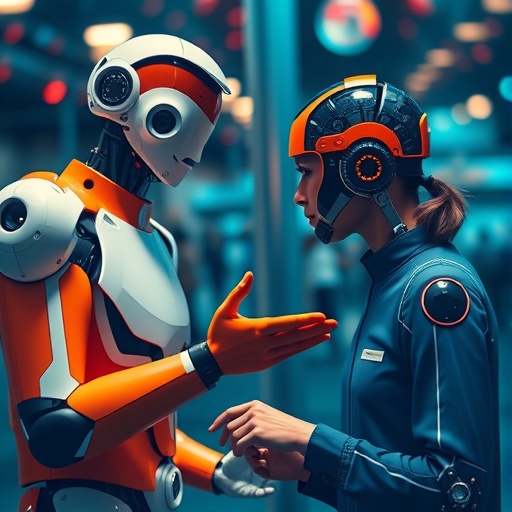
The rapidly evolving landscape of human interaction is witnessing an unprecedented paradigm shift, fueled largely by advances in artificial intelligence and digital communication technologies. A groundbreaking systematic review and meta-analysis recently published in Communications Psychology dives deep into the nuanced psychological and behavioral responses elicited by human-agent interactions compared to traditional human-human engagements. This comprehensive study synthesizes findings from a vast reservoir of experimental and observational research, offering crucial insights into how humans adapt, react, and behave when interfacing with artificially driven agents rather than fellow humans.
At the heart of this investigation lies the fundamental question: How does the human mind process and respond differently when interacting with AI agents as opposed to another person? The paper meticulously aggregates data from diverse experimental contexts, ranging from customer service bots, virtual assistants, and social robots, to more complex AI-driven interfaces in professional and social environments. By using rigorous meta-analytic techniques, the authors unravel patterns of psychological engagement, trust formation, emotional reaction, and behavioral outcomes, constructing a robust framework for understanding this technologically mediated social dynamic.
Delving into the cognitive dimensions, the review highlights that interactions with AI agents often trigger a distinctive mental model in users, one bounded by expectations of predictability and limited agency. Unlike human interlocutors, AI entities are generally perceived as less emotionally nuanced, which profoundly impacts empathetic engagement and social presence. The meta-analysis reveals that while human-human interactions tend to foster richer emotional exchanges and higher subjective social presence, human-agent interactions evoke more utilitarian and task-focused responses, emphasizing efficiency and functional outcomes over relational depth.
Perhaps most notably, the study sheds light on the evolution of trust in these interactions. Psychological trust—a complex construct encompassing reliability, competence, and benevolence—is systematically compromised or recalibrated in the context of AI engagement. The data suggest that while initial trust in AI agents may be skepticism-laden, exposure and consistent performance can help attenuate distrust, leading to conditional acceptance. However, the trustworthiness of human agents remains more resilient due to the inherent believability of human intentions and ethical considerations that AI currently cannot fully mimic.
The behavioral adaptations documented further underscore significant shifts. As humans increasingly engage with digital agents, their communicative patterns adapt accordingly, often simplifying language structures and reducing emotional modulation. The analysis points to a tendency for users to issue more directive and concise commands to AI, a phenomenon dubbed conditional pragmatism, in contrast with the more nuanced and contextually rich conversations typical in human-human interactions. These findings carry implications not only for interface design but also for social cognitive frameworks that describe communication efficacy.
Moreover, the meta-analysis addresses the emotional landscape navigated during human-agent interactions. Despite prevalent assumptions about AI’s inability to foster genuine emotional connection, the synthesis of studies indicates that users frequently anthropomorphize AI agents, attributing emotions and intentions, which in turn modulate their behavioral responses. This anthropomorphism, while beneficial for smoother interactions, raises complex questions about authenticity, emotional labor, and user dependency on artificial entities.
On a broader social level, the review posits that sustained human-agent interaction could precipitate shifts in social norms and expectations. As AI agents assimilate into everyday life—serving as companions, assistants, and even quasi-social partners—the boundary between human and machine-mediated sociality becomes increasingly permeable. The psychological impacts extend beyond individual user behavior to encompass societal attitudes towards agency, responsibility, and identity within technologically mediated relationships.
Delving deeper into the methodologies, the review incorporates a detailed classification of experimental paradigms employed across studies, ranging from controlled laboratory designs to ecological validity-driven field research. This rigorous methodological synthesis enables the illumination of contextual moderators, such as the role of agent embodiment, interaction mode (voice vs. text), and task type, which all significantly modulate psychological and behavioral responses. For instance, embodied agents—those with a physical or highly anthropomorphic digital presence—tend to elicit stronger emotional and trust-based responses than disembodied agents.
Technical discussions in the article also explore the neuropsychological mechanisms underpinning these interaction differences. Researchers reference fMRI and EEG studies showing differential activation patterns within brain regions associated with social cognition, empathy, and reward when interacting with human vs. AI agents. This neurobiological evidence lends a foundational understanding of how deeply ingrained social processing pathways are differentially engaged, potentially influencing long-term cognitive adaptation to artificial social partners.
The review does not shy away from addressing potential ethical implications and future directions. It emphasizes the importance of designing AI agents that can more transparently communicate their limitations and foster appropriate user expectations, mitigating risks of overreliance and social isolation. The authors call for interdisciplinary collaboration, integrating insights from psychology, human-computer interaction, cognitive neuroscience, and ethics to co-create AI frameworks that enhance human well-being rather than diminish human agency.
Another compelling aspect highlighted is the differential psychological impact on diverse user groups, including vulnerable populations such as the elderly and individuals with social anxiety or autism spectrum disorders. The meta-analysis suggests that for some, AI agents offer a low-risk avenue for social interaction and skill development, while for others, these interactions might compound feelings of social alienation. Tailored AI interaction paradigms, sensitive to user diversity, emerge as a critical area for future research and application.
In technological terms, the paper underscores the accelerating advancements in natural language processing, affective computing, and adaptive learning algorithms that are progressively narrowing the experiential gap between human-agent and human-human interactions. The authors discuss how innovations in emotional recognition and context-aware AI can enhance the responsiveness and perceived agency of artificial counterparts, escalating both their utility and psychological complexity.
Significantly, the meta-analysis also scrutinizes longitudinal studies to ascertain how repeated exposures to AI agents shape psychological attitudes and behavioral habits over time. Findings suggest a trajectory of increasing familiarity and improved user competency, alongside emerging behavioral norms that accommodate AI’s distinct interactive affordances. These long-term adaptations have profound implications for education, workplace dynamics, and societal integration of AI.
The article closes with a forward-looking discourse on the evolving definition of social interaction itself. In an era where digital and physical realities converge, traditional constructs of relationality and social cognition may need to be reformulated. The authors posit that human-agent interactions serve as a crucible for new theories that might better capture the fluid, hybrid nature of contemporary sociality shaped by AI.
Ultimately, this systematic review and meta-analysis unravel the intricate interplay of psychological constructs and behavioral patterns that characterize human-agent versus human-human interactions. Its comprehensive and multidisciplinary approach provides a foundational knowledge base for academics, technologists, and policymakers aiming to leverage AI in ways that harmonize with the complex fabric of human social life.
This seminal work represents a milestone in the ongoing quest to understand and optimize the human experience in an increasingly automated and interconnected world. As AI continues to advance and embed itself deeper into our social ecosystems, such research offers the scientific compass needed to navigate the challenges and opportunities of these profound interactions.
Cite Scienmag News
Glenn Wilkins. (May 5, 2026). Human-Agent vs. Human-Human Interaction: Psychological Insights. Scienmag. https://scienmag.com/human-agent-vs-human-human-interaction-psychological-insights/
Glenn Wilkins. "Human-Agent vs. Human-Human Interaction: Psychological Insights." Scienmag, 5 May 2026, https://scienmag.com/human-agent-vs-human-human-interaction-psychological-insights/. Accessed 4 September 2026.
Glenn Wilkins. "Human-Agent vs. Human-Human Interaction: Psychological Insights." Scienmag. May 5, 2026. https://scienmag.com/human-agent-vs-human-human-interaction-psychological-insights/


