


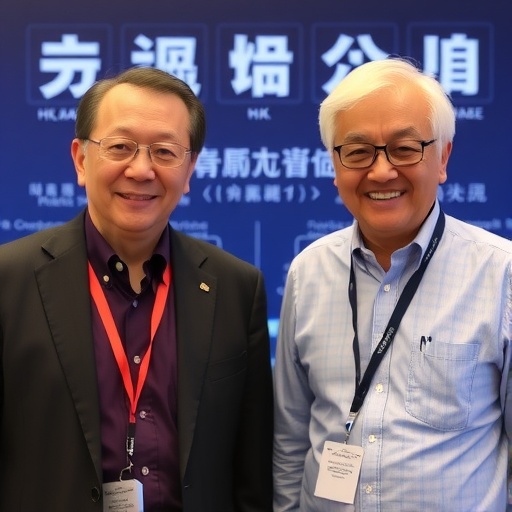
In a groundbreaking international collaboration, the University of Hong Kong (HKU) has unveiled a pioneering theoretical framework poised to revolutionize our understanding of complex network predictability. This study represents a significant leap forward in deciphering the intricate behavior of large-scale systems that underpin contemporary technology and science. Led by Dr. Fei Jing, a postdoctoral researcher under the guidance of Professor Qingpeng Zhang at the HKU Musketeers Foundation Institute of Data Science (HKU IDS), the research integrates expertise from Zhejiang University and Sapienza University of Rome, bringing together an elite team including Nobel Laureate Professor Giorgio Parisi.
Complex networks, whether manifested in the vast realms of artificial intelligence, biological interactions, or social frameworks, have long posed a challenge to researchers due to their inherent unpredictability and dynamic nature. The ability to forecast the evolution and behavior of such networks is critical for advancing numerous fields, including drug discovery, communications, and AI model design. The research collective approached this enduring problem by employing mathematical structures inspired by the statistical physics of spin glasses—a class of disordered magnetic materials known for their complexity and rich theoretical properties.
The essence of the study lies in mapping the predictability of connections within a network onto the classical spin glass model. This sophisticated approach permits the quantification of how local interactions aggregate to influence the global behavior of the network. By translating the problem into this well-explored physical paradigm, the team establishes robust theoretical underpinnings for predicting network dynamics that had previously remained elusive due to computational intractability.
A striking breakthrough arises from the researchers’ demonstration that the global predictability of extensive networks is not a monolithic property but rather can be deconstructed into localized contributions centered on individual connections. This profound insight allows the disentanglement of a prohibitively complex global problem into manageable local computations, drastically reducing the computational resources traditionally required. Such localization heralds a new era where analyzing networks comprising millions of nodes and interactions becomes computationally feasible.
Capitalizing on this localization principle, the team devised a novel local sampling algorithm that harnesses information confined to immediate neighborhoods within the network. Unlike conventional global algorithms demanding exhaustive processing of entire network structures, this local method scales gracefully, embracing the immense datasets characteristic of modern research and industry applications. This model facilitates faster and more accurate predictions, opening doors to real-time analysis which was previously unattainable in large-scale settings.
The implications of this work extend far beyond theoretical interests; they present transformative potential for multiple scientific domains. In artificial intelligence, the framework introduces new quantitative metrics that can assess and refine neural network architectures, enhancing both their explainability and efficiency. By offering a rigorous basis for interpreting network behaviors, this approach could underpin the next generation of AI systems characterized by increased robustness and reduced energy consumption.
Simultaneously, the biomedical sphere stands to benefit immensely from these advances. Molecular interaction networks, which govern biochemical pathways and drug mechanisms, notoriously suffer from complexity-induced unpredictability. The refined computational lens facilitated by this framework promises to expedite molecular interaction predictions, which could substantially shorten drug discovery timelines. This precision accelerates therapeutic breakthroughs, potentially translating into faster responses to emergent health challenges.
Moreover, the interdisciplinary nature of this research epitomizes the growing synergy between fundamental science and applied technology. By uniting statistical physics concepts with cutting-edge data science and AI methodologies, the study exemplifies how abstract theoretical frameworks can yield concrete innovations with far-reaching impacts. This synergy also underscores the importance of international collaborations that harness diversified expertise to address shared scientific frontiers.
The publication of this research in the prestigious journal Proceedings of the National Academy of Sciences (PNAS) solidifies its importance and reach within the global scientific community. Underpinning the study is a meticulous experimental methodology complemented by rigorous theoretical analysis, ensuring that the conclusions are both scientifically sound and practically relevant. The collaborative contributions from leading institutions reinforce the study’s authority and potential as a benchmark in network science.
In reflecting on these findings, it becomes evident that the conceptual leap in understanding predictability offers a paradigm shift akin to milestones in physics and mathematics. By providing a scalable and interpretable framework, this research paves the way for innovations that could redefine how we model, analyze, and manipulate complex systems. Whether strategizing AI development or unraveling biological mysteries, the insights offered here represent a foundational step toward future breakthroughs.
The team at HKU Musketeers Foundation Institute of Data Science continues to push the envelope by fostering interdisciplinary approaches that blend fundamental science with tangible technological advances. Their leadership exemplifies how modern scientific inquiry benefits from integrating diverse fields, from physics to computer science, enabling the tackling of problems that were once considered insurmountable. Future research will likely build upon this cornerstone to explore broader classes of networks and predictive challenges.
In the broader context of scientific innovation, this work also highlights the critical role of theoretical foundations in driving practical advancements. While data-driven approaches dominate many areas, this study exemplifies the enduring power of conceptual frameworks rooted in physics to illuminate and solve pressing issues in data science and beyond. The insight that local structures collectively dictate global phenomena provides a compelling lens through which to reassess not only networks but complex systems at large.
As the volume and diversity of data continue to explode in the digital age, methodologies that combine theoretical rigor with computational efficiency become indispensable. The local sampling algorithm and its underpinning theory answer this call, offering scalable solutions essential to meet the demands of modern research and industry. This aligns with the growing need for explainability and interpretability in AI and complex system analyses, addressing core challenges faced by scientists and engineers alike.
Ultimately, this research sets a precedent for how complex network predictability can be approached in the coming decades. By unraveling the tapestry of local interactions that compose global network behavior, it provides a powerful toolkit for scientists seeking to render the chaotic order of complex systems comprehensible and manageable. These developments stand poised to impact a wide spectrum of disciplines, marking a new chapter in our quest to understand and harness the interconnected world.
Cite Scienmag News
Katie Riggs. (May 7, 2026). HKU IDS Unveils International Collaborative Study on Complex Network Predictability with Nobel Laureate in Physics. Scienmag. https://scienmag.com/hku-ids-unveils-international-collaborative-study-on-complex-network-predictability-with-nobel-laureate-in-physics/
Katie Riggs. "HKU IDS Unveils International Collaborative Study on Complex Network Predictability with Nobel Laureate in Physics." Scienmag, 7 May 2026, https://scienmag.com/hku-ids-unveils-international-collaborative-study-on-complex-network-predictability-with-nobel-laureate-in-physics/. Accessed 6 September 2026.
Katie Riggs. "HKU IDS Unveils International Collaborative Study on Complex Network Predictability with Nobel Laureate in Physics." Scienmag. May 7, 2026. https://scienmag.com/hku-ids-unveils-international-collaborative-study-on-complex-network-predictability-with-nobel-laureate-in-physics/


