


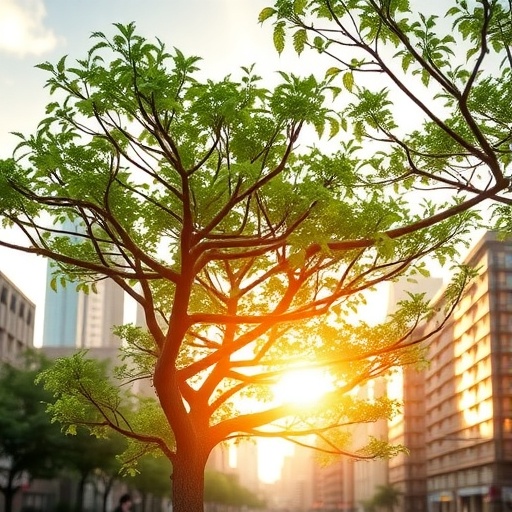
Urban centers are increasingly recognized as critical battlegrounds in the fight against climate change. A recent comprehensive field study conducted in Dayton, Ohio—a city emblematic of many legacy urban areas undergoing economic and demographic shifts—has shed new light on the viability of urban reforestation as an adaptive strategy to mitigate rising temperatures. This landmark study, involving the systematic planting of 640 tree saplings across twenty municipal parks, investigates how varying irrigation methods and ambient heat influence the survival and growth of diverse tree species within a resource-constrained urban environment.
The experimental design hinged on deploying multiple irrigation regimes to assess their effectiveness in promoting sapling establishment amid elevated urban heat conditions, reflecting the compound stresses anticipated to intensify under projected climate warming scenarios. Notably, irrigation efforts were complicated by the lack of proximate public water sources, necessitating logistical reliance on water transported from local fire hydrants. This practical constraint foregrounds the challenges faced by cities with limited infrastructure and underscores the importance of cost-effective and low-labor horticultural innovations for urban forestry projects.
Data analysis revealed a survival rate of approximately 48% at season’s end, indicating significant mortality yet aligning with expectations from prior five-year post-planting benchmarks in the literature. Crucially, survival and health outcomes exhibited notable species-dependent variability, spotlighting red maple (Acer rubrum), northern catalpa (Catalpa speciosa), and honey locust (Gleditsia triacanthos) as species demonstrating robust establishment performance relative to more vulnerable species such as white oak (Quercus alba), black gum (Nyssa sylvatica), and sassafras (Sassafras albidum). These findings illuminate how intrinsic physiological tolerances and adaptive capacities modulate tree responses to hydric and thermal stressors in urban microclimates.
The study further elucidates the efficacy of innovative irrigation technologies, particularly slow-release watering devices known as gator bags, which optimize water delivery while minimizing labor requirements. Though the initial capital and replacement costs of these irrigation aids are non-trivial, their sustained benefits in reducing water stress and enhancing sapling vigor represent a strategic investment, especially within financially constrained legacy cities where resource allocation is a perennial challenge. Protective measures, such as fencing to safeguard irrigation apparatus from vandalism or inadvertent damage, are indispensable adjuncts to maximize the return on such investments.
Beyond considerations of irrigation, the research underscores the heterogeneity of urban forest ecosystems, advocating against monocultural plantings that may exacerbate susceptibility to pests, diseases, and environmental shocks. Instead, a tailored, multi-species approach calibrated to the specificities of site conditions—including soil quality, existing infrastructure, and microclimatic variances—is paramount for fostering resilient urban green spaces capable of delivering sustained ecosystem services. The potential inclusion of carefully selected non-native species merits further exploration as a mechanism to enhance adaptive plasticity in the face of unprecedented climate perturbations.
The broader ecological and socio-economic implications of thriving urban forests are profound. Urban green spaces function as integrated ecosystems offering myriad benefits: they sequester carbon, support biodiversity, modulate local climates through evapotranspiration and shading, and reduce energy demands by lowering summertime ambient temperatures. These ecosystem services translate directly into enhanced public health, quality of life, and even economic savings, particularly in mitigating urban heat island effects that disproportionately impact vulnerable populations.
Nonetheless, the study acknowledges the persistent challenges posed by environmental and anthropogenic disturbances, which contributed to unexpected sapling losses even post-establishment. Human interference, potentially in the form of vandalism or land-use encroachment, alongside environmental stressors such as pests or extreme weather events, complicates urban forestry efforts and requires vigilant community engagement and monitoring strategies.
This research situates itself within a growing body of work aimed at leveraging urban forestry as a scalable and sustainable climate mitigation tool, particularly in cities grappling with legacy infrastructure and limited fiscal capacity. By elucidating species-specific responses to irrigation and heat stress, and by foregrounding the operational nuances of implementing green infrastructure in real-world urban contexts, the study provides actionable insights to municipal planners, environmental managers, and policymakers committed to integrating ecological resilience into urban design paradigms.
In the face of inevitable warming trends and urban expansion, the study’s recommendations underscore the critical need for innovative, context-sensitive interventions that balance ecological integrity with pragmatic resource management. Continued interdisciplinary collaboration, incorporating entomology, hydrology, climatology, and urban planning, is essential to refine these strategies and expand their applicability across diverse metropolitan landscapes globally.
Ultimately, this research champions urban reforestation not merely as an aesthetic or recreational enhancement but as a cornerstone of climate resilience frameworks. As cities worldwide confront the dual imperatives of environmental stewardship and social equity, planting and nurturing urban forests emerge as a tangible, scientifically grounded pathway toward a cooler, healthier, and more sustainable urban future.
News Publication Date: 28-Mar-2026.
Web References:
– Urban Forestry & Urban Greening journal: http://dx.doi.org/10.1016/j.ufug.2026.129422
– Ohio State University Entomology Department: https://entomology.osu.edu/
– Urban forest management ecosystem services: https://www.fs.usda.gov/managing-land/urban-forests
– Urban forests health benefits: https://physicsworld.com/a/urban-forests-add-to-cities-health-and-wealth/
Cite Scienmag News
Sloane Callahan. (May 6, 2026). Urban Trees: Nature’s Essential Cooling Solution for a Warming Planet. Scienmag. https://scienmag.com/urban-trees-natures-essential-cooling-solution-for-a-warming-planet/
Sloane Callahan. "Urban Trees: Nature’s Essential Cooling Solution for a Warming Planet." Scienmag, 6 May 2026, https://scienmag.com/urban-trees-natures-essential-cooling-solution-for-a-warming-planet/. Accessed 4 September 2026.
Sloane Callahan. "Urban Trees: Nature’s Essential Cooling Solution for a Warming Planet." Scienmag. May 6, 2026. https://scienmag.com/urban-trees-natures-essential-cooling-solution-for-a-warming-planet/


