


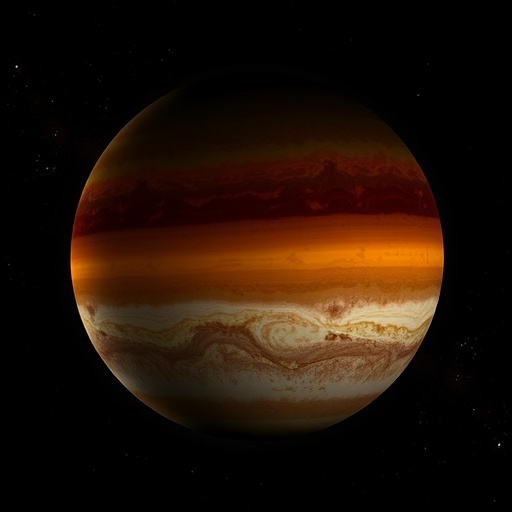
In a groundbreaking discovery that challenges long-standing assumptions about the atmospheres of distant solar system bodies, astronomers have detected a thin atmosphere on the trans-Neptunian object (TNO) known as (612533) 2002 XV93. This small plutino, roughly 250 kilometers in radius, has long been considered too diminutive and cold to maintain a gaseous envelope. However, observations from a stellar occultation event on January 10, 2024, reveal a refractive atmospheric signature that definitively proves otherwise. This revelation not only expands the roster of icy minor planets with atmospheres beyond Pluto but also forces a re-examination of volatile retention and atmospheric generation mechanisms in the outer solar system.
Until recently, Pluto was the only TNO confirmed to possess an atmosphere, boasting an average surface pressure around 10 microbars (μbar). Such an atmosphere is primarily sustained by sublimated nitrogen and methane ices on its relatively large and warm surface. Larger TNOs exceeding 500 kilometers in diameter have been carefully examined, but only upper limits for their atmospheres, typically in the nanobar (nbar) range, had been established, often pushing the boundary of detectability. The detection on 2002 XV93, with surface pressures estimated between 100 and 200 nanobars, surpasses these prior upper limits despite the object’s considerably smaller size. This contradicts canonical models that predict smaller TNOs cannot effectively retain atmospheres under the harsh conditions of the Kuiper Belt.
The method utilized to detect this tenuous atmospheric layer hinged on a stellar occultation campaign targeting 2002 XV93. During such an occultation, the TNO passes in front of a distant star from the vantage point of observers on Earth, effectively blocking the starlight. Atmospheric refraction can soften the star’s disappearance and reappearance in a manner detectable with precise photometric measurements, revealing the presence and properties of any surrounding gases. The refractive signature recorded in this campaign provided clear evidence of an atmospheric envelope, enabling researchers to derive reliable estimates of its pressure.
This atmosphere’s transient nature, suggested by its tenuous pressure and the volatile retention challenges posed by the stepwise sublimation processes at these distances, hints at dynamic underlying sources. One hypothesis gaining traction is that cryovolcanic activity — the extrusion of volatile materials like methane and nitrogen in liquid or gaseous form from subsurface reservoirs — could episodically replenish the atmosphere. Such geological processes, although speculative for small TNOs, would constitute a significant paradigm shift in our understanding of Kuiper Belt object geophysics.
Alternative explanations consider recent impact events involving small icy bodies as potential atmospheric generation mechanisms. Collisions could release trapped volatiles or heat subsurface ices enough to cause temporary outgassing, forming a brief but detectable atmosphere. The consequences of such impacts could be fleeting, accounting for why detectable atmospheric signatures have eluded previous surveys of similar or larger objects. However, distinguishing between outgassing from cryovolcanism and impact-generated atmospheres remains a complex challenge, requiring longitudinal data and perhaps follow-up occultation observations.
The implications of this discovery resonate beyond mere cataloging of atmospheric occurrence. It suggests reservoirs of volatiles may be more common on small, distant bodies than previously assumed, and that transient atmospheres may be relatively frequent, sustained by intermittently active geophysical or exogenic processes. This realization broadens the scope of targets for future exploration and may influence mission designs, particularly for spacecraft intending to probe Kuiper Belt objects for clues about solar system formation and evolution.
Furthermore, the detection methodology underscores the power of occultation campaigns combined with high-precision photometry in unveiling subtle atmospheric characteristics at vast solar distances. As telescope sensitivity and coordination among observatories improve, more faint atmospheres on other TNOs might be discovered, potentially unveiling a diversity of atmospheric compositions and behaviors previously hidden due to technological limitations.
Such findings prompt a reassessment of volatile retention theories hinging on gravity, temperature, and solar radiation pressure. The classical models typically predict rapid loss of the most volatile species from smaller bodies, yet 2002 XV93’s atmosphere defies these expectations. This might indicate a hitherto underappreciated mechanism for the sequestration and episodic release of volatile materials, possibly influenced by localized thermal anomalies or subsurface layering that insulates and preserves volatile ices.
The tenuous atmosphere of 2002 XV93, much thinner than Pluto’s, nevertheless opens a new chapter in comparative planetology of the outer solar system. It invites fresh scrutiny of other plutinos, including its larger counterparts, to understand whether this phenomenon is unique or more widespread. Moreover, studying the composition of this newly detected atmosphere could shed light on the chemical pathways and evolutionary histories of Kuiper Belt objects, enhancing our overall comprehension of outer solar system chemistry.
Intriguingly, prior near-infrared investigations into large TNO Makemake reported methane gas emissions, but the origins remained ambiguous. This recent detection on 2002 XV93 might provide a contextual framework for interpreting such methane signals, associating them more confidently either with atmospheric outgassing or surface-sputtering processes. Methane’s presence, often a signature of active resurfacing or internal activity, can hence be linked with dynamic evolutionary scenarios even in these small, cold bodies.
Continued monitoring and additional observations will be critical to understanding the atmospheric dynamics of 2002 XV93. Identifying variability over time, such as seasonal cycling or transient enhancements, could differentiate between atmospheric sustenance mechanisms and establish whether these envelopes are stable, episodic, or subject to rapid dissipation. This temporal aspect remains unexplored but crucial for unraveling the lifecycle of atmospheres on TNOs.
This landmark detection reflects a convergence of advancements in telescopic precision, observational strategies, and a growing scientific appetite for probing the frontiers of our solar system. As the community pivots toward deeper exploration of Kuiper Belt objects, findings like this will catalyze further theoretical and observational efforts aimed at demystifying the physical and chemical characteristics of the outer solar system’s minor planets. In essence, the thin veil of gas around 2002 XV93 marks not just a scientific first for small TNOs but a bold invitation to rethink the atmospheric potential of the solar system’s coldest frontier.
Cite Scienmag News
Russell Cooper. (May 6, 2026). Atmosphere Discovered on Trans-Neptunian Object Beyond Pluto. Scienmag. https://scienmag.com/atmosphere-discovered-on-trans-neptunian-object-beyond-pluto/
Russell Cooper. "Atmosphere Discovered on Trans-Neptunian Object Beyond Pluto." Scienmag, 6 May 2026, https://scienmag.com/atmosphere-discovered-on-trans-neptunian-object-beyond-pluto/. Accessed 3 September 2026.
Russell Cooper. "Atmosphere Discovered on Trans-Neptunian Object Beyond Pluto." Scienmag. May 6, 2026. https://scienmag.com/atmosphere-discovered-on-trans-neptunian-object-beyond-pluto/


