


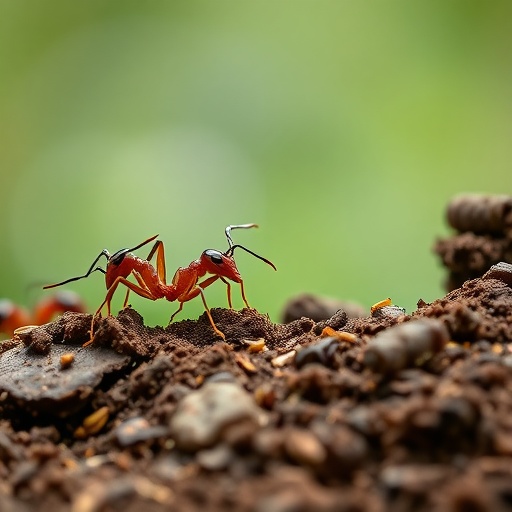
In recent years, soil ecosystems have come under increased scrutiny for their role in the global carbon cycle. Scientists have long known that soil is a crucial reservoir for carbon storage, profoundly influencing atmospheric CO2 concentrations and, by extension, climate dynamics. However, the specific biological agents that regulate soil organic matter and carbon transformations remain under intense investigation. A groundbreaking 2026 meta-analysis published in Nature Communications by Wang, Fan, Zamanian, and colleagues has shed new light on one of the most ubiquitous yet overlooked players in this subterranean drama: ants.
Ants, despite their small individual size, collectively represent a massive biomass across terrestrial ecosystems worldwide. Their intricate social behaviors, nest-building activities, and foraging patterns significantly affect soil structure and chemistry. The meta-analysis compiled and synthesized data from numerous field studies spanning diverse habitats and biomes, offering a comprehensive understanding of how ant activity mediates soil carbon cycling and influences organic matter stability. This holistic approach has unraveled complex mechanisms by which ants alter the fate and turnover of soil carbon, with profound implications for ecosystem functioning and climate models.
One of the key insights from the study is the role of ant bioturbation—the physical mixing of soil layers through nest construction and tunneling—in promoting carbon dynamics. Ant nests create heterogenous microenvironments that enhance soil aeration and moisture regulation, both critical factors governing microbial decomposition processes. By altering soil porosity and water retention, ants effectively control the microbial communities responsible for organic matter breakdown, thus modulating carbon mineralization rates. This biophysical modification of soil architecture underscores ants as ecosystem engineers whose activities transcend mere biological interactions to alter fundamental soil properties.
Further, the analysis highlights how ants influence the quality and quantity of organic substrates in soils. Their foraging behavior often leads to the accumulation of organic detritus in nest vicinity—food remnants, dead insects, and plant materials—that enrich soil nutrient profiles. This localized organic matter input stimulates heterotrophic microbial communities that participate in carbon cycling. Moreover, the chemical composition of ant wastes, which may include nitrogen-rich compounds from excretions, enhances nutrient availability and thus microbial activity. This cascade of effects showcases the multifaceted linkage between ant ecology and soil biogeochemistry.
Intriguingly, the researchers also documented variation in ant-mediated effects depending on species-specific traits and habitat context. For instance, mound-building ant species in arid or semi-arid ecosystems demonstrated particularly strong influences on soil carbon stocks, likely due to their profound impacts on soil microhabitats. Conversely, arboreal or canopy-dwelling ants exhibited subtler effects confined mostly to litter layers. Such variation emphasizes the necessity of incorporating species-specific ecological roles in modeling efforts that attempt to scale up ecosystem-level carbon flux estimations.
Another dimension of the study delved into ants’ role in the stabilization of soil organic carbon. Soil organic matter can be stabilized through physical protection within soil aggregates or chemical bonding to mineral surfaces. Ant activities appear to facilitate the aggregation process by excreting glues and polysaccharides during nest building, which bind soil particles into stable clumps. These aggregates physically occlude organic matter, reducing microbial access and slowing decomposition rates. This aggregation mechanism suggests ants indirectly prolong soil carbon residence times, allowing soils to function as longer-term carbon sinks.
Microbial interactions underpinning these changes emerged as a major focus. Ant nests were observed to harbor distinct microbial consortia compared to bulk soils, with shifts toward communities specialized in processing specific organic compounds. This microbial niche differentiation may accelerate selective decomposition pathways, optimizing carbon cycling efficiency. Additionally, some ant-associated microbes engage in mutualistic relationships with the ants themselves, contributing enzymes that facilitate organic matter breakdown. The study underscores ants as architects not only of soil structure but also of the microbial metabolic landscape.
The meta-analysis also examined the influence of environmental variables such as temperature, moisture, and soil texture on ant-mediated carbon cycling. Warmer temperatures generally amplified ant activity and consequent soil modifications, compounding effects on carbon turnover. Moisture availability influenced nest stability and soil aeration patterns, modulating microbial processes. Soil texture mediated the physical scope of ant bioturbation and organic matter protection. These findings demonstrate the intricate interplay between abiotic controls and biotic engineering, highlighting the dynamic feedback loops inherent in soil ecosystems.
Implications for global carbon budgets and climate change projections are substantial. By integrating ant-driven processes into soil carbon models, scientists can achieve improved accuracy in forecasting soil carbon release or sequestration under future climate scenarios. This research calls for a paradigm shift that recognizes myriads of belowground fauna as vital modulators, not mere background actors. The overlooked contributions of ants to carbon stabilization and cycling potentially slow down atmospheric CO2 accumulation, tempering greenhouse gas feedbacks.
Moreover, the study catalyzes new avenues for applied environmental management. Understanding ant-soil carbon dynamics opens opportunities to harness these insects in agroecosystems to enhance soil fertility and carbon retention. Integrating ant-friendly practices could reduce dependence on chemical inputs while promoting sustainable soil health. Restoration projects in degraded lands might also benefit from fostering native ant populations as natural ecosystem engineers that rebuild soil carbon pools.
Despite these advances, the authors acknowledge ongoing knowledge gaps. The exact biochemical pathways linking ant activity to organic matter polymer transformations remain elusive. Quantifying the net balance between carbon inputs and mineralization mediated by ants under fluctuating climatic pressures is challenging. Furthermore, interactions between ants and other soil fauna such as earthworms or termites require deeper exploration to unravel synergistic or antagonistic relationships shaping carbon cycling.
Nevertheless, this meta-analysis forms a critical foundation for future interdisciplinary research integrating soil ecology, microbiology, entomology, and biogeochemistry. It exemplifies the power of synthesizing diverse empirical findings to construct emergent patterns that inform ecosystem-scale understanding. The revelation of ants as pivotal players in soil carbon stabilization contests traditional hierarchies that prioritize plants and microbes as sole regulators, advocating for broader ecological perspectives.
In closing, Wang et al.’s pioneering work heralds a new frontier in environmental science that celebrates the complexity and connectivity of life beneath our feet. As soil carbon storage increasingly surfaces as a strategic climate mitigation target, recognizing ants’ instrumental role reshapes scientific and societal approaches toward ecosystem stewardship. These diminutive yet dynamic creatures might hold a key piece of the puzzle in safeguarding Earth’s carbon equilibrium in an era of unprecedented environmental change.
Cite Scienmag News
Violet Maxwell. (May 5, 2026). Ants Influence Soil Carbon and Organic Matter Stability. Scienmag. https://scienmag.com/ants-influence-soil-carbon-and-organic-matter-stability/
Violet Maxwell. "Ants Influence Soil Carbon and Organic Matter Stability." Scienmag, 5 May 2026, https://scienmag.com/ants-influence-soil-carbon-and-organic-matter-stability/. Accessed 3 September 2026.
Violet Maxwell. "Ants Influence Soil Carbon and Organic Matter Stability." Scienmag. May 5, 2026. https://scienmag.com/ants-influence-soil-carbon-and-organic-matter-stability/


