


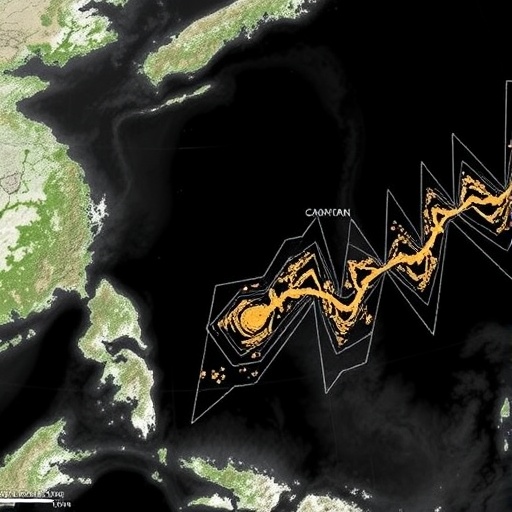
In a groundbreaking study published in Communications Earth & Environment, researchers Kimura, Shiraishi, Nakamura, and their colleagues have unveiled the dynamic geological processes occurring along the eastern Nankai Trough, a region notorious for its seismic activity and potential for devastating earthquakes. The team’s pioneering work highlights the impact of ridge collision—a complex geotectonic interaction—on forearc segmentation, deepening our understanding of subduction zones and the mechanics that drive forearc region evolution.
The eastern Nankai Trough represents a critical junction where the Philippine Sea Plate subducts beneath the Eurasian Plate. This subduction zone has long been a subject of intense scientific scrutiny due to its propensity for generating megaquakes. The new research casts light on how collision between oceanic ridges and the forearc wedge gradually sculpts the segmentation of this forearc zone, a factor that has profound implications for earthquake behavior, rupture propagation, and ultimately, tsunami hazards.
At the heart of the study lies the interaction between the subducting Palau-Kyushu Ridge and the overriding forearc. The ridge’s collision with the forearc wedge induces significant structural heterogeneity along the trench, effectively compartmentalizing the forearc into discrete segments. Utilizing state-of-the-art seismic imaging and geophysical modeling, the team has mapped out these segmentation patterns with unprecedented clarity. This segmentation is pivotal in modulating the mechanical properties of the plate boundary, creating zones that may either inhibit or facilitate seismic rupture.
The team employed a multifaceted approach combining seismic reflection profiles, bathymetric data, and geodynamic simulations. These techniques allowed for a detailed reconstruction of the forearc architecture and the deformation mechanisms underpinning it. Their integrated methodology sheds light on the three-dimensional geometry of the subduction interface and elucidates how the collision between bathymetric highs like ridges modifies stress distribution and strain accumulation.
One of the key revelations of the research is the recognition that ridge collision acts as a natural segmentation engine. As the ridge advances into the trench, it disrupts the continuity of the plate interface, generating variations in coupling strength along the megathrust fault. This alternating pattern of strong and weak coupling segments influences the nucleation and propagation of earthquakes, potentially explaining the patchy rupture characteristics seen in historical events along the Nankai Trough.
Moreover, the implications of such segmentation extend beyond seismic hazard assessment. The forearc structural variations likely control fluid flow pathways and thermal gradients within the subduction channel, affecting processes such as dehydration of the slab, metamorphic reactions, and the generation of arc volcanism. These interconnected factors underscore the importance of understanding ridge collision dynamics for a holistic grasp of subduction zone evolution.
The study also reports that forearc segmentation promoted by ridge collision creates differential sediment accretion and erosion patterns. These tectonostratigraphic changes contribute to the forearc’s morphological diversity, which can influence slope stability and the initiation of submarine landslides, another potential source of tsunamigenic disturbances. Such insights emphasize the systemic nature of geotectonic interactions in shaping not only seismic but also sedimentary and geomorphological processes.
From a hazard mitigation perspective, these findings have potential to refine earthquake forecasting models. With forearc segmentation influencing seismic coupling and rupture extent, hazard assessments incorporating this geological complexity can better anticipate the size and spatial distribution of future megathrust earthquakes. This is especially critical for Japan, where the Nankai Trough poses a constant threat to densely populated coastal regions.
The team’s work also brings attention to the variable seismic behavior seen along other global subduction zones. By drawing parallels between the eastern Nankai Trough and analogous regions where ridge collision occurs, this research encourages a reevaluation of assumptions regarding seamless fault rupture along subduction interfaces. Instead, it proposes a paradigm where geological heterogeneities play a fundamental role in earthquake dynamics worldwide.
As the study concludes, the process of ridge collision is not a sudden event but rather a gradual sculpting of the forearc geometry across geological timescales. This slow but persistent deformation reshapes the segmentation landscape, progressively altering the seismic potential of the region. Understanding these long-term tectonic processes requires continued interdisciplinary investigation combining geology, geophysics, and modeling efforts.
Looking ahead, the authors advocate for enhanced high-resolution seismic surveys and offshore drilling initiatives targeting these forearc segments. Such endeavors would yield direct samples and in situ measurements critical for validating their models and advancing knowledge about the mechanical behavior of segmented megathrusts. The integration of multidisciplinary data will pave the way for predictive models that accurately simulate fault interaction under varying geodynamic conditions.
This novel insight into the tectonic choreography along the eastern Nankai Trough serves as a potent reminder of Earth’s ceaseless geodynamic evolution. The interplay of ridges, trenches, and forearcs is a dance choreographed over millions of years, one whose steps hold the key to understanding seismic hazard patterns and the broader workings of plate tectonics. As scientific tools sharpen and surveys deepen, our capacity to decode these complex processes steadily improves.
Ultimately, this research sets a benchmark for future subduction zone studies by revealing how otherwise subtle tectonic features like ridge collision can decisively modulate forearc segmentation and, by extension, seismic risk. It invites the global earth sciences community to adopt a more nuanced perspective on the physical controls shaping megathrust earthquake phenomena and prepares us better for forecasting and mitigating natural disasters in these volatile regions.
The collaborative efforts by Kimura and colleagues demonstrate the power of scientific synergy in unraveling intricate earth processes. Their findings provide a template for dissecting similar tectonic settings around the world and enrich the growing body of knowledge essential for safeguarding communities living in proximity to powerful subduction trenches. As research progresses, the eastern Nankai Trough will remain a natural laboratory for tectonic inquiry with implications extending well beyond its geographic confines.
Cite Scienmag News
Violet Maxwell. (May 5, 2026). Ridge Collision Shapes Eastern Nankai Trough Segmentation. Scienmag. https://scienmag.com/ridge-collision-shapes-eastern-nankai-trough-segmentation/
Violet Maxwell. "Ridge Collision Shapes Eastern Nankai Trough Segmentation." Scienmag, 5 May 2026, https://scienmag.com/ridge-collision-shapes-eastern-nankai-trough-segmentation/. Accessed 3 September 2026.
Violet Maxwell. "Ridge Collision Shapes Eastern Nankai Trough Segmentation." Scienmag. May 5, 2026. https://scienmag.com/ridge-collision-shapes-eastern-nankai-trough-segmentation/


