


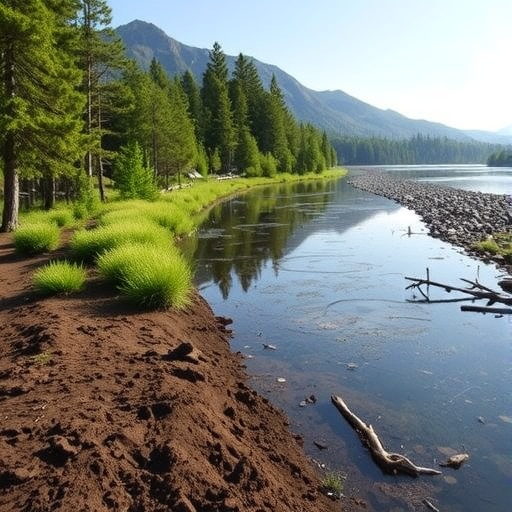
Rivers play a crucial role in the global carbon cycle, acting not only as ferries transporting vast quantities of carbon across terrestrial and marine boundaries but also as active processors that transform carbon along their pathways. Despite extensive research on riverine carbon fluxes, the precise factors that govern the age and composition of dissolved organic carbon (DOC) in river systems have remained elusive. A groundbreaking study published in National Science Review, led by Professor Yongqiang Zhou and colleagues from the Nanjing Institute of Geography and Limnology at the Chinese Academy of Sciences, now presents a paradigm-shifting framework. By integrating an unparalleled global dataset with advanced machine learning techniques, the team has developed the first high-resolution, global atlas of riverine DOC concentrations alongside detailed isotopic signatures, specifically radiocarbon (Δ^14C) and stable carbon isotope (δ^13C) ratios. Their findings reveal that the temporal age of DOC in rivers is fundamentally controlled by its residence time in terrestrial soils prior to mobilization into aquatic environments. This insight fundamentally advances our understanding of how climatic, hydrological, and pedological factors converge to regulate carbon cycling within the world’s river networks.
The study opens with a revealing characterization of global riverine DOC concentrations, which exhibit an extraordinary three-orders-of-magnitude variability worldwide, averaging about 6.6 mg C per liter. Notably, rivers draining permafrost-influenced and densely forested catchments exhibit the highest DOC levels, attributable to abundant terrestrial organic matter and extensive soil carbon stocks. In stark contrast, glacially fed rivers register markedly low DOC concentrations due to minimal organic input. Model predictions generated by the research team elucidate that more than half of the river systems globally have DOC concentrations below 5 mg C per liter. Interestingly, DOC distributions demonstrate pronounced latitudinal patterns, with Arctic and boreal rivers exhibiting concentration peaks, whereas tropical rivers maintain lower baseline values. The extensive span of δ^13C-DOC isotopic values, ranging from –43.8‰ to –12.1‰, reflects a mosaic of source contributions and biogeochemical alteration processes across biomes. Tropical systems predominantly receive carbon from C3-type terrestrial vegetation, whereas temperate rivers show mixed sources including in situ primary production.
The incorporation of radiocarbon data (Δ^14C) dramatically expands the insight into the temporal dynamics of riverine DOC, unveiling a remarkable spectrum ranging from modern carbon to ancient material exceeding 29,000 years in radiocarbon age. The mean Δ^14C signature corresponds to a radiocarbon age of roughly 221 years, highlighting that the vast majority of riverine DOC is relatively young, with nearly 60% of carbon bearing an age younger than a century. Nevertheless, distinct pockets of aged carbon persist prominently in high-latitude and high-altitude ecosystems, driven by processes such as permafrost thaw and glacial melt which remobilize carbon repositories sequestered for millennia. These findings underscore the critical influence of climate-sensitive biogeophysical mechanisms in modulating the age composition of dissolved organic matter entering aquatic systems.
To disentangle the sources of riverine DOC, the authors employed a sophisticated four-endmember isotope mixing model. This analytical approach enabled quantification of the contributions from petrogenic fossil carbon, modern terrestrial organic matter, in-stream autochthonous production, and Holocene-aged sedimentary carbon. The results indicate that fossil carbon constitutes a relatively minor fraction globally, averaging 6.7%, but can locally surge to upwards of 40% in Arctic and alpine rivers, where ancient sedimentary rocks and carbon deposits are exposed. In contrast, modern terrestrial organic carbon and in-stream primary production dominate the global DOC pool, delivering approximately 38% and 44%, respectively. Holocene sediment-derived DOC also represents a noteworthy 10.7%, particularly in floodplains subjected to permafrost degradation and sediment reworking. This nuanced compositional framework reveals competing spatial controls dictating the prevalence of carbon from distinct sources, reflecting landscape-scale variability and biogeochemical cycling histories.
Climatic variables emerge as pivotal regulators of Δ^14C in riverine DOC, with temperature and precipitation patterns exerting primary control on soil carbon turnover and subsequent leaching into aquatic systems. Warm, wet conditions accelerate microbial respiration and organic matter decomposition in soils, fostering the export of younger carbon, whereas cold or dry environments slow these processes, promoting the release of older carbon stocks. Hydrological transport pathways further modulate DOC age by facilitating the movement of both recently fixed carbon near the surface and older carbon from subsoil horizons through complex surface and subsurface flow networks. The close alignment of riverine Δ^14C-DOC with surface soil organic carbon signatures suggests that DOC primarily originates from topsoil layers rather than depths below. These interactions eloquently articulate how integrated climatic and hydrological forcings orchestrate carbon age and fluxes from terrestrial reservoirs into river systems.
Human impacts superimpose additional complexity onto natural controls of riverine DOC. Reservoir creation alters flow regimes and nutrient dynamics, often stimulating algal blooms and enhancing contributions of modern, ^14C-enriched DOC derived from aquatic autotrophs. Meanwhile, agricultural practices and urban expansion can elevate soil disturbance, erosion, and fossil carbon mobilization, effectively increasing the export of older carbon fractions to rivers. These anthropogenic influences compound the sensitivity of carbon cycling dynamics to land-use changes, underscoring the need to incorporate human perturbations into predictive models of carbon fluxes and ecosystem responses.
Comparative analysis with particulate organic carbon (POC) further dissects carbon dynamics in rivers by highlighting that POC is generally older than DOC, reflecting differential transport mechanisms and transformation processes. While DOC is primarily composed of “young” carbon derived from surface soils and contemporary biological production, POC includes more refractory organic matter, often deriving from eroded soil and sediment sources. This decoupling of DOC and POC age structures emphasizes the heterogeneous nature of terrestrial carbon inputs into riverine environments and their distinct biogeochemical fates.
This study represents a crucial advancement in bridging knowledge gaps between terrestrial carbon storage, mobilization, and aquatic processing at a global scale. By elucidating the dominant role of soil carbon residence times in controlling riverine DOC age and provenance, the research establishes a mechanistic foundation for anticipating how ongoing and future climate change may reshape organic carbon cycling along the terrestrial–aquatic continuum. Such insights will be pivotal for refining Earth system models and informing strategies aimed at mitigating greenhouse gas emissions and managing the carbon balance across critical ecosystems.
The collaborative endeavor underpinning this research harnessed expertise from multiple institutions worldwide, demonstrating the power of international cooperation in addressing major environmental challenges. Co-first authors Zhaohui Liu and Professor Gerard Rocher-Ros contributed significantly to data synthesis and model development, while senior co-authors including Professors Joshua F. Dean, Jack J. Middelburg, and Pierre Regnier provided critical interpretation and contextualization within broader biogeochemical frameworks. The study benefited from funding support by the National Natural Science Foundation of China and the Chinese Academy of Sciences, ensuring the integration of cutting-edge analytical methodologies and comprehensive environmental datasets.
Ultimately, this pioneering global atlas of riverine DOC isotopic characteristics not only refines our fundamental understanding of carbon biogeochemistry but also serves as an invaluable resource for scientists and policymakers seeking to address the complex feedback loops between the biosphere, hydrosphere, and atmosphere. By revealing how terrestrial processes govern the age spectra of organic carbon exported to rivers, the study signals new directions for research into ecosystem resilience, carbon sequestration potential, and the impacts of anthropogenic change on freshwater carbon fluxes worldwide.
Web References:
DOI: 10.1093/nsr/nwag237
Cite Scienmag News
Violet Maxwell. (May 5, 2026). Soil Carbon Storage Controls the Age of Dissolved Organic Matter in Rivers Worldwide. Scienmag. https://scienmag.com/soil-carbon-storage-controls-the-age-of-dissolved-organic-matter-in-rivers-worldwide/
Violet Maxwell. "Soil Carbon Storage Controls the Age of Dissolved Organic Matter in Rivers Worldwide." Scienmag, 5 May 2026, https://scienmag.com/soil-carbon-storage-controls-the-age-of-dissolved-organic-matter-in-rivers-worldwide/. Accessed 1 September 2026.
Violet Maxwell. "Soil Carbon Storage Controls the Age of Dissolved Organic Matter in Rivers Worldwide." Scienmag. May 5, 2026. https://scienmag.com/soil-carbon-storage-controls-the-age-of-dissolved-organic-matter-in-rivers-worldwide/


