


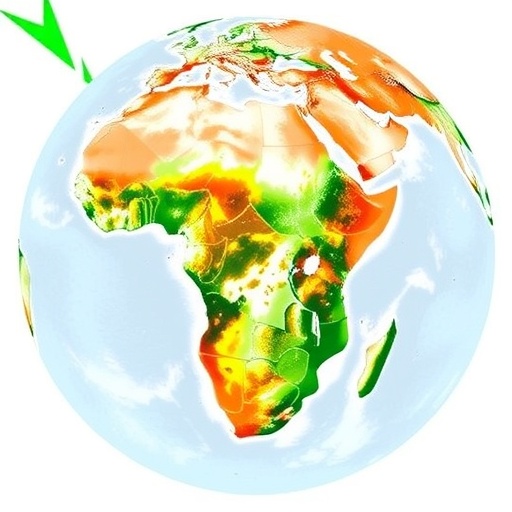
A groundbreaking study published in Geophysical Research Letters unveils a remarkable atmospheric link between cold air masses advancing over the United States and the vital transatlantic transfer of minerals fertilizing the Brazilian Amazon. This research reveals how synoptic-scale weather systems can influence the transport of nutrient-rich aerosols, originating from African dust and biomass burning, all the way to the Amazon basin, reshaping our understanding of global ecosystem interconnectivity.
Synoptic meteorological phenomena—vast weather systems spanning thousands of kilometers—serve as the engine behind this intricate intercontinental exchange. Notably, cold waves sweeping across the United States and persistent high-pressure anomalies over the South Atlantic orchestrate fluctuations in rainfall across the tropical Atlantic region. These rainfall patterns critically regulate whether Amazonian air masses are infused with mineral-laden aerosols from Africa or remain relatively free of particulate matter, a factor that has profound implications for ecosystem nutrient cycling.
During the peak rainy seasons in the Amazon, days characterized by “clean” atmospheric air with minimal aerosols are consistently preceded by peak precipitation episodes over the tropical Atlantic Ocean. Prior to this research, it was mostly assumed that such aerosol variability occurred primarily due to shifts in wind direction. However, the new findings highlight the dominant role of complex synoptic systems modulating rainfall, moisture transport, and aerosol deposition across continents.
The Amazon rainforest, renowned for its breathtaking biodiversity and dense vegetation, paradoxically nests on soils severely deficient in essential nutrients. This nutrient scarcity primarily arises from intense leaching, where heavy rain floods the soil, washing away vital minerals such as phosphorus, calcium, potassium, and magnesium. Among these, phosphorus stands out as the most limiting nutrient, effectively bottlenecking biological productivity despite the region’s lush vegetation.
Compensating for these nutrient losses is the continual atmospheric transport of aerosols rich in minerals and residues from biomass burning in Africa. Dust particles from the vast Sahara Desert and smoke from African wildfires traverse the Atlantic via powerful upper atmospheric currents, delivering key elements like phosphorus and iron to the Amazon basin. These mineral inputs, delivered via “flying rivers,” play a critical role in sustaining forest productivity and aquatic ecosystems alike.
Professor Luiz Augusto Toledo Machado of the University of São Paulo underscores the profound planetary significance of this intercontinental nutrient exchange. Contrary to popular perception, the Sahara Desert—often seen as an ecological void—is, in fact, a crucial planetary “fertilizer,” supplying indispensable minerals that uphold the health of both terrestrial and marine ecosystems across two continents. The geochemical influence of its dust extends far beyond its arid lands.
Adding context to the vital nature of these aerosol imports, a 2022 Nature publication led by Brazilian researchers demonstrated that phosphorus limitation in Amazonian soils hampers rainforest growth, even under elevated atmospheric CO₂ conditions. While increased carbon dioxide typically stimulates plant growth and carbon sequestration, the deficiency of phosphorus constrains this beneficial effect, posing challenges to climate change mitigation by the forest.
Advancements in digital mapping technologies have since corroborated these findings. Utilizing artificial intelligence tools, researchers created detailed geospatial phosphorus concentration maps, reaffirming that much of the Amazon remains severely phosphorus-poor. These insights highlight the delicate balance maintained by aerosol-derived nutrient inputs and the potential vulnerabilities introduced by disruptions to this atmospheric nutrient conveyor belt.
This investigation leveraged continuous black carbon measurements from the Amazon Tall Tower Observatory (ATTO), a towering 325-meter research station located in the Uatumã Sustainable Development Reserve within the Brazilian state of Amazonas. Black carbon serves as an effective tracer for long-range aerosol transport, representing particulate matter produced by incomplete combustion of fossil fuels and biomass and significantly influencing atmospheric radiation budgets.
According to the study, approximately 60% of the black carbon reaching the Amazon basin during the wet season originates from African sources. By analyzing daily black carbon concentrations from 2015 to 2022 during January and February—the onset of the Amazon’s rainy season—researchers observed striking variability. Some days exhibited high particulate loads due to African biomass burning and dust transport, while others displayed unusually clear atmospheric conditions.
The researchers distinguished between “peak” and “trough” rainfall days in the tropical Atlantic as markers for clean and polluted air masses over the Amazon. They uncovered that rainy periods in the tropics align closely with clean atmospheric conditions above the Amazon and are intricately linked with cold air outbreaks over the United States. These events coincide with dominant high-pressure systems over the eastern United States and augmented atmospheric pressures spanning the central and southern Atlantic in the Southern Hemisphere.
This synoptic setup fosters intensified low-level wind convergence over the equatorial Atlantic, accelerating moisture transport toward the Amazon basin. Enhanced moisture inflow fuels increased precipitation, which simultaneously cleanses the atmosphere of aerosols, drastically reducing particle concentrations over the rainforest. This dynamic interplay directly shapes the quality of air feeding into the Amazon ecosystem.
Conversely, the study reveals that aerosol particles and gaseous pollutants are primarily ferried from Africa across the Atlantic above the marine boundary layer, the ocean-atmosphere interface, before being entrained into the Amazon’s atmosphere via the region’s characteristic low-level jet streams. These fast-moving air currents act as conveyor belts, channeling African mineral dust and smoke into South American airspace, crucial for nutrient deposition.
Professor Machado emphasizes that fluctuations in these low-level jets—both over the Atlantic and the Amazon—have direct implications for the quantity and timing of particle transport. Changes in jet strength or direction could alter the delivery of nutrients, potentially impacting the resilience and long-term stability of Amazonian ecosystems. Therefore, understanding jet stream behavior under future climate scenarios is now an essential focus of ongoing research.
The significance of this emerging atmospheric connection is underscored by its sensitivity to climate change. As global warming alters planetary weather patterns, the delicate balance governing hemispheric aerosol transport and rainforest fertilization is at risk of disruption. The ultimate outcomes for the Amazon’s flora and fauna—and by extension, the Earth’s biosphere—remain uncertain, urging continued multidisciplinary investigation.
This pioneering study received funding from the São Paulo Research Foundation (FAPESP) under their Thematic Project within the Research Program on Global Climate Change (RPGCC). Through international collaboration between Brazilian and German institutions, it integrates meteorological, chemical, and ecological data streams to deepen our comprehension of atmospheric nutrient pathways and their planetary ramifications.
News Publication Date: 4-Mar-2026
Web References:
- https://agupubs.onlinelibrary.wiley.com/doi/10.1029/2025GL117732
- https://www.nature.com/articles/s41586-022-05085-2
- https://mudancasclimaticas.fapesp.br/
- https://www.attoproject.org/
References:
Machado, L. A. T., et al. (2026). Hemispheric Synoptic Patterns Control Rainfall and Long-Range Aerosol Transport in the Amazon. Geophysical Research Letters. https://doi.org/10.1029/2025GL117732
Cite Scienmag News
Russell Cooper. (May 4, 2026). Atmospheric Systems Drive Rainfall and Nutrient Transport from Africa to the Amazon. Scienmag. https://scienmag.com/atmospheric-systems-drive-rainfall-and-nutrient-transport-from-africa-to-the-amazon/
Russell Cooper. "Atmospheric Systems Drive Rainfall and Nutrient Transport from Africa to the Amazon." Scienmag, 4 May 2026, https://scienmag.com/atmospheric-systems-drive-rainfall-and-nutrient-transport-from-africa-to-the-amazon/. Accessed 3 September 2026.
Russell Cooper. "Atmospheric Systems Drive Rainfall and Nutrient Transport from Africa to the Amazon." Scienmag. May 4, 2026. https://scienmag.com/atmospheric-systems-drive-rainfall-and-nutrient-transport-from-africa-to-the-amazon/


