


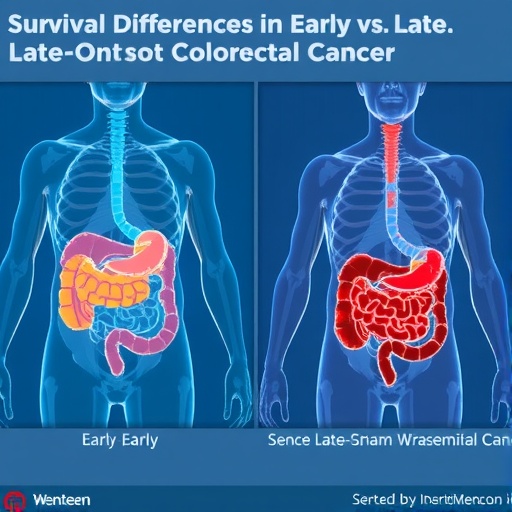
In a groundbreaking systematic review published this month in the British Journal of Cancer, researchers have provided new insights into the survival outcomes of colorectal cancer (CRC), comparing early-onset and late-onset cases with a refined focus on their pathological staging. The study meticulously stratifies patients by the TNM classification system—a universally adopted method that categorizes cancer severity based on tumor size, lymph node involvement, and metastasis—offering a nuanced perspective on how prognosis varies within distinct clinical parameters.
Colorectal cancer has long been recognized as a predominantly late-onset disease, typically affecting individuals beyond the age of 50. However, the incidence of early-onset CRC, diagnosed in patients younger than 50, has been alarmingly rising over recent decades. This epidemiological shift has raised urgent questions about whether younger patients fare better, worse, or comparably to their older counterparts when adjusted for cancer stage at diagnosis. The review by Al-Khafaji and colleagues addresses this critical issue, carefully compiling and analyzing survival data from diverse, large-scale cohort studies to elucidate patterns that could influence both clinical decision-making and public health strategies.
One of the salient themes emerging from this systematic analysis is that survival is not solely dictated by the time of cancer onset but is heavily intertwined with the TNM stage at detection. Early-onset CRC patients often present with more advanced tumors, which might be attributed to delayed diagnosis due to less routine screening in younger populations. Conversely, late-onset CRC cases are commonly detected at earlier stages, benefiting from established screening programs such as colonoscopy starting in middle age. This disparity underscores the complex interplay between biological aggressiveness, healthcare access, and cancer detection practices.
The researchers observed that when stratified by stage, survival outcomes between early-onset and late-onset CRC cohorts show nuanced differences. For instance, at early TNM stages (I and II), early-onset patients generally exhibit marginally better overall survival rates, potentially reflecting better physiological resilience and fewer comorbidities. In stark contrast, at more advanced stages (III and IV), survival metrics tend to converge, with late-onset patients sometimes displaying equivalent or even slightly improved outcomes, possibly linked to treatment responses or underlying tumor biology.
Delving deeper, the study brings attention to the molecular and genetic heterogeneity distinguishing early-onset from late-onset CRC. Early-onset tumors are often characterized by distinct genomic alterations, including a higher prevalence of microsatellite instability, a hallmark of defective DNA mismatch repair mechanisms. Such molecular discrepancies could influence tumor progression and response to chemotherapy or immunotherapy, factors critically relevant to staging-based survival projections but still under active investigation.
The TNM staging system itself remains a pillar in oncology, yet its prognostic precision may be complemented by integrating molecular markers, which are gaining traction in personalized cancer care. This systematic review implicitly advocates for a multidimensional approach where classical staging criteria are augmented with genetic profiling to better stratify patients and tailor therapies—particularly crucial given the variable survival trajectories uncovered between early- and late-onset CRC.
Notably, the authors highlight potential biases and confounders present across the studies analyzed, such as heterogeneous treatment modalities, demographic variations, and differences in healthcare systems that could skew survival statistics. This recognition calls for cautious interpretation and emphasizes the need for prospective longitudinal studies that harmonize data collection methods and incorporate standardized staging and molecular analyses globally.
From a clinical perspective, these findings may recalibrate strategies for screening and surveillance. Given the increased incidence and distinct survival profiles of early-onset CRC, there is a growing argument for lowering the screening age and developing targeted awareness campaigns aimed at younger populations. Conversely, such tailored approaches require resource allocation and policy shifts underscored by robust evidence—including the insights provided in this comprehensive review.
The interplay between age of onset and TNM stage in CRC prognosis also has significant implications for patient counseling and risk stratification. Clinicians can leverage these findings to provide more individualized survival forecasts, enhancing shared decision-making and optimizing therapeutic approaches. For example, intensive adjuvant treatment might be more justifiable for certain early-stage early-onset patients to capitalize on their potential for prolonged survival despite aggressive tumor biology.
Equally compelling is the potential impact on research trajectories. Future investigations may prioritize exploring how genetic and epigenetic landscapes of tumors evolve differently in younger versus older CRC patients and how these changes modulate disease progression and response to standard-of-care interventions. Such knowledge would be instrumental in developing new targets for precision oncology and improving survival outcomes across age groups.
The review also shines a light on the psychosocial and quality-of-life considerations distinct to early-onset CRC patients, who often face unique challenges such as fertility preservation, career disruption, and familial responsibilities. Understanding survival within the context of staging informs multidisciplinary care models that integrate oncologic, psychological, and supportive services to better address these holistic needs.
Moreover, the synthesis of data spanning multiple continents provides a global perspective on CRC survival disparities, accentuating the role of socioeconomic factors, healthcare infrastructure, and cultural elements in shaping outcomes. This global viewpoint reinforces the necessity for international collaboration in cancer control efforts and equitable healthcare delivery.
In conclusion, this seminal systematic review elucidates the complex relationship between age of colorectal cancer onset and survival outcomes when stratified by TNM stage. By revealing stage-specific survival nuances and underscoring molecular distinctions, the research advances the paradigm of precision oncology and informs clinical practice, public health policy, and future scientific inquiry. The findings affirm that survival in colorectal cancer cannot be generalized by age alone but must be contextualized within the framework of tumor staging and biological heterogeneity—a message that resonates profoundly in the era of personalized medicine.
Cite Scienmag News
Nathaniel Bowman. (May 4, 2026). Survival Differences in Early vs. Late-Onset Colorectal Cancer. Scienmag. https://scienmag.com/survival-differences-in-early-vs-late-onset-colorectal-cancer/
Nathaniel Bowman. "Survival Differences in Early vs. Late-Onset Colorectal Cancer." Scienmag, 4 May 2026, https://scienmag.com/survival-differences-in-early-vs-late-onset-colorectal-cancer/. Accessed 3 September 2026.
Nathaniel Bowman. "Survival Differences in Early vs. Late-Onset Colorectal Cancer." Scienmag. May 4, 2026. https://scienmag.com/survival-differences-in-early-vs-late-onset-colorectal-cancer/


