


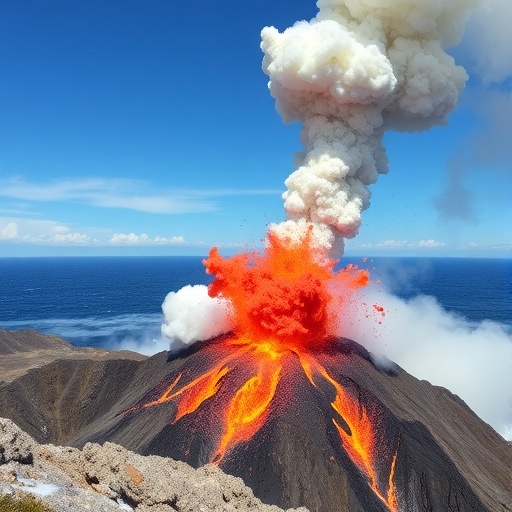
In the depths of our planet’s oceans, cataclysmic events are unfolding that challenge long-held perceptions about volcanic activity beneath the seas. A groundbreaking study published in Nature Communications by Nash, J.A., Yeo, I.A., Clare, M.A., and colleagues in 2026 reveals compelling evidence of far-reaching volcaniclastic density current deposits, marking some of the most explosive marine eruptions ever documented. This discovery not only reshapes our understanding of submarine volcanism but also signals important implications for geological hazards, marine ecosystems, and sedimentology.
Volcaniclastic density currents are sediment-laden flows generated by volcanic eruptions that plunge through the water column, transporting vast quantities of fragmented volcanic material across the ocean floor. Traditionally, these deposits are observed in proximity to volcanic islands or ridge systems, gradually dispersing as they settle from plumes. However, the new evidence described in this pivotal research illustrates that the reach of such volcaniclastic flows is far greater than previously assumed, extending hundreds of kilometers away from their eruption sites in unprecedented fashion.
The research team employed an integration of deep marine sediment core analyses, seismic reflection profiling, and geochemical fingerprinting to trace the provenance and dynamic dispersal of volcaniclastic deposits lurking within ancient seabed layers. Radiometric dating techniques allowed the team to correlate the timing of these deposits with known tectonic episodes, explicitly linking them to periods of intense explosive marine volcanism. These methodologies collectively uncover a vivid record of energetic underwater eruptions that have reshaped seafloor morphology and sediment composition over geological time scales.
More strikingly, the composition of these deposits diverges significantly from previously cataloged marine sediments. Characterized by an intricate admixture of vesicular volcanic glass shards, lithic fragments, and altered minerals, these volcaniclastic layers point to explosive interactions between magma and seawater. The rapid quenching of volcanic material coupled with the sudden fragmentation processes in submarine conditions evidently creates highly mobile density currents that can traverse ocean basins. Such far-reaching transport mechanisms suggest a broader environmental footprint for submarine eruptions than geology has traditionally recognized.
From a geophysical perspective, the revelation of vast volcaniclastic density current deposits challenges the conventional models of submarine volcanic hazard assessment. While volcanic island eruptions have been extensively studied due to their visibility and associated hazards like tsunamis, underwater eruptions—often stealthy and difficult to detect—pose an underappreciated risk by generating dense currents capable of scouring seabed ecosystems and damaging infrastructure such as communication cables and pipelines. Understanding the sedimentological signatures and transport dynamics described in this study can inform better predictive frameworks to mitigate such submarine geological hazards.
The study further elaborates on the erosive power of these density currents, positing that the rapid flow of sediment-rich water can carve deep channels and reshape bathymetric features. Seafloor mapping data reveal anomalously scoured troughs and depositional fans inconsistent with known sediment sources, now attributable to these extreme volcanic events. This geomorphological impact ripples across oceanic sediment budgets, influencing nutrient distributions and possibly altering benthic habitats, thus linking geological phenomena with marine ecological consequences.
Significantly, the temporal correlation of these volcaniclastic deposits with regional tectonic uplift and magmatic pulses sheds light on the dynamic interplay between Earth’s internal processes and ocean floor evolution. Explosive submarine volcanism appears tightly coupled to tectonic stress release within oceanic crust segments, with eruptions triggering volcaniclastic flows that rapidly blanket broad swaths of abyssal plains. Such insights augment our grasp of seafloor formation processes and the episodic nature of submarine volcanic activity—a frontier that continues to intrigue volcanologists and earth scientists alike.
Moreover, this research underscores the advancements in instrumentation and analytical techniques enabling scientists to unravel the complexities of underwater volcanism. High-resolution seismic surveys now allow unprecedented imaging of deposit geometry and internal stratigraphy, while geochemical tools discern mineralogical fingerprints with exquisite precision. Together, these technologies facilitate reconstruction of ancient eruption dynamics and density current behaviors with enhanced clarity, opening vistas into the hidden turmoil beneath our oceans.
The ramifications of acknowledging far-reaching explosive marine eruptions extend to paleoceanography and climate science as well. Volcaniclastic flows deliver volcanic materials rich in iron and other trace elements into deep ocean sediments, which can influence nutrient cycling and carbon sequestration over millennial timescales. Understanding the timing, scale, and magnitude of these underwater eruptions thus contributes to broader narratives of Earth’s climatic fluctuations, biogeochemical cycles, and the ocean’s role in modulating atmospheric conditions.
Additionally, this investigation opens new avenues for exploring volcanic hazard potential in marine settings including continental margins and island arcs, where dense population centers depend on subsurface and oceanic infrastructure. The recognition that explosive submarine eruptions can propagate volcaniclastic flows across vast distances emphasizes the need for enhanced ocean monitoring systems. Real-time detection of submarine seismicity and water column disturbances is critical to alerting communities and mitigating the risks posed by such underwater volcanic phenomena.
Furthermore, the findings challenge existing sedimentary classification schemes by adding a spectrum of volcaniclastic deposits previously underrepresented in marine sedimentary records. This profound contribution prompts reexamination of sediment core datasets worldwide, urging geologists to revisit marine stratigraphy with a focus on identifying subtle volcaniclastic signatures. It may lead to reinterpreting certain sediment sequences as products of explosive marine activity rather than conventional sedimentation, thereby influencing theories on seafloor sediment genesis and diagenesis.
In a broader scientific context, these discoveries illustrate the interconnectedness of Earth’s systems—tectonics, volcanism, oceanography, and biology converge in a complex dynamic that governs the planet’s evolution. Mapping the extent and impact of submarine volcanic deposits enriches our holistic understanding of volcanic processes beyond the terrestrial realm, highlighting the ocean’s active role in the planet’s geological and environmental history.
This paradigm shift also encourages interdisciplinary collaboration among volcanologists, sedimentologists, oceanographers, and hazard mitigation experts. Such cooperative efforts are essential to advance predictive models that factor in the scale, frequency, and sedimentological consequences of submarine volcanic eruptions. Future research ventures may focus on refining eruption reconstruction through fluid dynamic simulations and experimental volcanology that replicate underwater explosive conditions to better grasp eruption dynamics and resulting sediment dispersal.
In conclusion, the work by Nash et al. represents a landmark contribution to marine geology and volcanology, unveiling the existence of far-reaching volcaniclastic density current deposits as unequivocal testament to powerful explosive submarine eruptions. This breakthrough expands our knowledge of oceanic volcanic activity’s complexity, geomorphological impact, and hazard potential. As scientific inquiry deepens into the mysteries beneath the waves, such revelations underline the ocean floor as a vibrant and evolving landscape sculpted by forces as explosive and dynamic as those on land.
Cite Scienmag News
Violet Maxwell. (May 1, 2026). Explosive Marine Eruptions Revealed by Volcaniclastic Deposits. Scienmag. https://scienmag.com/explosive-marine-eruptions-revealed-by-volcaniclastic-deposits/
Violet Maxwell. "Explosive Marine Eruptions Revealed by Volcaniclastic Deposits." Scienmag, 1 May 2026, https://scienmag.com/explosive-marine-eruptions-revealed-by-volcaniclastic-deposits/. Accessed 1 September 2026.
Violet Maxwell. "Explosive Marine Eruptions Revealed by Volcaniclastic Deposits." Scienmag. May 1, 2026. https://scienmag.com/explosive-marine-eruptions-revealed-by-volcaniclastic-deposits/


