


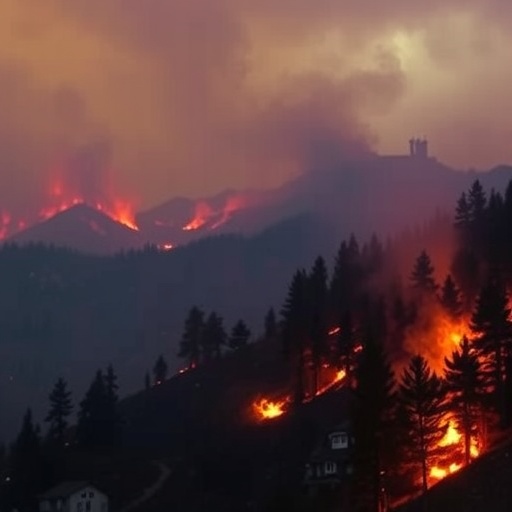
In recent years, the increased prevalence and severity of forest fires have emerged as one of the most daunting environmental challenges facing mountainous regions across Europe. These ecosystems, once considered naturally resistant to fire due to their altitude and cooler climates, are now experiencing unprecedented wildfire activity. The newly published research by Beloiu, Loeillot, Griess, and colleagues in Nature Communications in 2026 sheds critical light on a disturbing trend: the climate-driven upward spread of forest fires in European mountain regions. This comprehensive study integrates advanced climate modeling with long-term fire records to reveal how rising temperatures and changing precipitation patterns are enabling fires to encroach into higher elevation zones previously deemed safe from such disturbances.
The heart of this issue lies in complex climatological shifts that have intensified over the past few decades, fueling a cascade of ecological consequences. In European mountainous landscapes extending from the Pyrenees through the Alps and into the Carpathians, prolonged warming has diminished critical moisture reserves in the soil and vegetation. This aridity, coupled with reduced snowpack duration, creates prime conditions for the ignition and spread of wildfires at elevations once characterized by moist, fire-resistant coniferous forests and alpine meadows. The study highlights that these upward-moving fires disrupt fragile high-altitude ecosystems already under pressure from habitat fragmentation and human encroachment, thereby threatening biodiversity and ecosystem services vital to local communities.
A technical cornerstone of the research involved analyzing fire dataset trends alongside detailed climatological variables recorded over nearly half a century. By employing remote sensing technologies, including satellite imagery and LiDAR, the authors map fire scars across elevation gradients with unprecedented precision. This data revealed a statistically significant increase in fire occurrences above the traditional upper forest line, a zone formerly considered too cold and damp to sustain large-scale fires. The upward progression, quantified at several meters per year, illustrates a tangible impact of global temperature increase, aligning with IPCC climate projection scenarios that predict escalating wildfire risks in mountainous terrains under continued greenhouse gas emissions.
From an ecological standpoint, the implications are profound. Trees and understory species native to high elevations often possess limited fire-adaptive traits, such as resprouting ability or serotinous cones that release seeds post-fire. The newfound presence of intense fires at altitude introduces a fire regime with return intervals and intensities at odds with historical ecological balances. Certain endemic species face near extinction risks, while invasive fire-adapted species may colonize freshly burned areas, altering vegetation structure and function. These changes also feedback into climate dynamics, as the loss of forest cover reduces carbon sequestration potential and increases surface albedo, potentially exacerbating local warming.
Further complicating the scenario is the interaction between fire regimes and mountain hydrology. Increased fire frequency in these areas disrupts soil stability and snowmelt processes. Burned slopes become prone to erosion and landslides, threatening water quality and sediment loads in downstream rivers and reservoirs. The study illustrates that post-fire hydrological disturbances could compromise water supply reliability for millions of Europeans who depend on these mountain watersheds. Moreover, ash and particulate matter released during forest fires pose significant air quality health hazards both locally and in distant urban centers via atmospheric transport.
On the technical front, the authors discuss the utilization of coupled climate-vegetation-fire models to project potential future scenarios under various emission pathways. Integrating physical climate science with biogeochemical modeling enables a mechanistic understanding of threshold conditions triggering fire spread at higher elevations. This approach also simulates potential mitigation interventions, such as forest management strategies to enhance moisture retention or to reduce fuel loads. However, the complexity and variability of mountain microclimates pose substantial challenges to predictive accuracy, underscoring the need for continuous data refinement and interdisciplinary collaboration.
From a policy perspective, the study critically emphasizes the urgency for revised wildfire management frameworks attuned to these emerging climatic realities. Traditional firefighting methods and prevention strategies tailored to lowland environments may prove ineffective or counterproductive in high-altitude contexts. The findings advocate for adaptive management that incorporates climate adaptation principles, enhanced monitoring systems, and community engagement in mountainous regions. Importantly, transnational cooperation across European countries is vital given the shared nature of mountain ecosystems and the cross-border implications of climate-induced wildfire spread.
This research also deepens our understanding of feedback loops within the global climate system. Forest fires, especially in carbon-rich mountain biomass, release substantial greenhouse gases, contributing to atmospheric warming and a potential vicious cycle of escalating fire risk. The study quantifies these emissions, correlating fire frequency data with regional carbon flux estimates. The insights gained enable policymakers and climate scientists to refine carbon budgets and to prioritize high-altitude fire mitigation as a crucial component of broader climate change strategies aiming for net-zero emissions.
The societal dimensions are equally critical. Many European mountain communities are culturally and economically intertwined with their forested landscapes, relying on forestry, tourism, and recreation for livelihoods. The increasing frequency and intensity of fires jeopardize these economic activities while also posing direct risks to human safety and infrastructure. The research underlines the importance of integrating wildfire risk assessments into regional development and land use planning, ensuring resilient community designs that account for both immediate and long-term fire-related hazards.
Another novel aspect explored in the paper is the role of atmospheric circulation patterns, such as heatwaves and drought spells exacerbated by climate change, in triggering the observed fire spread. The researchers draw connections between large-scale synoptic phenomena and localized fire events, emphasizing the importance of improved weather forecasting and early warning systems in mountainous terrain. This meteorological linkage enhances predictive capabilities and offers opportunities for pre-emptive firefighting readiness, mitigating fire propagation before it spirals out of control at higher elevations.
The study also addresses the limitations and uncertainties inherent in climate-fire interaction research. Fine-scale variability in vegetation types, topographic influences, and human intervention complicate the attribution of fire changes to climate factors alone. Nevertheless, the multi-method approach—combining empirical observations, statistical analyses, and model experiments—builds a robust evidentiary basis that elevates our confidence in the observed trends. These methodological advances contribute valuable knowledge to the field of fire ecology and climate impact science.
Looking ahead, the authors propose priorities for future research, including detailed studies on post-fire ecosystem recovery trajectories, carbon cycle feedback quantifications, and socio-economic impact assessments. Systematic monitoring of high-altitude fire regimes using emerging technologies such as unmanned aerial systems and hyperspectral imaging is recommended to enhance temporal and spatial resolution of data. These initiatives aim to develop actionable insights that integrate conservation, climate resilience, and sustainable development goals in European mountain regions.
In conclusion, the upward spread of forest fires driven by climate change constitutes a transformative challenge with broad environmental, social, and climatic repercussions. The pioneering work of Beloiu and colleagues represents a critical advancement in recognizing the vulnerability of mountainous ecosystems to wildfire under warming conditions. Their findings compel us to rethink not only traditional fire management practices but also broader strategies to address the cascading effects of climate change. As Europe grapples with changing fire regimes in its highlands, this research provides an indispensable foundation for guiding science-based policy and fostering adaptive stewardship of these iconic landscapes.
Cite Scienmag News
Violet Maxwell. (April 30, 2026). Climate Fuels Rising Forest Fires in European Mountains. Scienmag. https://scienmag.com/climate-fuels-rising-forest-fires-in-european-mountains/
Violet Maxwell. "Climate Fuels Rising Forest Fires in European Mountains." Scienmag, 30 April 2026, https://scienmag.com/climate-fuels-rising-forest-fires-in-european-mountains/. Accessed 1 September 2026.
Violet Maxwell. "Climate Fuels Rising Forest Fires in European Mountains." Scienmag. April 30, 2026. https://scienmag.com/climate-fuels-rising-forest-fires-in-european-mountains/


