


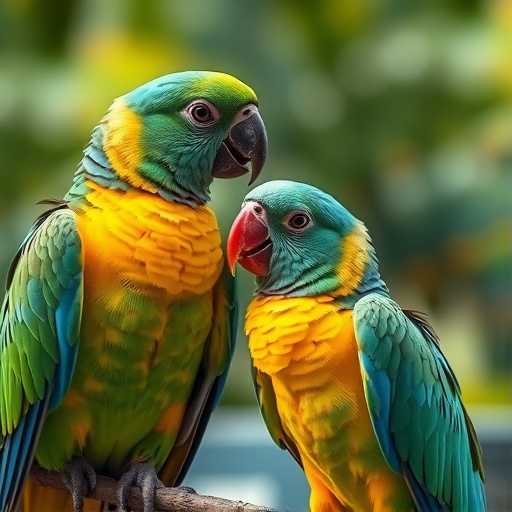
In a landmark study published in PLOS Biology, researchers have revealed how wild sulphur-crested cockatoos demonstrate sophisticated social learning strategies to identify and adopt novel foods within their urban habitats. This inquiry, conducted by Julia Penndorf and her colleagues from the Australian National University and international collaborators, provides the first experimental evidence that wild parrots acquire dietary knowledge by observing their social networks, leading to rapid cultural transmission of food preferences and feeding techniques.
The adaptive conundrum facing animals when encountering unfamiliar foods is well recognized: attempting to consume an unknown item carries the risk of toxicity, while avoidance might mean missing out on valuable nutrients. Traditionally, animals have been thought to rely on individual trial-and-error learning. However, this study definitively illustrates that wild sulphur-crested cockatoos engage in social learning to circumvent these risks, gleaning critical information from their peers before incorporating novelty into their diets.
Over 700 cockatoos inhabiting the urban areas of central Sydney were meticulously observed during this experiment. The researchers first trained a small subset of birds to eat almonds still in their shells but painted blue or red, colors that these parrots would not naturally encounter, ensuring the novelty of the food. By placing feeders loaded with these painted almonds near their roost sites and observing the uptake patterns, the team traced the diffusion of cautious curiosity developing into acceptance across the flocks.
Initially, untrained cockatoos consistently avoided the painted almonds. However, the presence of even a few trained individuals catalyzed a dramatic shift—other birds rapidly began to consume these novel nuts after witnessing their conspecifics’ success. By the tenth day, nearly half of the observed population, precisely 349 individuals, had integrated the almonds into their diet. Statistical models confirmed that the spread of this behavior was tightly linked to observable social connections rather than random encounters, underscoring social learning as the key mechanism.
These findings challenge the previously laboratory-centric perspective on social learning, highlighting that such mechanisms operate robustly in complex, natural environments. Moreover, the nuanced social structure of cockatoo roosts influenced how the information percolated through the groups. For instance, male cockatoos displayed a tendency to be influenced more strongly by other males, suggesting same-sex social bonds are particularly crucial in knowledge transmission. Adults also showed greater responsiveness to roost mates compared to juveniles, reflecting experience-based social preferences.
Juvenile cockatoos presented a fascinating behavioral divergence: exhibiting heightened conformity, they overwhelmingly favored adopting the most popular almond color rather than individual trial preferences. This form of social conservatism parallels similar patterns seen in human developmental stages, where children often mirror majority behavior, indicating convergent evolutionary strategies across species for optimal learning and survival.
Beyond mere adoption of new foods, the study unveiled the emergence of culturally distinct foraging techniques. Cockatoos employed several divergent methods to crack open the tough almond shells, and these motor strategies clustered along social lines. Birds with close associations were more likely to share similar shell-opening behaviors, and these differences extended geographically across neighboring roosts, suggesting the formation of micro-level behavioral traditions or ‘cultures’ predicated on social learning.
The implication of these cultural divisions is profound, suggesting not merely individual or species-level plasticity but the evolution of social transmission systems enabling rapid adaptation to environmental changes—critical for urban-dwelling species facing ongoing anthropogenic pressures. Learning socially about new foods may be a cornerstone in the cockatoos’ remarkable success and persistence in dynamic urban ecosystems.
Social learning’s influence on behavioral innovation provides a compelling explanation for behavioral flexibility in wild animals. This study elucidates how urban cockatoos circumvent ecological challenges by leveraging social structures. The efficiency of spreading novel dietary knowledge among the birds demonstrates an evolved solution to the risks imposed by rapidly changing habitats and human-modified food landscapes.
Importantly, the research was carefully designed with a solid experimental framework to untangle social learning from mere individual exploratory behavior. The use of painted almonds and controlled placement of feeders was pivotal in establishing causality. The statistical confirmation that social network connectivity, rather than chance or environmental factors, explains the knowledge diffusion further enhances the robustness of the conclusions.
Furthermore, the research highlights age- and sex-specific strategies within the social learning matrix. Adults’ stronger propensity to learn from roost mates contrasts with juveniles’ conformist biases, illuminating the layered complexity of knowledge transmission. Males preferentially modeled behavior after other males, implying gender-specific social learning may influence cultural evolution within these avian groups.
These insights not only broaden our understanding of animal cognition and culture but suggest that conservation strategies should consider social dynamics as vital in fostering adaptive capacities. The documented capacity for cultural transmission in wild parrots potentiates resilience to environmental challenges and may inform urban wildlife management practices.
In conclusion, the work of Penndorf et al. pioneers a new frontier in behavioral ecology, illustrating that wild parrots are not only capable of learning about new resources via intricate social networks but also forge culturally transmitted feeding behaviors that impact the survival and proliferation of urban populations. This capacity for social learning elucidates a significant mechanism by which animals mitigate risks, capitalize on novel environmental opportunities, and thrive amidst rapid ecological transformations driven by human presence.
For more detailed insights, the full open-access paper is available at: https://plos.io/4uXTCfm
News Publication Date: April 30, 2026
Web References:
References:
Penndorf J, Barrett BJ, Wild S, Martin JM, Aplin LM (2026) Wild parrots exhibit age-dependent conformity when learning about novel food. PLoS Biol 24(4): e3003741.
Cite Scienmag News
Drew Townsend. (April 30, 2026). Wild parrots rapidly adapt to new foods by mimicking peers, study finds. Scienmag. https://scienmag.com/wild-parrots-rapidly-adapt-to-new-foods-by-mimicking-peers-study-finds/
Drew Townsend. "Wild parrots rapidly adapt to new foods by mimicking peers, study finds." Scienmag, 30 April 2026, https://scienmag.com/wild-parrots-rapidly-adapt-to-new-foods-by-mimicking-peers-study-finds/. Accessed 1 September 2026.
Drew Townsend. "Wild parrots rapidly adapt to new foods by mimicking peers, study finds." Scienmag. April 30, 2026. https://scienmag.com/wild-parrots-rapidly-adapt-to-new-foods-by-mimicking-peers-study-finds/


