


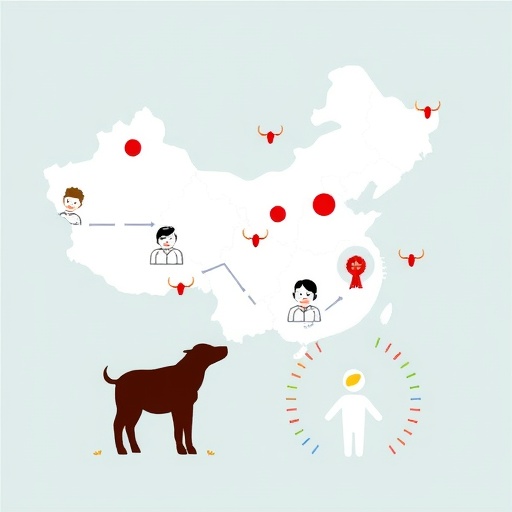
In a groundbreaking synthesis published in the prestigious journal Science in One Health, researchers have illuminated the intricate and often underappreciated dynamics of zoonotic disease transmission within China’s diverse socio-ecological tapestry. This comprehensive review transcends conventional outbreak reaction paradigms, advocating for a robust, prevention-centric approach that methodically addresses the complex human–animal–environment interfaces integral to zoonotic risk. By analyzing 93 zoonotic diseases monitored across China’s One Health sectors, the review underscores the urgency of integrating nuanced behavioral insights and tailored risk communication strategies underpinned by One Health principles.
Central to the review’s findings is the recognition that zoonotic spillover is not solely the consequence of rare or exotic wildlife interactions but frequently emerges through everyday human activities such as smallholder farming, informal food handling, animal trade, and recreational behaviors. This nuanced understanding challenges prevailing perceptions and compels a broadened surveillance framework that transcends the formal sector to encapsulate endemic practices within rural and peri-urban milieus, where exposure risk is elevated. The research identifies critical contact pathways across seven key animal groups and distinctly maps their interface with at-risk human populations—smallholder farmers, herders, rural residents, and informal market actors—across indirect, direct, and vector-borne transmission routes.
Intriguingly, the epidemiological role of bats and rodents, traditionally spotlighted in zoonotic discourse, manifests through largely indirect pathways. Bat-associated risks arise predominantly from habitat proximity, cave visitation, and indirect transmission via domestic livestock, rather than direct consumption. Rodent exposure pathways leverage environmental contamination through excreta, soil, water, and ectoparasite vectors within domestic and occupational settings. Meanwhile, the burgeoning companion and exotic pet sectors represent emerging conduits for zoonotic spillovers, underscoring the complexity of wildlife-human contact in contemporary urbanizing landscapes.
The analytical framework dissects four prioritized human–animal interfaces where transmission risk coalesces: domestic animals within households and markets, wildlife management in rural environs, synanthropic rodents and bats inhabiting residential niches, and nature-based tourism activities including cave exploration. Each interface exhibits distinct socio-ecological characteristics necessitating bespoke risk communication strategies. The review critically evaluates existing surveillance and communication infrastructures, highlighting significant blind spots—most notably the under-characterization of informal wildlife trade, exotic pet ownership, and traditional medicine practices—compounded by a paucity of granular behavioral data essential for precision-targeted interventions.
A salient critique pertains to the prevalent reactive orientation of current risk communication strategies, which tend to be one-directional, emergency-driven, and focused on short-term compliance. Such approaches often neglect the socio-economic contexts and cultural landscapes within which target populations operate. Consequently, messages lacking cultural resonance or practical relevance risk engendering unintended negative consequences, such as vilification of wildlife species whose ecological roles are critical for biodiversity and ecosystem health. The review advocates for a paradigm shift toward community-engaged, participatory message design, privileging trust-based relationships with local leaders, veterinarians, and health workers as pivotal conduits.
From an efficacy standpoint, the synthesis marshals evidence demonstrating that sustained behavioral change materializes when risk communication is embedded within locally meaningful narratives that link health security with conservation imperatives. This integrative framing counters dichotomous portrayals of health versus environment and leverages ecological awareness to bolster adherence. The Chinese experience with pandemic-scale outbreaks—SARS, H7N9, and COVID-19—offers instructive lessons in rapid, large-scale community engagement and multi-sectoral coordination, capabilities now poised to support more upstream, prevention-oriented strategies.
Legislative reforms, including the forthcoming enhancements to China’s Law on the Prevention and Control of Infectious Diseases effective April 2025, institutionalize risk communication as a core public health function. These policies usher in a critical opportunity to embed tiered communication paradigms that deliver both broad-spectrum preventive guidance and finely calibrated, interface-specific messaging where evidence permits. The review emphatically calls for stronger One Health integration, fostering data sharing and collaborative governance across health, agricultural, and environmental sectors to render surveillance more anticipatory.
Furthermore, the review underscores the imperative to integrate behavioral science and ecological insights within surveillance systems, ensuring that detection efforts are attuned not only to pathogen presence but also to the socio-behavioral contexts shaping human-animal interactions. Such an approach promises to refine risk stratification and enable precision public health interventions. Together, these strategies align to create a proactive defense against zoonotic emergence that moves beyond crisis response, fundamentally reconfiguring prevention as a continuous, ecosystem-sensitive process.
Ultimately, this review represents a clarion call for a holistic reimagining of zoonotic disease risk governance in China, one that leverages the synergies of multi-sectoral collaboration, culturally aligned communication, and rigorous scientific inquiry. Translating this vision into actionable policy and practice can mitigate zoonotic threats at their source, safeguard livelihoods dependent on animal husbandry and wildlife resources, and contribute to global health security in an era marked by escalating human-animal interconnectivity and environmental change.
The efforts led by Columbia University, EcoHealth Alliance, and the Future Earth Health Knowledge-Action Network exemplify the value of transdisciplinary research bridging linguistic, cultural, and scientific barriers, providing an evidentiary foundation for policy reforms and community engagement frameworks adapted to China’s unique epidemiological landscape. This integrative lens not only advances local and national health outcomes but illuminates global pathways for One Health operationalization amidst the complexities of emerging infectious diseases.
As the international health community grapples with the persistent threat of zoonoses, this timely review enriches strategic discourse by demonstrating that context-specific, behavior-centered prevention, coupled with ecological stewardship and legislative backing, constitutes a formidable bulwark against future pandemics. It is a compelling reminder that successful zoonotic disease mitigation hinges upon coexistence paradigms that respect biodiversity, empower communities, and anticipate risk through collaborative foresight.
Cite Scienmag News
Kristina Jarvis. (April 29, 2026). Preventing Zoonotic Diseases at the Human-Animal Interface in China: Moving Beyond Outbreaks. Scienmag. https://scienmag.com/preventing-zoonotic-diseases-at-the-human-animal-interface-in-china-moving-beyond-outbreaks/
Kristina Jarvis. "Preventing Zoonotic Diseases at the Human-Animal Interface in China: Moving Beyond Outbreaks." Scienmag, 29 April 2026, https://scienmag.com/preventing-zoonotic-diseases-at-the-human-animal-interface-in-china-moving-beyond-outbreaks/. Accessed 31 August 2026.
Kristina Jarvis. "Preventing Zoonotic Diseases at the Human-Animal Interface in China: Moving Beyond Outbreaks." Scienmag. April 29, 2026. https://scienmag.com/preventing-zoonotic-diseases-at-the-human-animal-interface-in-china-moving-beyond-outbreaks/


