


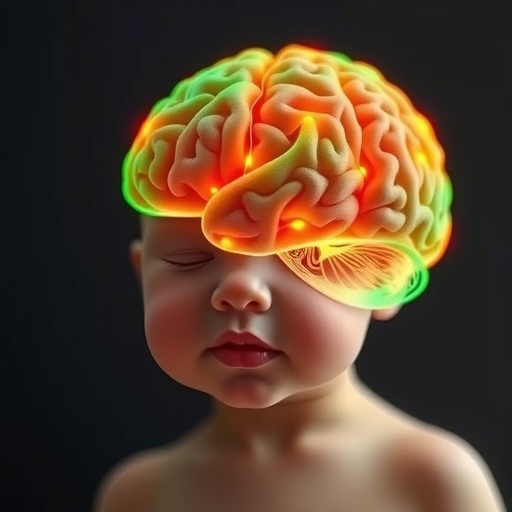
In a groundbreaking study emerging from Ohio State University, researchers have unveiled new insights into the distinct neurological origins of two fundamental human cognitive functions: language and theory of mind. These functions, which underpin our ability to communicate effectively and understand others’ mental states, have long intrigued scientists seeking to unravel the mysteries of the developing brain. This study pioneers in demonstrating that these capacities arise from separate, non-overlapping regions in the superior temporal lobe of children’s brains, a finding that carries significant implications for neuroscience and cognitive development.
The superior temporal lobe, located near the temples, serves as a critical hub for processing complex linguistic and social information. Prior research in adults has noted the lateralization of these functions, with language predominantly processed in the left hemisphere and theory of mind—the cognitive skill allowing individuals to infer others’ thoughts and feelings—processed in the right hemisphere. However, until now, it remained unclear whether such functional segregation was present in the brains of young children or developed later through experience and maturation.
Utilizing functional magnetic resonance imaging (fMRI), the research team scanned the brains of both adults and children aged between 3 and 9 years, while exposing them to carefully designed stimuli. Children heard coherent sentences designed to activate language areas and watched a silent cartoon aimed at engaging theory of mind regions. These stimuli were chosen to invoke specific neural patterns: listening to real language versus nonsensical string of sounds, and observing social interactions eliciting mentalizing responses versus reactions to physical pain cues.
The fMRI data revealed a striking dissociation. The brain regions activated during language tasks were completely distinct from those engaged during theory of mind assessments. This spatial dissociation in children mirrors the patterns previously observed in adult brains, confirming that these cognitive functions are supported by segregated neural architectures from a young age. This runs contrary to earlier hypotheses proposing that language and mentalizing may share overlapping neural substrates during early development.
In addition to spatial separation, the study probed the connectivity patterns of these regions, employing resting-state fMRI scans. Even in the absence of task-driven stimuli, the neural networks underlying language and theory of mind showed unique “connectivity fingerprints” — distinctive patterns of communication with other brain areas. These connectivity profiles remained stable within individuals over time, underscoring the robustness of these functional distinctions throughout childhood.
Crucially, the data suggests that these brain networks did not exhibit increasing segregation with age; rather, their distinctive patterns of connectivity and function were established early and remained consistent from ages three to nine. This challenges models positing that early brain systems overlap extensively and differentiate only through experience and cognitive development. Instead, the findings imply that our brain’s architecture is fundamentally organized into discrete circuits supporting language and social cognition from early childhood.
Interestingly, while children display clear-cut functional boundaries between these regions, neuroimaging of adults revealed a more nuanced interaction—regions associated with theory of mind begin to communicate with areas tied to language. This subtle cross-talk may reflect the complexity of adult cognition, where sophisticated social reasoning and linguistic processing intertwine, enhancing our ability to navigate complex social and communicative landscapes.
Senior author Zeynep Saygin, an associate professor of psychology, emphasizes the evolutionary and developmental significance of these results. “This dissociation suggests that distinct evolutionary pressures shaped neural substrates for language and social cognition separately, equipping humans with dedicated machinery for these core capabilities,” Saygin explains. This insight could reshape our understanding of how uniquely human cognitive faculties emerge during brain development.
The use of advanced fMRI techniques with fine-grained spatial resolution — measuring brain activity at the scale of millimeters and employing 3D voxel analysis — enabled the team to pinpoint these specialized brain regions with unprecedented precision. This approach highlights how technological advancements in neuroimaging continue to deepen our grasp of brain organization and function, particularly concerning the emergence of complex cognitive skills.
Equally remarkable was the longitudinal aspect of this research. By scanning the same children at multiple points, the team confirmed that individual connectivity signatures in language and theory of mind networks remain steadfast over time. This constancy provides strong evidence that these systems are maturing along independent trajectories, governed by preconfigured genetic and neurobiological determinants rather than solely by environmental interaction.
Furthermore, these discoveries have potential clinical implications. A clearer understanding of the separate neural substrates supporting language and social cognition could inform interventions for developmental disorders where these functions are impaired, such as autism spectrum disorder or specific language impairments. Tailored therapies targeting these discrete pathways could enhance efficacy and improve outcomes for affected individuals.
This research contributes to a broader debate about the architecture of human cognition. By demonstrating the early emergence of specialized neural systems for language and mentalizing, it challenges integrated models proposing a shared origin or substantial overlap between these faculties. Instead, it supports frameworks that emphasize modularity and parallel development of complex human skills.
Funded by prominent institutions including the National Science Foundation, the Alfred P. Sloan Foundation, and the National Institutes of Health, this study exemplifies interdisciplinary collaboration bridging psychology, neuroscience, and evolutionary biology. It paves the way for future research exploring how these discrete networks interact dynamically throughout life and adapt to cultural and environmental influences.
As the landscape of cognitive neuroscience evolves, findings such as these provide a compelling glimpse into how our brains are wired not only to acquire language but also to navigate intricate social worlds—two cornerstones of what it means to be human. This foundational knowledge strengthens the bridge connecting biological mechanisms to the richness of human mind and behavior.
Cite Scienmag News
Cassandra Pierce. (April 27, 2026). Scientists Discover Two Complex Cognitive Functions Present from Birth. Scienmag. https://scienmag.com/scientists-discover-two-complex-cognitive-functions-present-from-birth/
Cassandra Pierce. "Scientists Discover Two Complex Cognitive Functions Present from Birth." Scienmag, 27 April 2026, https://scienmag.com/scientists-discover-two-complex-cognitive-functions-present-from-birth/. Accessed 4 September 2026.
Cassandra Pierce. "Scientists Discover Two Complex Cognitive Functions Present from Birth." Scienmag. April 27, 2026. https://scienmag.com/scientists-discover-two-complex-cognitive-functions-present-from-birth/


