


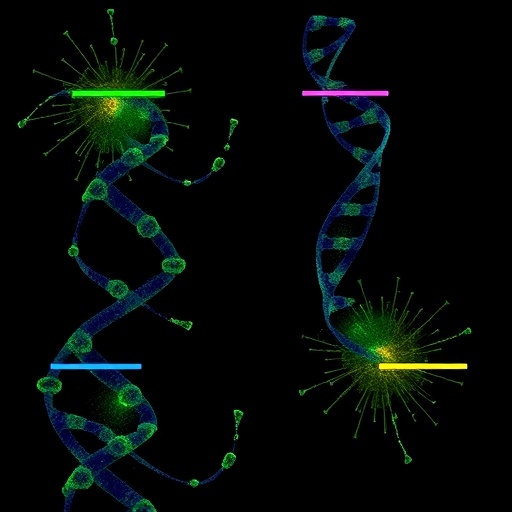
In a groundbreaking stride for cancer biology and genomic medicine, researchers at The University of Texas MD Anderson Cancer Center have pioneered a novel imaging technology called RF-SIRF, a tool that captures the elusive reversed DNA replication forks with unprecedented precision directly within living cells. This innovation transcends previous limitations, providing scientists with an unprecedented ability to visualize and quantify the dynamics of replication fork reversal—a critical cellular response to DNA replication stress that is intimately tied to genomic stability, cancer resistance, and therapeutic outcomes.
During the vital process of DNA replication, the replication forks act as molecular engines by unwinding the DNA double helix and facilitating the synthesis of new strands. However, these forks can encounter obstacles such as DNA damage, replication stress, or chemotherapeutic agents, which risk fork stalling or collapse. To mitigate such detrimental events, cells deploy a protective mechanism wherein the forks reverse to form a unique four-way junction structure. This reversal not only temporarily stalls replication to allow for damage tolerance but also acts as a safeguard against the formation of lethal DNA double-strand breaks.
Despite the recognition of reversed replication forks as central players in maintaining genomic integrity, their study has been hampered by a lack of tools able to visualize these transient structures in situ with high specificity and resolution. Traditional approaches have relied heavily on in vitro assays or bulk analyses, obscuring the intricate spatial and temporal context these structures inhabit within native chromatin. The RF-SIRF imaging technology fills this critical gap by enabling the single-cell resolution mapping of reversed forks within their native cellular environment, providing a window into the molecular choreography at stalled replication sites.
The technical foundation of RF-SIRF capitalizes on the distinct four-way architecture of reversed forks, employing a combination of immunofluorescent labeling and proximity ligation techniques to detect and quantify these unique DNA junctions. This method allows for the spatial correlation of reversed forks with a myriad of chromatin features and DNA repair proteins, thereby unraveling the complex interplay between DNA replication stress responses and epigenetic regulation in living cells. As a consequence, the approach unveils a rich “epigenetic code” tied explicitly to replication stress that markedly diverges from the regulatory landscapes governing canonical gene transcription.
This epigenetic signature, identified through RF-SIRF, illuminates how stalled forks actively recruit specific DNA damage response factors. Such localization not only influences repair pathway choice but also intertwines with inflammatory and transcriptional programs, potentially mediating cancer resistance and aging phenotypes. These insights mark a paradigm shift by revealing that reversed forks are not merely passive structures halting replication but are dynamically embedded in signaling circuits that influence cell fate decisions.
In the context of oncology, this discovery holds transformative implications. Many cancers, especially those harboring mutations in BRCA1 and BRCA2—genes critical for fork protection—exemplify altered responses to replication stress, influencing their sensitivity to chemotherapy and immunotherapy. By delineating the molecular underpinnings of fork reversal in these contexts, RF-SIRF sets the stage for precision medicine strategies designed to target therapy resistance mechanisms at their molecular inception. This tool empowers researchers to visualize hidden resistance pathways and test novel therapeutic interventions directly at the single-cell level.
Katharina Schlacher, Ph.D., the leading investigator of this study, emphasizes that the ability to decode the “crosstalk” between DNA replication stress, inflammation, and transcription unfolds new frontiers in precision oncology. “Our imaging platform doesn’t just reveal where and when forks reverse; it exposes the epigenetic signals orchestrating the cellular response to replication stress, unveiling possible targets to circumvent cancer’s adaptive resistance,” Schlacher notes.
From a broader perspective, RF-SIRF opens avenues to investigate how replication stress responses influence aging and disease suppression. Alterations in fork dynamics and associated epigenetic landscapes may underpin age-related genomic instability and immunotherapy outcomes, expanding the relevance of this research beyond oncology into fundamental biology and translational medicine.
Moreover, by providing a quantitative, native context visualization, RF-SIRF empowers future studies to dissect how external stressors, including environmental factors and pharmacological agents, modulate replication fork behavior. This capacity promises to enhance our understanding of gene-environment interactions at the molecular level, contributing to more effective therapeutic designs that minimize collateral genomic damage.
This breakthrough exemplifies how integrating cutting-edge imaging technologies with molecular biology can decode complex cellular mechanisms that were previously obscured. The investigative team’s collaborative efforts, supported by the National Institute of Environmental Health Sciences and the Cancer Prevention and Research Institute of Texas, underscore the critical role of interdisciplinary research in advancing biomedical science.
The detailed findings are published in the prestigious journal Nature Communications, where they outline the mechanistic insights and potential clinical applications of RF-SIRF. This study not only marks a significant leap in DNA replication research but also offers a promising new tool for dismantling the molecular basis of cancer resistance and optimizing therapeutic responses.
As cancer treatment paradigms increasingly shift toward tailored and combination therapies, tools like RF-SIRF stand to revolutionize the early detection of resistance mechanisms and pave the way for more intentional and effective interventions. By shining light on the spatial and temporal dimensions of replication fork dynamics, this technology sets a new standard for molecular oncology research and personalized medicine.
The advent of RF-SIRF heralds a future where the intricate dance of DNA replication and repair can be charted with the clarity needed to design next-generation therapies that will ultimately improve patient outcomes and longevity.
News Publication Date: April 27, 2026
Web References:
https://www.mdanderson.org/
https://www.nature.com/articles/s41467-026-70716-5
References: Published study in Nature Communications by Katharina Schlacher et al.
Cite Scienmag News
Nathaniel Bowman. (April 27, 2026). New Imaging Tool Uncovers Breakthrough Insights into DNA Replication Stress Response. Scienmag. https://scienmag.com/new-imaging-tool-uncovers-breakthrough-insights-into-dna-replication-stress-response/
Nathaniel Bowman. "New Imaging Tool Uncovers Breakthrough Insights into DNA Replication Stress Response." Scienmag, 27 April 2026, https://scienmag.com/new-imaging-tool-uncovers-breakthrough-insights-into-dna-replication-stress-response/. Accessed 1 September 2026.
Nathaniel Bowman. "New Imaging Tool Uncovers Breakthrough Insights into DNA Replication Stress Response." Scienmag. April 27, 2026. https://scienmag.com/new-imaging-tool-uncovers-breakthrough-insights-into-dna-replication-stress-response/


