


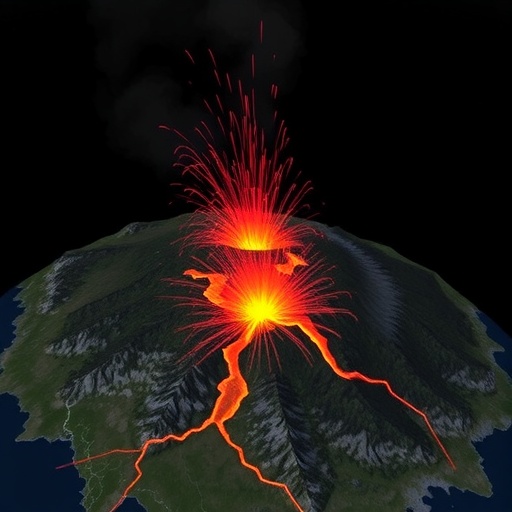
In the dynamic realm of Earth sciences, the interplay between tectonic activity and volcanic processes remains a subject of intense scrutiny. Recent research published by Hicks et al. provides a groundbreaking perspective on this interaction, focusing on the 2022 unrest event at São Jorge, part of the Azores archipelago. This study elucidates the mechanisms of fault-mediated magma propagation and its consequential triggered seismicity, offering invaluable insights into volcanic hazard assessment and our broader understanding of crustal dynamics.
The São Jorge island, nestled within the Azores volcanic arc, presents a unique natural laboratory due to its complex tectonic framework and frequent volcanic activity. In 2022, an unprecedented unrest episode was detected, characterized by increased seismicity, ground deformation, and subtle magmatic intrusions beneath the island. Hicks and colleagues embarked on a comprehensive multidisciplinary investigation combining seismology, geodesy, and geological mapping to unravel the underlying processes governing this phenomenon.
Traditional models of magma ascent often emphasize vertical migration through fracture networks; however, this study reveals a more nuanced mechanism involving fault zones as primary pathways for magma propagation. The researchers identified that magma does not merely rise buoyantly through the crust but is strongly guided laterally and vertically by pre-existing fault structures. These faults act as stress concentrators, creating conducive conduits for magma intrusion, thereby altering the expected pathways and potentially accelerating the migration process.
Seismic data collected during the unrest were pivotal in delineating the fault-mediated magma pathways. The seismicity patterns indicated clustered events aligned along known fault planes, with focal mechanisms consistent with strike-slip and normal faulting. This correlation suggests that the stresses imparted by the ascending magma interact intricately with the regional tectonic stress field, triggering seismic events that not only signify magma movement but also reshape the local stress architecture.
Moreover, ground deformation measurements obtained through satellite-based Interferometric Synthetic Aperture Radar (InSAR) and Global Positioning System (GPS) networks revealed a complex deformation pattern. This pattern pointed towards a dike-like intrusion propagating along fault zones rather than a simplistic vertical pressurization beneath a volcanic edifice. Such deformation signatures challenge conventional interpretations and highlight the necessity to integrate fault dynamics in volcanic monitoring frameworks.
The integration of geophysical data with petrological analyses further enriched the findings. Variations in magma composition and temperature inferred from erupted materials suggested episodic injections and storage within different crustal levels influenced by the fault architectures. These interactions potentially modulate the eruptive behavior by controlling magma ascent rates and storage durations, which are critical parameters for eruption forecasting.
Importantly, the study underscores the role of fault activation in inducing seismicity as a response to magmatic pressure changes. The triggered earthquakes, in some instances, could potentially escalate into larger events, raising concerns regarding seismic hazards in volcanically active regions. This interplay between magma intrusion and fault mechanics thus emerges as a critical factor in assessing both volcanic and earthquake risks simultaneously.
The implications of these findings extend beyond São Jorge, offering a template applicable to other volcanic systems worldwide. Understanding fault-mediated magma transport informs hazard models in regions where tectonic and magmatic activities coexist, such as the Cascades in North America, the Japanese volcanic arc, and the East African Rift. The acknowledgment of faults as magma pathways necessitates a reevaluation of monitoring strategies to incorporate tectonic stress measurements alongside traditional volcanic parameters.
Furthermore, the research advances the theoretical framework of crustal deformation by illustrating how magmatic processes can dynamically alter fault strength and slip behavior. The transient nature of stress redistributions caused by magma movement implies a feedback mechanism where faults can both facilitate and hinder magma ascent, depending on prevailing stress conditions and fault maturity.
This paradigm shift towards recognizing the fault-magma nexus holds promise for improving early warning systems. By identifying precursory seismic patterns linked to fault activation, volcanologists can better anticipate magmatic intrusions, affording critical lead-time for emergency response. The multidisciplinary methodology showcased by Hicks et al. exemplifies how integrating diverse datasets can overcome the inherent complexities of volcanic unrest scenarios.
Additionally, the findings reverberate in the context of geothermal energy exploration and induced seismicity associated with fluid injections. Comprehending how natural magma intrusions exploit fault zones provides analogs for predicting the behavior of artificial fluid movements within the crust, thereby informing sustainable and safer geothermal resource development.
In essence, the 2022 São Jorge unrest event serves as a compelling case study that bridges volcanic and tectonic research domains, revealing the intricate dance between fault structures and magmatic systems. Hicks and colleagues’ work not only unpacks the physical processes at play but also sets the stage for a holistic approach to mitigating volcanic and seismic hazards in complex geological settings.
The pursuit of understanding fault-mediated magma propagation enriches our grasp of Earth’s internal dynamics, unveiling the profound influence of structural geology on magmatism. As monitoring technologies advance and multidisciplinary collaborations deepen, future studies are poised to decode further complexities of such interactions, ensuring communities residing in volcanic regions are better protected.
This research reaffirms how the Earth continues to challenge and refine scientific paradigms, prompting innovation and vigilance in deciphering its multifaceted natural phenomena. The 2022 São Jorge findings will undoubtedly influence future volcano monitoring and hazard mitigation strategies, reaffirming the vital importance of integrating tectonic and magmatic processes in Earth science research.
Cite Scienmag News
Violet Maxwell. (April 23, 2026). Fault-Driven Magma Movement Sparks 2022 São Jorge Quakes. Scienmag. https://scienmag.com/fault-driven-magma-movement-sparks-2022-sao-jorge-quakes/
Violet Maxwell. "Fault-Driven Magma Movement Sparks 2022 São Jorge Quakes." Scienmag, 23 April 2026, https://scienmag.com/fault-driven-magma-movement-sparks-2022-sao-jorge-quakes/. Accessed 31 August 2026.
Violet Maxwell. "Fault-Driven Magma Movement Sparks 2022 São Jorge Quakes." Scienmag. April 23, 2026. https://scienmag.com/fault-driven-magma-movement-sparks-2022-sao-jorge-quakes/


