


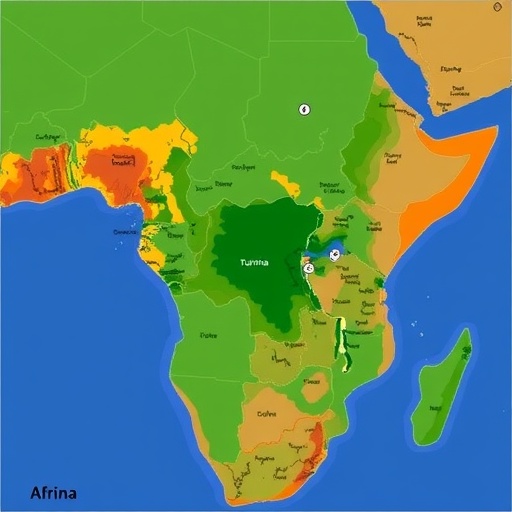
In a groundbreaking study published in Nature Communications, a team of geoscientists has unveiled new insights into the tectonic dynamics shaping one of Earth’s most intriguing geological features—the Turkana Rift Zone in Eastern Africa. This active rift zone, a critical segment of the broader East African Rift System, offers an exceptional window into the processes that precede continental breakup. The international research collaboration, led by Dr. Christopher M. Rowan and colleagues, reveals how the phenomenon known as ‘necking’ is actively sculpting the crust beneath the Turkana region, effectively priming eastern Africa for eventual division along tectonic lines.
The East African Rift System holds profound significance within the geosciences due to its role in continental rifting, a process by which a landmass extends and ultimately fractures, leading to the formation of new ocean basins. The Turkana Rift Zone is particularly enigmatic because it represents a nascent stage of rifting, where the crust begins to thin and deform but has yet to break apart completely. Understanding the mechanisms governing this stage is crucial for broader insights into tectonic evolution and earthquake hazard assessment in this densely populated region.
Rowan et al.’s research focuses on the structural evolution within the Turkana Rift Zone, especially the localized deformation called necking, where the continental crust experiences pronounced thinning in an asymmetric and segmented manner. Their work combines high-resolution seismic imaging with geological data, unveiling a complex pattern of crustal deformation that challenges previously simplistic models of uniform crustal thinning. By integrating geophysical observations with tectonic modeling, the team illustrates how necking zones concentrate strain and create weaknesses that could serve as precursors to full-scale continental rupture.
The study’s data were acquired using state-of-the-art seismic arrays deployed across the Turkana region. These arrays detected variations in seismic wave velocities, which are sensitive to changes in crustal thickness and rock composition. Their readings highlight zones of extreme thinning, where the crust transitions from a typical continental thickness to nearly half that in certain segments. This spatial variability indicates that continental breakup does not proceed evenly but rather occurs in a punctuated fashion, with discrete zones of intense deformation forming the weak points in the lithosphere.
Crucially, the research illuminates how the necking phenomenon correlates with subsurface magmatic activity. Intrusions of magma, often concealed beneath kilometers of rock, appear to exacerbate crustal weakening by heating and fracturing the crustal rocks. This thermomechanical feedback loop plays a pivotal role in accelerating the rift’s evolution. Magmatic processes not only facilitate necking but also contribute to surface expressions such as faulting and earthquake swarms, phenomena frequently observed in the Turkana Rift Zone.
Another important highlight of the study is the characterization of asymmetric extensional strain within the rift. Rather than a symmetrical stretching of the crust on either side of the rift axis, Rowan and colleagues demonstrate that strain distribution is skewed, leading to one flank exhibiting more pronounced thinning and faulting. This asymmetry influences erosion patterns, sediment deposition, and the geomorphology of the rift valley, factors that significantly impact both the geological evolution of the area and its habitability.
The implications of this research extend far beyond academic curiosity. Eastern Africa’s evolving tectonic landscape lies beneath densely inhabited regions, where understanding the timing and nature of rifting processes can inform natural hazard preparedness. Earthquakes, volcanic eruptions, and ground subsidence are all potential outcomes of continued rifting and crustal deformation. By delineating the current state of crustal weakening and predicting likely zones of future rupture, the research aids regional risk mitigation efforts, contributing to disaster resilience for local populations.
Moreover, the insights gathered about the Turkana Rift have bearing on global geodynamic theories. Continental rifting is a fundamental tectonic process responsible for shaping Earth’s continents and ocean basins over geological time. Yet, many questions remain regarding the initial stages where continents transition from stable blocks to actively extending and fracturing plates. This study’s detailed characterization of necking advances the field by showcasing the heterogeneous and dynamic nature of early rifting, challenging linear or steady-state conceptualizations of continental breakup.
The study underscores the integrative power of combining geophysical, geological, and geochemical methods for deciphering complex tectonic phenomena. Rowan’s team leveraged seismic tomography alongside field geology and numerical modeling to produce a multidimensional perspective of rift zone evolution. This holistic approach serves as a blueprint for future investigations aimed at unraveling the intricacies of continental deformation across different rift systems worldwide, ranging from mature oceanic rifts to incipient continental splits.
Environmental and climatic consequences also follow from the tectonic processes observed in the Turkana Rift Zone. Rift basins act as traps for sediment and water, influencing local hydrology and biogeochemical cycles. As the crust stretches and subsides, the creation of deep basins can modify regional drainage patterns and ecosystem connectivity. Understanding the geological underpinnings of rift evolution, therefore, also contributes to earth system science fields by linking tectonics with surface processes and environmental change.
Interestingly, the researchers discuss parallels between the Turkana Rift Zone and other prominent rifts such as the Red Sea Rift and the Rio Grande Rift, noting that necking appears to be a common mechanical precursor to continental breakup in diverse tectonic settings. This comparative analysis posits that despite varying tectono-magmatic environments, necking-induced crustal thinning is a fundamental mechanism governing early rift development worldwide. This universality enhances the predictive power of geodynamic models and potentially refines exploration strategies for natural resources often associated with rift settings.
Looking forward, the team highlights the importance of continuous monitoring and advanced seismic imaging to track the temporal evolution of necking zones. The temporal resolution provided by repeated seismic surveys would allow scientists to observe the progression of crustal thinning and magmatic intrusions in near-real time, improving forecasts of tectonic activity and associated geohazards. Furthermore, expanding the geographic scope of such studies to under-investigated regions of the East African Rift could yield a comprehensive framework describing rift evolution on a continental scale.
This pioneering research also carries implications in the context of plate tectonics theory as a whole. The observation that continental breakup may be governed by localized necking and asymmetric strain challenges traditional conceptions of tectonic plates as rigid blocks with uniform boundaries. Instead, the lithosphere appears to behave more dynamically, with zones of weakness and deformation evolving heterogeneously over time. Such findings invite a reevaluation of how tectonic forces distribute stresses within continental interiors and drive geological evolution.
In conclusion, the study by Rowan et al. marks a significant leap forward in our understanding of rift tectonics and continental breakup. By revealing the nuanced and multifaceted processes of necking in the Turkana Rift Zone, the research opens avenues for improved geohazard assessment, refined geological models, and a deeper appreciation of Earth’s dynamic crust. As Eastern Africa stands on the geological cusp of continental transformation, studies like this illuminate not only the forces of nature at play but also the interplay between Earth’s interior dynamics and surface environments shaping humanity’s planet.
Cite Scienmag News
Violet Maxwell. (April 23, 2026). Active Turkana Rift: Eastern Africa’s Continental Breakup Prep. Scienmag. https://scienmag.com/active-turkana-rift-eastern-africas-continental-breakup-prep/
Violet Maxwell. "Active Turkana Rift: Eastern Africa’s Continental Breakup Prep." Scienmag, 23 April 2026, https://scienmag.com/active-turkana-rift-eastern-africas-continental-breakup-prep/. Accessed 3 September 2026.
Violet Maxwell. "Active Turkana Rift: Eastern Africa’s Continental Breakup Prep." Scienmag. April 23, 2026. https://scienmag.com/active-turkana-rift-eastern-africas-continental-breakup-prep/


