


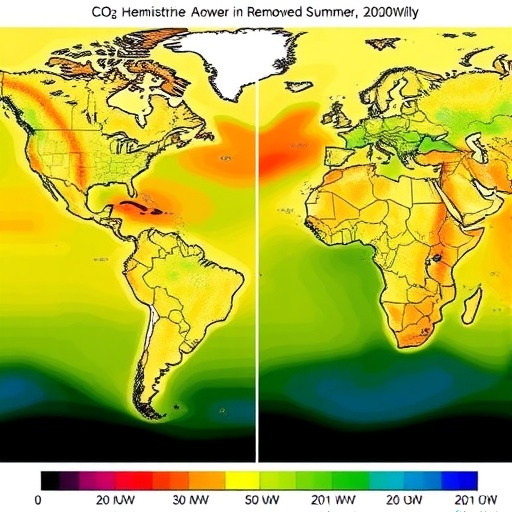
In an era defined by a shifting climate paradigm, understanding the nuanced impacts of carbon dioxide (CO2) removal on Earth’s seasonal rhythms has become paramount. A groundbreaking study by Park, BJ., Min, SK., An, SI., and colleagues, recently published in Communications Earth & Environment (2026), sheds new light on an area previously underexplored: the hemispheric contrasts in summer season duration as a response to CO2 removal efforts. This research not only challenges conventional assumptions about climate mitigation impacts but also suggests complex, differential responses in the Northern and Southern Hemispheres, potentially reshaping global ecological and atmospheric dynamics.
The central premise of this study revolves around the temporal modulation of summer—the warmest and typically most ecologically vibrant season—under scenarios where atmospheric CO2 concentrations are deliberately reduced. CO2 removal, a critical component of climate intervention strategies, is often promoted as a pathway to stabilize global temperatures and reverse some of the deleterious effects of anthropogenic emissions. However, the researchers emphasize that the climatic and ecological outcomes of such interventions are not monolithic but are instead subject to significant spatial variability.
Using advanced Earth system modeling techniques, the authors simulated scenarios involving rapid CO2 drawdown and examined subsequent seasonal length responses over multiple decades. These models integrate atmospheric, oceanic, and land surface processes with unprecedented granularity, allowing the team to dissect hemispheric differences in summer duration changes with precision. The results unveiled a striking dichotomy: while the Northern Hemisphere exhibited a pronounced extension of summer length, the Southern Hemisphere paradoxically experienced a contraction in summer duration upon CO2 removal.
This hemispheric contrast, according to the authors, arises from fundamental differences in latitudinal solar radiation receipt, land-ocean distribution, and feedback mechanisms inherent to each hemisphere’s climate system. The Northern Hemisphere’s greater landmass proportion amplifies surface warming feedbacks that extend the summer season, whereas the Southern Hemisphere’s ocean-dominated geography and associated thermal inertia temper these effects, leading to a shortened summer under similar atmospheric conditions. These findings underscore the complexity of climate system responses and caution against a one-size-fits-all perspective on CO2 mitigation impacts.
Delving deeper into the mechanisms, the study highlights alterations in atmospheric circulation patterns, specifically the jet streams and monsoon systems, as critical drivers of seasonal duration change. In the Northern Hemisphere, CO2 removal enhances radiative cooling but simultaneously strengthens certain atmospheric circulation components that favor prolonged warm spells. Conversely, changes in the Southern Hemisphere’s circumpolar vortex and associated oceanic currents contribute to a hastening of seasonal transitions, culminating in briefer summers.
Moreover, the researchers interrogated the role of cryospheric changes, acknowledging that retreating Arctic ice cover under initial warming phases extends northern summer characteristics, but the reverse dynamic unfolds as CO2 levels decline. This complex interplay of ice-albedo feedbacks and temperature gradients illustrates the intricacy of seasonal shifts beyond mere temperature metrics, encompassing albedo changes, soil moisture regimes, and vegetation dynamics that collectively redefine seasonal nomenclature in a changing climate.
The ecological implications of differing summer lengths are profound. Extended Northern Hemisphere summers may exacerbate heat stress on terrestrial and aquatic ecosystems, disrupt phenological cycles, and amplify wildfire risks. Meanwhile, the shrinkage of Southern Hemisphere summers could compress growing seasons, alter migratory patterns, and impact biodiversity hotspots that rely on predictable seasonal cues. The study thus calls for an ecosystem-level reassessment of climate intervention strategies, integrating biotic responses into mitigation planning.
An additional layer of complexity arises when considering regional disparities within each hemisphere. The researchers find that mid-latitude areas particularly showcase dramatic summer duration shifts, hinting at heightened vulnerability in populous and agriculturally significant zones. This granularity underscores the policy relevance of the study, as it equips decision-makers with detailed forecasts necessary for adaptive resource management and anticipatory societal planning.
On an atmospheric chemistry front, the study also explores how CO2 removal-induced changes in summer length modulate surface ozone formation, with potential repercussions for air quality and human health. Longer Northern Hemisphere summers may exacerbate ozone pollution episodes through enhanced photochemical activity, while shorter Southern Hemisphere summers could reduce such events, illustrating an unanticipated heterogeneity in air quality outcomes linked to climate intervention.
Modeling uncertainties and limitations are addressed candidly in the paper. The authors acknowledge the challenges in simulating coupled ocean-atmosphere-cryosphere interactions under unprecedented removal scenarios but emphasize that converging evidence from multiple models strengthens confidence in the observed hemispheric contrast phenomenon. They advocate for further observational campaigns and integration of remote sensing data to validate and refine projections.
The findings carry significant weight for global climate policy frameworks. Carbon dioxide removal is often framed as a scalable solution to climate change; however, this study prompts a re-evaluation of mitigation targets and timings to account for spatially differentiated environmental consequences. A nuanced approach balancing CO2 removal with adaptation measures tailored to hemispheric and regional realities emerges as indispensable for holistic climate responsiveness.
In conclusion, Park and colleagues’ pioneering work advances understanding of how intentional atmospheric CO2 reductions influence the very fabric of Earth’s seasonal cycles. By uncovering stark hemispheric differences in summer duration responses, the study not only enriches fundamental climate science but also signals caution for geoengineering optimism. It underscores the imperative of considering planetary-scale complexity and cross-disciplinary integration in designing climate intervention strategies capable of sustaining both human and ecological health.
As the climate discourse increasingly embraces proactive carbon management, this research serves as an incisive reminder of the interconnectedness and variability inherent in Earth’s system. The pursuit of net-zero emissions and beyond must be informed by studies such as this, which reveal that the path to planetary equilibrium is neither linear nor uniform. Policymakers, scientists, and stakeholders alike must grapple with these revelations to foster resilient futures amidst a dynamically changing climate mosaic.
Ultimately, navigating the challenges posed by summer season duration alterations linked to CO2 removal will require sustained collaborative efforts that span atmospheric science, ecology, socioeconomics, and technology innovation. The work of Park et al. opens an essential dialogue, stimulating further inquiry into the delicate seasonal dance choreographed by humanity’s carbon footprint and its ambitious reversal endeavors.
Cite Scienmag News
Violet Maxwell. (April 23, 2026). Hemispheric Differences in CO2 Removal Duration Summer. Scienmag. https://scienmag.com/hemispheric-differences-in-co2-removal-duration-summer/
Violet Maxwell. "Hemispheric Differences in CO2 Removal Duration Summer." Scienmag, 23 April 2026, https://scienmag.com/hemispheric-differences-in-co2-removal-duration-summer/. Accessed 4 September 2026.
Violet Maxwell. "Hemispheric Differences in CO2 Removal Duration Summer." Scienmag. April 23, 2026. https://scienmag.com/hemispheric-differences-in-co2-removal-duration-summer/


