


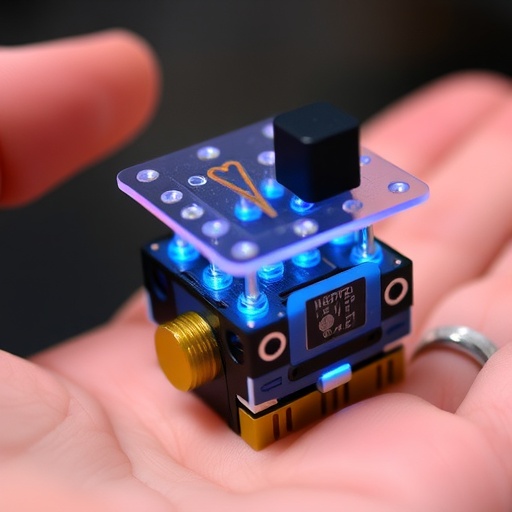
In a groundbreaking development that bridges neuroscience and advanced electronics, researchers have introduced a three-dimensional (3D) micro-instrumented neural network device that ushers in a new era for brain-inspired computing and the study of neural phenomena. The device represents an intricate integration of a 3D flexible electronic sensor and stimulator array with a 3D cultured neural network, achieving stable multi-plane electrophysiological monitoring and stimulation deep within neural tissue models. This unprecedented capability marks a substantial technological leap forward in our ability to emulate, observe, and manipulate neural network behaviors in a controlled, long-term environment.
Historically, the challenge of interfacing with neural tissues, particularly those organized in complex three-dimensional architectures akin to the brain, has limited progress in both the understanding and technological harnessing of neural computation. Conventional two-dimensional culture systems and planar electrode arrays fail to capture the intricate spatial connectivity and dynamics inherent in real neural networks. This new device surmounts those limitations by embedding flexible electronic arrays directly into a 3D engineered neural matrix, thereby achieving stable electrical interfacing across multiple depths and dimensions.
The device’s architecture centers around a 3D flexible electronic sensor and stimulator array that can be precisely embedded within a cultured neural network grown in vitro. This physical integration allows continuous, simultaneous recording of neural action potentials across multiple planes of the 3D culture. Such multi-depth monitoring is essential for decoding the evolving connectivity landscape that defines neural network development and functional plasticity. The system’s design ensures biocompatibility and minimal mechanical mismatch with the tissue, preserving the network’s viability and electrophysiological integrity for upwards of six months — a remarkable longevity that enables chronic studies rarely feasible before.
Beyond passive recording, the device incorporates electrical stimulation capabilities that enable researchers to actively modulate and train the neural networks housed within the 3D matrix. By delivering precisely timed electrical impulses, the system can induce synaptic plasticity, strengthening or weakening neural connections. This feature transforms the device from a mere observation tool into a platform for probing learning and memory-like processes in artificial networks, allowing researchers to tune connectivity strengths systematically. Such adaptive changes simulate neurobiological mechanisms and position the engineered network as a reservoir computing system, capable of performing complex biocomputational tasks.
This chronic stimulation and recording potential offers new vistas for drug discovery and pharmacological testing. Researchers can apply pharmacological agents to the cultured networks and directly observe network responses over time in a physiologically relevant 3D context. The detailed connectivity maps and functional readouts enable quantitative assessment of how drugs affect neural firing patterns, synaptic connectivity, and network-level dynamics, thus providing a powerful tool for neuropharmacology and toxicology.
The implications of stable, integrated 3D neural network-electronics devices extend well beyond neural engineering. They provide a versatile platform to study the intricate principles underlying brain-inspired computing algorithms. By mimicking the multiscale electrical activity and synaptic adaptation of biological networks, these devices can inform the design of next-generation neuromorphic hardware that outperforms conventional architectures in energy efficiency and parallel information processing.
Technically, the fabrication of the flexible electronic arrays leveraged cutting-edge microfabrication techniques that produce ultrathin, biocompatible meshes capable of conforming to the 3D contours of the cultured networks. These flexible electronics maintain conductivity and function despite tissue movements and growth dynamics. This approach is a marked departure from rigid electrode arrays, which often cause tissue damage and signal degradation over time. The incorporation of micro-scale stimulators within the flexible mesh further enhances control over localized network modulation.
Long-term stability is critical, and the researchers validated the device’s performance over months, demonstrating consistent action potential recordings across depths without signal loss or tissue deterioration. Such chronic stability is essential for studying phenomena like synaptic pruning, network maturation, and plasticity that unfold over extended timeframes. The ability to observe temporal evolution at the microscale within a 3D network opens unprecedented avenues for neuroscience research.
Furthermore, the system’s design supports scalability and customization. Researchers can cultivate neural networks of varying complexity and composition—incorporating different neuronal subtypes or glial components—and embed sensors tailored to specific spatial configurations. This customizable framework broadens applicability across diverse neuroscience domains, including disease modeling, where pathological network alterations can be examined in a 3D context resembling in vivo conditions more closely than any previous model.
At its core, this device epitomizes a convergence of bioengineering, microelectronics, and neuroscience. It represents a shift in strategy from conventional ex vivo brain tissue studies and 2D cultures to dynamic, integrated 3D biohybrids capable of bidirectional electrical interfacing. Such systems serve as experimental testbeds for both fundamental neurobiological mechanisms and the development of innovative computing paradigms inspired by the brain’s architecture and adaptive capacity.
The demonstrated chronic training capability highlights how electrical stimulation can reinforce neural connectivity patterns, effectively “programming” the network via biologically plausible mechanisms. This neural training exploits principles akin to Hebbian learning, providing a living substrate for adaptive computational networks. By tuning the reservoir’s dynamics, the system can potentially perform tasks such as pattern recognition, signal classification, and temporal processing—a tantalizing prospect for future biocomputing platforms.
This research also opens avenues for studying neurodegenerative disorders and developmental abnormalities within an accessible, manipulable 3D neural substrate. By inducing disease-like perturbations in cultured networks and tracking network degradation or compensatory remodeling with embedded sensors, researchers gain mechanistic insights that are difficult to obtain in vivo due to ethical and technical constraints.
Moreover, the integration of flexible microelectronics into 3D cultured tissues may inspire novel medical devices for brain-machine interfaces and neuromodulation therapies. Devices capable of long-term stable interfacing with complex neural architectures could revolutionize treatment strategies for neurological disorders by enabling precise, localized stimulation and high-fidelity neural signal acquisition.
The commercial and translational potential of this technology is immense. With the capacity to screen neural responses at multi-plane resolution over prolonged timeframes, pharmaceutical companies and academic institutions alike may accelerate drug development pipelines, significantly reducing costs and improving efficacy through more physiologically relevant testing platforms.
Critically, the manufacturability of these devices, given reliance on existing microfabrication infrastructures, suggests routine production scalability and integration with current lab workflows. As fabrication methods mature, the cost and accessibility of such biohybrid platforms will likely drop, democratizing access to cutting-edge neuroscience tools globally.
In sum, this three-dimensional micro-instrumented neural network device embodies a transformative advance in the creation and monitoring of complex cultured neural systems. By fusing state-of-the-art flexible electronics with bioengineered neural circuits, the device transcends prior limitations of spatial resolution, longevity, and control, enabling detailed exploration of brain-inspired principles and fostering novel biocomputing architectures. The scientific community stands on the cusp of a new frontier where living neural networks can be precisely interrogated, trained, and harnessed for breakthroughs in neuroscience, artificial intelligence, and therapeutic innovation.
Cite Scienmag News
Cassandra Pierce. (April 23, 2026). 3D Micro-Instrumented Device Enhances Neural Network Research. Scienmag. https://scienmag.com/3d-micro-instrumented-device-enhances-neural-network-research/
Cassandra Pierce. "3D Micro-Instrumented Device Enhances Neural Network Research." Scienmag, 23 April 2026, https://scienmag.com/3d-micro-instrumented-device-enhances-neural-network-research/. Accessed 3 September 2026.
Cassandra Pierce. "3D Micro-Instrumented Device Enhances Neural Network Research." Scienmag. April 23, 2026. https://scienmag.com/3d-micro-instrumented-device-enhances-neural-network-research/


