


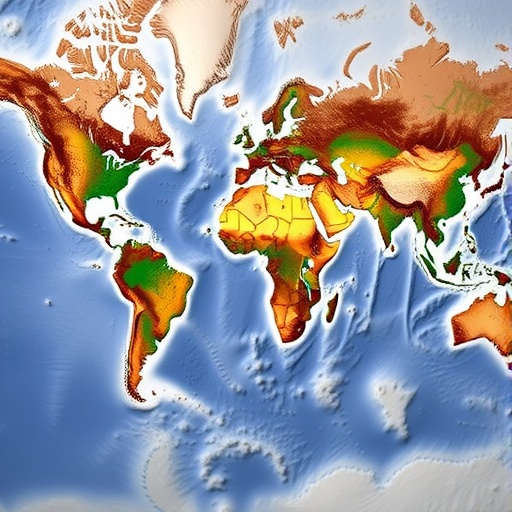
In an era marked by escalating climate concerns, the scourge of desertification and the fate of carbon sequestered within arid soils have attained paramount scientific interest. The groundbreaking study conducted by Wang, Maestre, Lu, and colleagues offers an unprecedented glimpse into the persistence and turnover of soil organic carbon (SOC) in global drylands, illuminating a critical yet poorly understood component of the terrestrial carbon cycle. Published in Nature Communications, this research not only advances our comprehension of carbon dynamics in some of the planet’s most vulnerable ecosystems but also holds significant implications for climate change mitigation strategies.
Drylands, encompassing roughly 41% of Earth’s terrestrial surface and home to nearly 40% of the human population, have long been viewed through the lens of ecological fragility and degradation. Yet the soil beneath these landscapes serves as a vast reservoir of organic carbon, a subtle but potent shield against atmospheric carbon dioxide accumulation. Understanding how this carbon persists or is turned over could redefine how we approach carbon budget estimations on a global scale. The study’s multidisciplinary team applied a combination of advanced isotopic tracing, meta-analysis of global datasets, and modeling techniques to capture the nuanced behavior of SOC in these ecosystems.
One of the study’s paramount revelations lies in the complex interplay between environmental factors and SOC stability. Contrary to the simplistic assumption that arid environments universally exhibit low SOC persistence due to microbial activity and harsh climatic conditions, the researchers identified heterogeneity in carbon turnover rates tied to soil texture, mineralogy, and climate variables. For instance, soils with finer particles and higher clay content demonstrated enhanced carbon protection mechanisms, suggesting that physical stabilization is critical under dryland contexts. This nuanced understanding challenges prevailing models that typically treat dryland soils as uniform carbon sinks or sources.
Furthermore, the investigation unveils that microbial communities in drylands play a dualistic role in SOC dynamics. These microorganisms, though often limited by moisture availability, orchestrate pivotal biochemical pathways governing carbon mineralization and stabilization. The researchers utilized isotopic signature analyses to trace carbon fluxes at the microbial scale, revealing that dormancy phases punctuated by episodic rainfall events drive a pulsed pattern of carbon turnover. This episodic nature has profound consequences on predicting carbon emissions during drought and precipitation cycles, underscoring the need for temporally resolved ecological models.
The persistence of soil organic carbon is also intricately linked to the chemical nature of the carbon compounds themselves. The study’s molecular analyses discerned distinct classes of organic molecules with varying resistance to decomposition. Lignin-derived compounds, often associated with woody plant residues, exhibited greater persistence compared to labile carbohydrates. This compositional insight advances the argument that vegetation shifts—induced by climate change or land use—could fundamentally alter SOC pools’ longevity by changing input quality and quantity.
Diving deeper, the team incorporated a meta-analytic approach, synthesizing data from dozens of dryland sites across continents. This global perspective allowed for the identification of broad biogeographic patterns. For example, SOC turnover rates were generally slower in cold desert regions compared to hot deserts, suggesting temperature as a dominant but not exclusive regulator. Moreover, the spatial heterogeneity within drylands calls for localized management practices to harness soil carbon sequestration effectively, moving beyond one-size-fits-all conservation frameworks.
From a methodological vantage point, this research embodies the cutting edge through its integration of machine learning algorithms with empirical field data. By coupling remote sensing datasets with ground-truth measurements, the researchers were able to upscale their findings and generate predictive maps detailing SOC stability hotspots worldwide. Such predictive capacity is indispensable for policymakers aiming to prioritize areas for conservation or restoration in the context of global carbon management.
Equally compelling is the study’s exploration of anthropogenic impacts on SOC dynamics. Land use changes—ranging from agriculture expansion to urban development—exert disruptive forces on soil structure and organic matter content. The authors argue that interventions promoting sustainable land management, such as reduced tillage and organic amendments, can enhance SOC persistence in drylands. Their model projections reveal that such practices, if widely adopted, could offset a substantial portion of carbon emissions originating from land degradation in these biomes.
The implications of this research extend beyond academic curiosity, intersecting with international climate frameworks such as the United Nations’ REDD+ initiatives and the Paris Agreement. By elucidating drylands’ capacity to act as carbon sinks, the study challenges the carbon accounting paradigms that currently undervalue these regions. Integration of dryland SOC dynamics into national greenhouse gas inventories could unlock new incentives for conserving these fragile ecosystems while advancing climate mitigation targets.
Critically, the insights gained underscore the urgency of integrating ecological function with socio-economic considerations within dryland management. These regions often support marginalized communities reliant on fragile natural resources. Sustainable practices that bolster soil carbon could concurrently enhance soil fertility and water retention, providing co-benefits for local livelihoods and ecosystem resilience. Therefore, adaptive governance structures embracing interdisciplinary research like this study are essential for translating scientific findings into real-world sustainability outcomes.
The novelty of Wang et al.’s study also lies in its temporal scale, addressing SOC turnover over decades rather than fleeting seasonal cycles. This long-term perspective is essential because soil carbon dynamics drive feedback loops influencing climate regulation over extended periods. By constructing robust chronosequences and employing radiocarbon dating techniques, the authors provide a temporal narrative of carbon persistence rarely afforded in dryland studies before. Such temporal depth enriches climate models seeking to forecast future carbon trajectories under various environmental scenarios.
However, challenges remain in disentangling the multiplicity of factors influencing SOC dynamics in drylands. The inherent variability and data scarcity in some regions limit the universal application of findings. The study acknowledges these gaps, advocating for expanded monitoring networks and interdisciplinary collaboration to refine our mechanistic understanding. Particularly, integrating hydrological processes and plant-soil-microbe feedbacks emerges as a frontier for subsequent research endeavors.
In conclusion, this seminal work redefines our understanding of soil organic carbon persistence and turnover across the world’s drylands. By unraveling the multifaceted controls spanning physical, chemical, biological, and anthropogenic dimensions, Wang and colleagues pave the way for more accurate carbon budgeting and ecosystem management. Their findings emphasize drylands’ potential as pivotal components in mitigating climate change, provided that tailored, science-driven land stewardship is embraced. As climate challenges intensify, embracing the complexity and resilience embedded within dryland soils could prove transformative for planetary health.
Cite Scienmag News
Violet Maxwell. (April 23, 2026). Soil Carbon Dynamics in Global Drylands Revealed. Scienmag. https://scienmag.com/soil-carbon-dynamics-in-global-drylands-revealed/
Violet Maxwell. "Soil Carbon Dynamics in Global Drylands Revealed." Scienmag, 23 April 2026, https://scienmag.com/soil-carbon-dynamics-in-global-drylands-revealed/. Accessed 4 September 2026.
Violet Maxwell. "Soil Carbon Dynamics in Global Drylands Revealed." Scienmag. April 23, 2026. https://scienmag.com/soil-carbon-dynamics-in-global-drylands-revealed/


