


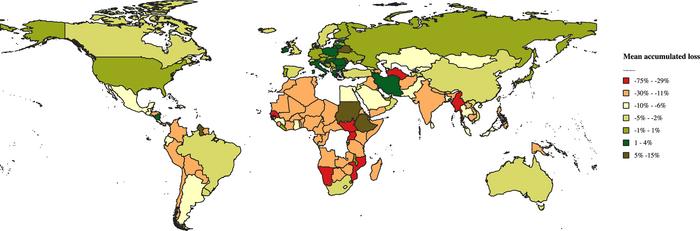
The COVID-19 pandemic significantly widened existing economic and health disparities between wealthy and low-income countries and slowed progress toward health-related Sustainable Development Goals (SDGs), according to a new study published July 24, 2024, in the open-access journal PLOS ONE by Wanessa Miranda of Federal University of Minas Gerais, Brazil, and colleagues.

Credit: Silveira et al., 2024, PLOS ONE, CC-BY 4.0 (
The COVID-19 pandemic significantly widened existing economic and health disparities between wealthy and low-income countries and slowed progress toward health-related Sustainable Development Goals (SDGs), according to a new study published July 24, 2024, in the open-access journal PLOS ONE by Wanessa Miranda of Federal University of Minas Gerais, Brazil, and colleagues.
The global SDGs were established in 2015 as a wide and integrated agenda with themes ranging from eradicating poverty and promoting well-being to addressing socioeconomic inequalities. However, the COVID-19 pandemic is known to have delivered a devastating blow to global health, with large economic repercussions.
The new study investigated the potential impact of these economic disruptions on progress toward health-related SDGs. The research team used data from the official United Nations SDG database and analyzed the associations between well-being, income levels, and other key socioeconomic health determinants. A yearly model was extrapolated to predict trends between 2020 and 2030 using a baseline projection as well as a post-COVID-19 scenario.
The study estimated average economic growth losses in the wake of the COVID-19 pandemic as 42% and 28% for low and lower middle-income countries and 15% and 7% in high- and upper middle-income countries. These economic disparities are projected to drive global health inequalities in the themes of infectious disease, injuries and violence, maternal and reproductive health, health systems coverage and neonatal and infant health. Overall, low-income countries can expect an average progress loss of 16.5% across all health indicators, whereas high-income countries can expect losses as low as 3%. Individual countries, such as Turkmenistan and Myanmar, have estimated a loss of progress which is as much as nine times worse than the average loss of 8%. The most significant losses are seen in Africa, the Middle East, Southern Asia, and Latin America.
The authors conclude that the impact of the pandemic has been highly uneven across global economies and led to heightened inequalities globally, particularly impacting the health-related targets of the 2030 SDG Agenda.
The authors add: “The COVID-19 pandemic significantly widened existing economic and health disparities between wealthy and low-income countries and slowed progress toward health-related Sustainable Development Goals (SDGs). Overall, low-income countries can expect an average progress loss of 16.5% across all health indicators, whereas high-income countries can expect losses as low as 3%.”
#####
In your coverage please use this URL to provide access to the freely available article in PLOS ONE:
Citation: Silveira F, Miranda W, Sousa RPd (2024) Post-COVID-19 health inequalities: Estimates of the potential loss in the evolution of the health-related SDGs indicators. PLoS ONE 19(7): e0305955.
Author Countries: Brazil
Funding: The authors received no specific funding for this work. The funders had no role in study design, data collection and analysis, decision to publish, or preparation of the manuscript.
Journal
PLoS ONE
Method of Research
Computational simulation/modeling
Subject of Research
Not applicable
Article Title
Post-COVID-19 health inequalities: Estimates of the potential loss in the evolution of the health-related SDGs indicators
Article Publication Date
24-Jul-2024
COI Statement
The authors have declared that no competing interests exist.
Cite Scienmag News
Kristina Jarvis. (July 24, 2024). The COVID-19 pandemic slowed progress towards health-related Sustainable Development Goals and increased inequalities. Scienmag. https://scienmag.com/the-covid-19-pandemic-slowed-progress-towards-health-related-sustainable-development-goals-and-increased-inequalities/
Kristina Jarvis. "The COVID-19 pandemic slowed progress towards health-related Sustainable Development Goals and increased inequalities." Scienmag, 24 July 2024, https://scienmag.com/the-covid-19-pandemic-slowed-progress-towards-health-related-sustainable-development-goals-and-increased-inequalities/. Accessed 3 September 2026.
Kristina Jarvis. "The COVID-19 pandemic slowed progress towards health-related Sustainable Development Goals and increased inequalities." Scienmag. July 24, 2024. https://scienmag.com/the-covid-19-pandemic-slowed-progress-towards-health-related-sustainable-development-goals-and-increased-inequalities/

