


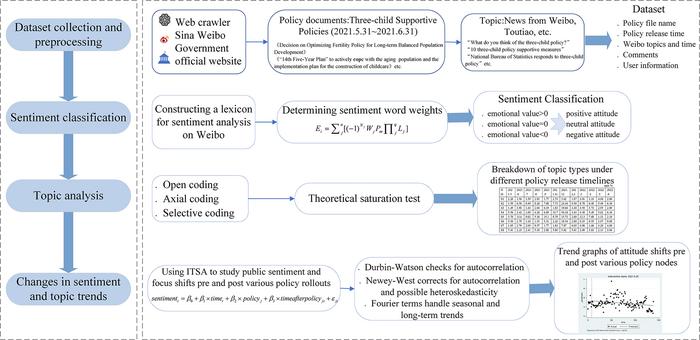
An analysis of comments on Chinese social media platform Sina Weibo reveals trends in the public response to measures implemented to support China’s three-child policy, highlighting concerns about women’s rights and employment. Lijuan Peng of Zhejiang Gongshang University in Hangzhou, China, and colleagues present these findings in the open-access journal PLOS ONE on July 24, 2024.

Credit: Peng et al., 2024, PLOS ONE, CC-BY 4.0 (
An analysis of comments on Chinese social media platform Sina Weibo reveals trends in the public response to measures implemented to support China’s three-child policy, highlighting concerns about women’s rights and employment. Lijuan Peng of Zhejiang Gongshang University in Hangzhou, China, and colleagues present these findings in the open-access journal PLOS ONE on July 24, 2024.
For decades, China’s one-child policy restricted most families to having just one child. In 2021, to combat a falling birthrate, China introduced its three-child policy, allowing couples to have up to three children. To help encourage childbirth, China has introduced supportive measures alongside, such as housing subsidies and maternity insurance.
Social media offers a unique window into the public response to new national policies, but few studies have analyzed the three-child policy through such a lens. To deepen understanding of the response to China’s three-child supportive measures, Peng and colleagues analyzed comments posted on Sina Weibo after the release of information about such measures between May 2021 and June 2022. They drew on various statistical and computational tools, including neural network analysis, to identify hot topics and areas of concern.
The analysis revealed short-term, positive attitudes among Weibo users in response to some supportive measures, including those relating to housing subsidies, maternity insurance, and financial incentives. However, users showed persistent negative responses to extensions of maternity leave, primarily due to concerns about women’s future employment opportunities and marital rights.
The researchers found that Sina Weibo discussions about the three-child policy were primarily centered around protection of women’s rights, including post-childbirth legal rights and access to adequate physical and mental healthcare. Other hot topics included the financial difficulty of raising multiple children and concerns about housing and childcare services. The study also highlighted a strong desire for children among many infertile or single women that has gone unfulfilled because of the limitations of the personal medical insurance system.
These findings could help inform China’s future efforts to raise birthrates. Meanwhile, further research could address some of the limitations of this analysis, such as by accounting for social media users’ demographics.
The authors add: “This study reveals the public’s evolving focus, cognition, and emotional response to the three-child supportive policy through Weibo analysis, providing insights for future policy releases.”
#####
In your coverage please use this URL to provide access to the freely available article in PLOS ONE:
Citation: Peng L, Chen T, Yang J, Cong G (2024) Changes in online public opinions associated with various three-child supportive policies in China: Observational study using social media data over time. PLoS ONE 19(7): e0306698.
Author Countries: China, USA
Funding: This research is supported by Zhejiang Provincial Natural Science Foundation of China (Grant No. LY22G010004), as well as Zhejiang Gongshang University “digital +” discipline construction key project (Grant No. SZJ2022B019). In addition, the funders had no role in study design, data collection and analysis, decision to publish, or preparation of the manuscript.
Journal
PLoS ONE
Method of Research
Observational study
Subject of Research
People
Article Title
Changes in online public opinions associated with various three-child supportive policies in China: Observational study using social media data over time
Article Publication Date
24-Jul-2024
COI Statement
NO authors have competing interests.
Cite Scienmag News
Courtney Benton. (July 24, 2024). Weibo posts illuminate public response to China’s three-child policy measures. Scienmag. https://scienmag.com/weibo-posts-illuminate-public-response-to-chinas-three-child-policy-measures/
Courtney Benton. "Weibo posts illuminate public response to China’s three-child policy measures." Scienmag, 24 July 2024, https://scienmag.com/weibo-posts-illuminate-public-response-to-chinas-three-child-policy-measures/. Accessed 3 September 2026.
Courtney Benton. "Weibo posts illuminate public response to China’s three-child policy measures." Scienmag. July 24, 2024. https://scienmag.com/weibo-posts-illuminate-public-response-to-chinas-three-child-policy-measures/

