


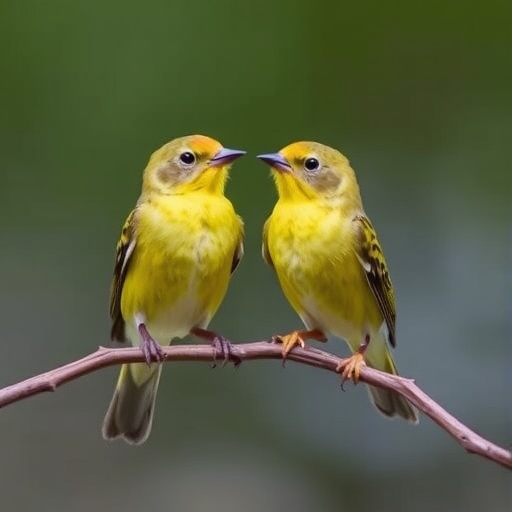
New research published in Nature Communications reveals a groundbreaking understanding of the evolutionary dynamics shaping the intricate relationships between adult sex ratios, mating behaviors, and parental investment in bird species. Rather than mating behaviors shaping population sex ratios, this comprehensive study finds that population demographics largely dictate these behavioral traits, fundamentally altering how we perceive the interplay of biology and social structures in avian populations.
An international consortium of researchers, combining expertise from the United Kingdom, China, Germany, and Hungary, conducted an extensive analysis across 261 bird species spanning 69 avian families. Utilizing advanced statistical modeling techniques, the team sought to untangle the complex associations among adult sex ratio (ASR) imbalances, reproductive strategies, parental roles, and survival differentials. The findings shed light on demographic processes as primary drivers behind sex ratio disparities, overturning traditional assumptions regarding causality in sex-biased behaviors.
The study highlights that bird hatchlings are typically produced in roughly equal male-to-female ratios; however, survival trajectories diverge notably before maturity due to differential mortality risks during juvenile and adult phases. In many species, one sex experiences higher mortality rates influenced by factors such as predation, disease susceptibility, or competition, culminating in skewed adult sex ratios. Crucially, these demographic factors—rather than behavioral adaptations—initiate sex ratio imbalances, dictating the subsequent evolution of mating systems and parental cooperation.
One compelling explanation for the prevalence of sex-based survival discrepancies lies in the distinct vulnerabilities inherent to each sex. For example, females often bear the burden of egg incubation, exposing them to heightened predator encounters, while some males display elaborate ornamentation to attract mates—attributes which themselves may increase predation risk. This delicate balance of costs contributes to differential mortality rates and hence influences adult sex ratios in varying species ecologies.
Professor Tamás Székely, a leading evolutionary biologist from the Milner Centre for Evolution, emphasizes that understanding whether mating systems drive sex ratio shifts or the converse has profound implications. “Our findings indicate a unidirectional evolutionary pathway where population demography dictates sex ratio, which subsequently influences sexual selection pressures, mating behavior, and parental role distribution,” he explains. This insight refines long-standing theoretical frameworks that sought to explain sex-role evolution and sexual dimorphism through mating behaviors alone.
Dr. Zitan Song of Nanjing Forestry University provides an innovative statistical perspective to this puzzle. By applying sophisticated causal inference methods, the researchers effectively disentangled the “chicken or egg” dilemma of sex ratio versus behavioral causality. Their models demonstrated convincingly that demographic forces precede and shape breeding behavior and parental investment patterns, rather than breeding behaviors perpetuating or exacerbating sex ratio biases.
Sex ratios profoundly impact reproductive strategies within populations. When one sex becomes numerically scarce, individuals of that sex typically adopt more promiscuous mating strategies, breeding with multiple partners to maximize reproductive success. Conversely, the more common sex often compensates by increasing parental care responsibilities. This shift in mating dynamics influences the division of labor within bird pairs and profoundly affects offspring survival rates and subsequent breeding success of the parents.
Another significant consequence of adult sex ratio variation is the intensification of sexual selection pressures on the more abundant sex. The researchers found that in male-biased populations, females tend to exhibit more pronounced competitive traits or physical ornamentation. Conversely, in female-biased populations, males often demonstrate the greater sexual dimorphism, with larger size and more elaborate displays—exemplified by species such as peafowl or the Great Bustard, where males are dramatically larger and more ornamented than females.
The Great Bustard (Otis tarda) serves as a fascinating case study illustrating these dynamics. This species exhibits delayed sexual maturity in males, reaching reproductive age around five years, compared to females who mature by three years. This difference further skews the adult population towards females, resulting in a heavily female-biased sex ratio of approximately 0.33 males to every female. The skew exacerbates sexual selection on males, who are roughly two and a half times larger than females and engage in polygamous mating systems, while females exclusively undertake incubation and parental care duties.
This research has broader implications for understanding evolutionary biology and population ecology. Sex ratio imbalances arising from demographic pressures can cascade into shaping mating systems, sexual dimorphism, and parental strategies over multiple generations. Increased mortality risks due to competition, infection, or predation can thus have profound multigenerational effects on species behavior and morphology, driving diversity in life-history strategies among bird populations.
The study leverages robust data analysis methodologies on extensive avian datasets, permitting the identification of demographic causes preceding behavioral responses. By rigorously quantifying the relationships linking sex-specific mortality, adult sex ratios, and mating system characteristics, the research advances our theoretical comprehension of population dynamics and evolutionary biology.
In conclusion, this pivotal research illuminates how adult sex ratios, primarily molded by demographic factors, actively shape the evolution of mating behaviors and parental roles within bird species. Recognizing the primacy of demographic influences offers new perspectives on sexual selection mechanisms, survival strategies, and ecological adaptations. Such insights underscore the intricate feedback between ecological constraints and social evolution in the natural world, advancing scientific understanding of biodiversity and species resilience.
News Publication Date: 6-Apr-2026
Web References:
https://www.nature.com/articles/s41467-026-71230-4
http://dx.doi.org/10.1038/s41467-026-71230-4
Cite Scienmag News
Drew Townsend. (April 22, 2026). Bird Behavior: Demographics Shape Promiscuity and Parenting, Not Vice Versa. Scienmag. https://scienmag.com/bird-behavior-demographics-shape-promiscuity-and-parenting-not-vice-versa/
Drew Townsend. "Bird Behavior: Demographics Shape Promiscuity and Parenting, Not Vice Versa." Scienmag, 22 April 2026, https://scienmag.com/bird-behavior-demographics-shape-promiscuity-and-parenting-not-vice-versa/. Accessed 3 September 2026.
Drew Townsend. "Bird Behavior: Demographics Shape Promiscuity and Parenting, Not Vice Versa." Scienmag. April 22, 2026. https://scienmag.com/bird-behavior-demographics-shape-promiscuity-and-parenting-not-vice-versa/


