


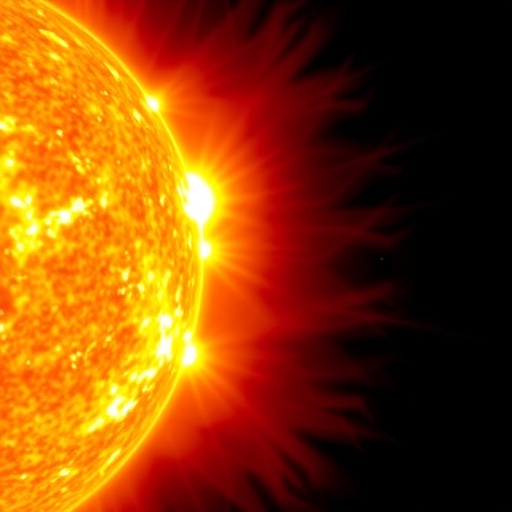
In a groundbreaking step toward understanding the Sun’s enigmatic atmosphere, scientists have harnessed advanced numerical simulations to unravel the complex formation and dynamic behavior of solar prominences. These colossal magnetic structures, towering thousands of kilometers above the solar surface, have long puzzled researchers due to their intricate interplay of plasma, magnetic fields, and radiation. Using the sophisticated MURaM code, a state-of-the-art radiative magnetohydrodynamic (MHD) solver, researchers have now decoded key processes shaping these features with unprecedented self-consistency.
The MURaM code stands as a pinnacle of computational astrophysics, uniquely designed to capture the physics spanning the solar photosphere, chromosphere, and corona in three dimensions. At its core, it solves the non-ideal MHD equations—conservation laws of mass, momentum, energy, and magnetic field evolution—within a Cartesian framework, integrating crucial effects such as gravity, resistive and radiative heating, Spitzer thermal conduction, and semi-relativistic corrections to circumvent stringent time-step constraints. This multiphysics approach is vital to replicate the harsh solar environment where magnetic forces and radiative processes dominate.
One of the key aspects of MURaM is its treatment of thermal conduction along magnetic field lines, modeled through an evolutionary Spitzer heat flux that incorporates saturation effects to prevent nonphysical overconduction at steep temperature gradients. The code also employs a hyperbolic divergence cleaning technique to enforce the divergence-free condition of magnetic fields, ensuring numerical stability. Notably, the Lorentz force—a crucial player governing magnetic pressure and tension—is carefully computed with a velocity-limiting factor to suppress artificially high Alfvén speeds that could bottleneck simulation time steps, utilizing a semi-relativistic approach adapted from Boris corrections.
To simulate the solar atmosphere with realism, MURaM leverages two versions: a coronal extension (MURaM-CE) that captures optically thin radiative losses and LTE radiation, and a chromospheric extension (MURaM-ChE) that adds non-LTE physics crucial in the chromosphere. The chromospheric mode integrates time-dependent hydrogen ionization, sophisticated radiative transfer with scattering, and detailed line emissions of elements such as hydrogen, magnesium, and calcium. These advances permit intricate modeling of radiative heating and cooling, including back-heating effects from extreme ultraviolet radiation, rendering a more nuanced simulation of chromospheric dynamics than ever before.
The simulations underpinning this study utilized 3D boxes spanning 80 Mm horizontally and up to 34 Mm vertically, capturing both the convection zone and atmospheric layers up to the corona. The grid resolution amounted to roughly 80 km horizontally and 50 km vertically, balancing physical fidelity and computational feasibility. Initial conditions were generated from evolved 2D simulations exhibiting dipped magnetic field structures, extended into three dimensions with stochastic perturbations to avoid artificial symmetries. These dipped magnetic arcades constitute the fundamental magnetic skeleton capable of supporting dense, cool prominence plasma against gravity.
Two primary simulation runs, distinct in magnetic field configurations and bottom boundary treatments, were explored alongside a sheared configuration derived from one of these runs. Run I features six narrow magnetic flux columns that create a nuanced multipolar structure, while Run II employs four wider flux columns resulting in stronger magnetic fields. These vertical flux concentrations were fixed deep in the convection zone to anchor the evolved field configurations, stabilizing the magnetic dips critical for prominence formation. The magnetic topology deliberately lacks an initial horizontal component, diverging from typical in-situ observed prominence fields but enabling controlled study of prominence onset and evolution.
Boundary conditions play a pivotal role in simulating solar physics accurately. The bottom boundary allowed open flows in Run I but suppressed flows within magnetic columns in Run II through asymmetric velocity constraints, reflecting different physical regimes below the photosphere. Horizontally periodic boundaries ensured seamless plasma dynamics, while an open, potential-field top boundary allowed outflows and realistic magnetic field extension into the corona. Notably, the sheared set-up implemented velocity drivers that imparted horizontal shear to the central magnetic flux regions, mimicking shear often inferred in solar active regions and allowing exploration of shear’s effects on prominence morphology.
The evolution from 2D snapshots to fully fledged 3D simulations was essential to capture realistic prominence dynamics. Randomized perturbations prevented artificial coherence, generating a three-dimensional dipped arcade resembling observed structures. Intriguingly, the sheared runs demonstrated how introducing horizontal velocity components selectively at the prominent magnetic columns induced localized shear that diminishes with height, closely replicating the naturally tapered shear profiles expected in the solar atmosphere. This nuanced shearing dynamics allowed the study of how realistic magnetic configurations influence prominence stability and evolution.
Magnetic field profiles extracted from the simulations reveal compelling insights. While the photospheric magnetic strength hits several hundred Gauss, the field in the prominence dips falls to tens of Gauss, matching observationally inferred strengths. The sheared configuration displayed a dominance of the horizontal field component aligned along the polarity inversion line, confirming that localized shear correlates with enhanced horizontal magnetic structuring. These findings bear directly on how magnetic support and confinement mechanisms operate in suspended prominence plasma and the balance of magnetic and plasma pressures.
Simulation physics included two treatments of the equation of state: a straightforward LTE model and a more sophisticated non-LTE approach that resolved hydrogen ionization and molecular hydrogen kinetics in time-dependent detail near the photosphere and chromosphere. The combined use of these EoS treatments enabled more accurate modeling of thermodynamics under varying optical depths and ionization states, critical for tracking prominence formation and thermal balance. The non-LTE runs also employed improved radiative loss functions that accounted for chromospheric line emission, vital for reproducing realistic energetics in the simulated prominence plasma.
These simulations mark a notable advance in prominence research by integrating multi-physics components into self-consistent, large-scale 3D models, bridging the photosphere-corona transition that is pivotal for understanding prominence mass loading and stability. They suggest that stable dipped magnetic configurations, seeded in subsurface flux bundles and evolving through naturally occurring flows and shear, can indeed support prominence plasma for extended periods. Furthermore, the sheared runs underscore the role of magnetic shear in shaping prominence geometry, offering fresh pathways to relate magnetic field measurements to prominence morphology.
Remarkably, the simulations handle extreme disparities in plasma parameter scales, such as transitioning from dense, cool chromospheric plasma to hot, tenuous coronal plasma, without resorting to non-physical approximations that could obscure essential dynamics. This is achieved through advanced numerical treatments like slope-limited diffusion, fourth-order hyperdiffusion, and careful energy equation partitioning to minimize numerical artifacts. The inclusion of resistive and viscous heating components emerging from numerical schemes ensures that dissipative energy conversions are physically meaningful within the simulated environment.
The computational demands of such simulations remain formidable. To balance this, initial prominence formation was modeled under LTE assumptions, speeding simulations, while the more computationally intensive NLTE runs were initiated from pre-formed prominence states. Future work aspires to push grid resolution beyond the current 50 km to better resolve fine-scale dynamics, turbulence, and instabilities within prominence plasma, which are essential for connecting simulation results with high-resolution solar observations.
This pioneering research synthesized complex physics, cutting-edge numerical methods, and advanced computational resources to create a comprehensive model for solar prominence formation and dynamics. The results open avenues for deeper investigation into solar activity phenomena, including prominence eruptions and their role in coronal mass ejections. They also lay foundations for improved understanding of magnetic energy storage and release in the solar corona, with direct relevance for space weather modeling and prediction.
By meticulously linking boundary conditions, magnetic field configurations, radiative transfer, and plasma thermodynamics, this work sets a new standard for self-consistent numerical simulations of solar prominences. Its clarity and detail provide researchers a robust platform to interrogate fundamental solar physics questions, ultimately advancing our mastery of Sun–Earth connections. As observational capabilities evolve, these simulation frameworks promise to be indispensable tools to interpret and predict solar behavior at multiple scales.
In sum, the merging of MURaM’s sophisticated code capabilities with a carefully crafted simulation setup has yielded transformative insights into the fundamental physics of solar prominences. The emergent magnetic dips and plasma condensations elucidated here offer a realistic path toward understanding one of solar physics’ enduring puzzles, propelling the field into a new era of modeling precision and physical fidelity.
Cite Scienmag News
Grant Pearson. (April 22, 2026). Self-Consistent Simulations Reveal Solar Prominence Dynamics. Scienmag. https://scienmag.com/self-consistent-simulations-reveal-solar-prominence-dynamics/
Grant Pearson. "Self-Consistent Simulations Reveal Solar Prominence Dynamics." Scienmag, 22 April 2026, https://scienmag.com/self-consistent-simulations-reveal-solar-prominence-dynamics/. Accessed 4 September 2026.
Grant Pearson. "Self-Consistent Simulations Reveal Solar Prominence Dynamics." Scienmag. April 22, 2026. https://scienmag.com/self-consistent-simulations-reveal-solar-prominence-dynamics/


