


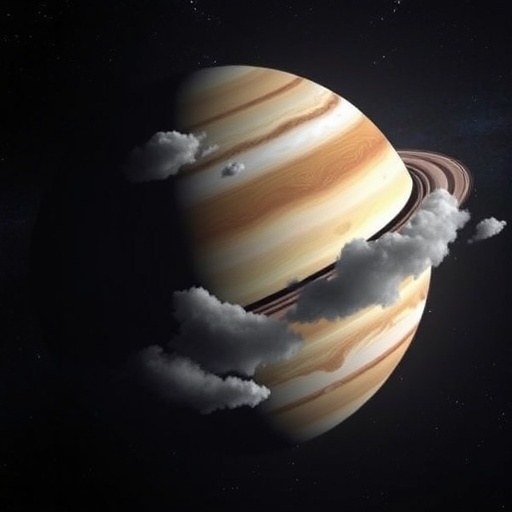
In a groundbreaking advance for exoplanet atmospheric studies, a team of astronomers led by Elisabeth Matthews at the Max Planck Institute for Astronomy (MPIA) has reported the first evidence of water-ice clouds on a distant Jupiter-like exoplanet named Epsilon Indi Ab. This pioneering research challenges existing atmospheric models that have so far overlooked the complexity introduced by clouds in gas giant exoplanets and paves a critical path toward the ultimate goal of detecting life on Earth-like planets beyond our Solar System.
The field of exoplanet research has evolved rapidly since the mid-1990s, initially focused on the detection of exoplanets through indirect methods, like transit photometry and radial velocity. Early observations revealed fundamental properties such as mass and radius but provided little insight into atmospheric composition or weather phenomena. The launch and operation of the James Webb Space Telescope (JWST) in 2022 initiated a transformative second phase, offering high-resolution spectroscopic capabilities that allow precise atmospheric characterization of numerous exoplanets. However, direct study of Jupiter analogs—gas giants with low atmospheric temperatures akin to those within our own Solar System—remained elusive due to observational constraints.
The study of Epsilon Indi Ab marks a significant departure from prior methods by exploiting the JWST’s mid-infrared instrument (MIRI) for direct imaging. This gas giant, orbiting the star Epsilon Indi A approximately 12 light years away in the southern constellation Indus, resides at a distance about four times that of Jupiter from our Sun. Its considerable mass, fixed at 7.6 times that of Jupiter, is offset by an unexpectedly similar radius, suggestive of dense, complex atmospheric layers that attenuate radius expansion despite the higher mass.
Epsilon Indi Ab’s relatively low equilibrium temperature, ranging between 200 and 300 Kelvin, is slightly warmer than Jupiter’s 140 Kelvin, primarily due to residual heat from its formation. Over geological timescales, the planet is expected to cool and eventually become colder than its solar counterpart. This thermal regime provides a unique laboratory to study atmospheric chemistry and dynamics in conditions markedly different from those of the typical hot Jupiters often discovered closer to their host stars.
To isolate the exoplanet’s faint infrared signatures from the overwhelming glare of its parent star, the research team utilized MIRI’s coronagraphic capability. This technology blocks starlight, enabling direct imaging in a narrow spectral window centered at 11.3 micrometers, near but distinct from the 10.6 micrometer emission feature of ammonia (NH3). By comparing these observations with earlier images captured in 2024 at the 10.6 micrometer wavelength, Matthews and colleagues derived the ammonia content in the planet’s atmosphere with unprecedented precision.
Unexpectedly, the photometric data revealed a lower-than-predicted abundance of ammonia gas. Instead, the best-fitting models indicate the presence of thick, patchy clouds composed of water ice in the upper atmosphere—analogous to the cirrus clouds observed high in Earth’s atmosphere. This finding is a critical deviation from traditional atmospheric models, which typically exclude clouds due to the complex and computationally expensive modeling required to simulate their formation, distribution, and radiative properties.
This discovery signals a pressing need for theorists to revise common atmospheric modeling approaches to incorporate clouds and their multifaceted roles. Co-author James Mang of the University of Texas at Austin remarked that such detections expose new layers of atmospheric complexity that were previously invisible, underscoring the enhanced sensitivity and capability of JWST to probe the weather patterns and structures of cold, distant worlds.
The study also heralds promising opportunities for upcoming observatories. NASA’s Nancy Grace Roman Space Telescope, planned for launch in the mid-2020s with participation from MPIA, will have the capability to directly detect reflected light from high-altitude water-ice clouds on similar exoplanets. This prospect opens a complementary avenue to infrared characterization, providing a multi-wavelength view crucial for comprehensive atmospheric modeling.
In parallel, Matthews and her team are pursuing additional JWST observation time to extend their survey to other cold Jupiter-like exoplanets. These efforts are not only crucial for understanding the diversity of gas giant atmospheres but also provide vital methodological stepping stones toward the more ambitious goal of characterizing Earth analogs. Such characterization is necessary for the long-sought detection of biosignatures—chemical markers that could signal the presence of life.
This research epitomizes the evolutionary trajectory of exoplanet atmospheric science, moving from mere detection to rich chemical, physical, and meteorological understanding. As Matthews noted, JWST affords astronomers an unprecedented opportunity to approach Jupiter-like planets as if they were looking back at our own Solar System from remote vantage points. Yet, replicating such scrutiny for smaller, terrestrial-type planets will demand still more advanced space telescopes.
As humanity edges closer to unveiling the detailed atmospheric structures of truly Earth-like worlds, the discovery of water-ice clouds on Epsilon Indi Ab marks a key milestone. It validates the efficacy of sophisticated direct imaging and spectral analysis techniques, highlights the limitations of earlier theoretical frameworks, and anticipates an era when the search for life beyond our planet moves from hopeful speculation to data-driven exploration.
The full results of this study have been published under the title “A second visit to Eps Ind Ab with JWST: new photometry confirms ammonia and suggests thick clouds in the exoplanet atmosphere of the closest super-Jupiter” in The Astrophysical Journal Letters. Researchers involved include Elisabeth Matthews and Bhavesh Rajpoot from MPIA, alongside James Mang and Caroline Morley from the University of Texas at Austin, and collaborators from the Space Telescope Science Institute.
This exciting work stands as a testament to the remarkable progress enabled by the James Webb Space Telescope and ongoing international collaboration, heralding a new era in our quest to understand the atmospheric complexities of planets beyond our own, and ultimately, to find life in the cosmos.
News Publication Date: 22-Apr-2026
References: E. C. Matthews et al., “A second visit to Eps Ind Ab with JWST: new photometry confirms ammonia and suggests thick clouds in the exoplanet atmosphere of the closest super-Jupiter,” The Astrophysical Journal Letters.
Keywords
Exoplanets, Epsilon Indi Ab, Jupiter analogs, water-ice clouds, ammonia, James Webb Space Telescope, mid-infrared imaging, coronagraphy, gas giants, planetary atmospheres, direct imaging, exoplanet clouds, next-generation telescopes
Cite Scienmag News
Grant Pearson. (April 22, 2026). Astronomers Discover Exo-Jupiter Exhibiting Cloudy Atmosphere. Scienmag. https://scienmag.com/astronomers-discover-exo-jupiter-exhibiting-cloudy-atmosphere/
Grant Pearson. "Astronomers Discover Exo-Jupiter Exhibiting Cloudy Atmosphere." Scienmag, 22 April 2026, https://scienmag.com/astronomers-discover-exo-jupiter-exhibiting-cloudy-atmosphere/. Accessed 3 September 2026.
Grant Pearson. "Astronomers Discover Exo-Jupiter Exhibiting Cloudy Atmosphere." Scienmag. April 22, 2026. https://scienmag.com/astronomers-discover-exo-jupiter-exhibiting-cloudy-atmosphere/


