


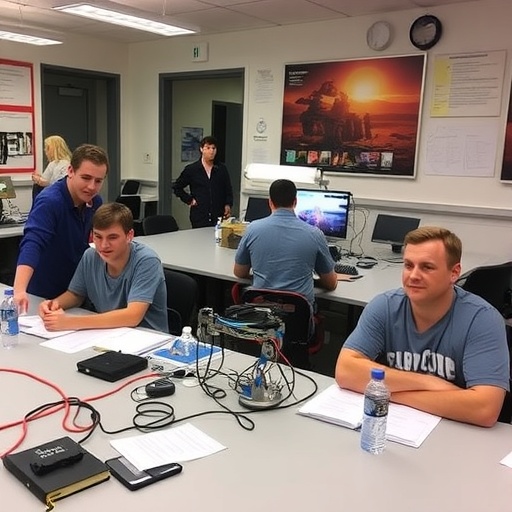
In a remarkable fusion of education, space exploration, and experiential learning, nine high school students hailing from Austria, Greece, and Portugal have successfully completed EXPLORE-2, an advanced six-day simulated Mars mission conducted near Monsaraz, Portugal. This immersive program placed these young Europeans into the rigorous roles of analog astronauts in a specially constructed habitat designed to replicate Martian conditions. Running from April 13 to 19, 2026, at the Observatório do Lago Alqueva (OLA) in Portugal’s Alentejo region, this analog mission leveraged a desolate, reddish terrain that closely mirrors the challenging surface of Mars.
The educational ambition of EXPLORE-2 extended far beyond the standard classroom experience, employing a realistic Mars mission framework to provide participants with a hands-on understanding of space operations. Equipped with rover control capabilities, scientific experimentation kits, and authentic mission protocols, students were immersed in scenarios demanding teamwork, critical thinking, and adaptability under isolation — all crucial components for future interplanetary explorers. The mission’s operational reality was underscored by the use of specialized “Delta suits,” simulators mirroring actual spacesuits worn during extravehicular activities on Mars. This fidelity to astronaut procedures fostered an appreciation for the physical and mental demands involved in space exploration.
Jean-Claude Worms, Executive Director of the Committee on Space Research (COSPAR), emphasized the transformational impact of such programs on youth. He noted, “ witnessing highly motivated high school students navigate simulated space mission challenges highlighted both their intrinsic potential and the effectiveness of hands-on STEM education. The dedication and skills cultivated in this setting promise to fuel the next generation of space scientists and engineers.” This sentiment was echoed by Rosa Doran, President of NUCLIO and Chair of the COSPAR Panel on Education, who highlighted the program’s success in nurturing exploration skills, self-confidence, and scientific inquiry through experiential learning. The mission’s design encouraged students to take genuine ownership of decision-making processes, echoing real-world astronaut responsibilities.
Building upon the foundation laid by EXPLORE-1 in June 2025, the second iteration of this project advanced mission authenticity and educational depth substantially. The students were not merely passive participants but active mission architects, developing self-directed daily mission plans and managing complex operational variables. Procedures were adapted from the Austrian Space Forum’s AMADEE program, a professional analog mission initiative, instilling a level of procedural rigor seldom found in educational simulations. Each crew member assumed specific roles vital to mission success, reinforcing collaboration and shared responsibilities under the pressures of isolated mission deployment.
One standout feature of EXPLORE-2 was the Experiment Design Challenge, a Europe-wide competition inviting young scientists to propose innovative research endeavors. The winning contribution, originating from Turkey’s Antalya Science and Art Center (BİLSEM), investigated astronaut reflex dynamics relative to donning and doffing the restrictive Delta suits. This experiment not only underscored cognitive and motor function adaptability in constrained environments but also illustrated how student-led scientific inquiry enhances mission value and learning outcomes. The integration of such original scientific content demonstrated how analog missions can serve as platforms for authentic research, bridging education with frontier science.
Beyond intellectual enrichment, the mission profoundly nurtured key psychosocial skills necessary for successful crew cooperation and mission viability. Angelos Lazoudis, a senior researcher from Ellinogermaniki Agogi in Greece and project partner, reflected on how communication and trust-building formed the mission’s cornerstone. The students’ ability to rely on one another and execute collective problem-solving echoed the interpersonal dynamics critical to real astronaut crews operating in extreme, high-stakes environments. These social competencies, often overlooked in conventional education, emerged as crucial lessons embedded within the mission experience.
Insights from participants and educators provide a window into the mission’s profound human impact. Greek student Danai Argyriadi described a profound personal and scientific transformation, emphasizing the importance of patience and collective efficacy in such intense settings. Austrian teacher Marigold Muchmore expressed renewed enthusiasm at witnessing the fusion of science and pedagogy in dynamic, applied contexts. Portuguese educator Sandra Baptista articulated pride in guiding students whose professionalism and camaraderie exemplified the promise of humankind’s exploratory future. Greek teacher Eleni Krokou encapsulated the mission’s ethos through the acronym EXPLORE, reflecting its layered educational and inspirational objectives.
Analog missions like EXPLORE-2 simulate the multifaceted challenges of extraterrestrial exploration through Earth-bound environments, providing testbeds for both technology and human factors. Such missions assess equipment performance, operational workflows, and psychological resilience against isolation and confinement — conditions anticipated during actual Mars expeditions. The Monsaraz analog facility, with its topography and climate resembling Martian terrain, offers an authentic setting where participants grapple with environmental constraints first-hand. Wearing spacesuit simulators during “spacewalks,” students confronted the practical limitations and protocols experienced by astronauts, deepening their comprehension far beyond textbook learning.
The selection process for EXPLORE-2 participants was uniquely democratic, entrusting peer classmates and Space Coach teachers to choose representatives who embodied collective trust and leadership. Remarkably, these nine students, strangers prior to the mission, rapidly forged a cohesive unit capable of adapting daily mission plans amidst unexpected challenges. The necessity to collectively recalibrate roles and tasks in real-time provided experiential lessons in flexibility, leadership, and crisis management — foundational skills for future space missions. This dynamic approach ensures that the educational benefits extend beyond scientific knowledge, cultivating resilient, effective teams for tomorrow’s interplanetary endeavors.
EXPLORE also transcends its physical mission footprint through its EU-supported virtual toolkit, enabling classrooms across Europe to engage with analog space exploration remotely. This inclusive educational innovation democratizes access to STEM fields by bringing authentic exploration simulations to diverse student populations regardless of geographical constraints. Looking ahead, the Monsaraz Mars Analog Station is projected to become a hub for such immersive experiences, welcoming students continent-wide to participate in week-long analog missions that inspire and educate through real-world challenge and exploration.
The overarching EXPLORE project—an Erasmus+ co-funded Erasmus+ initiative emphasizing experiential STEAM education—unites leading space research organizations with educators to catalyze innovation in learning. The Austrian Space Forum leads the project alongside partners including NUCLIO from Portugal, Ellinogermaniki Agogi in Greece, COSPAR, and the Observatório do Lago Alqueva. Together, these institutions harness their scientific expertise and educational outreach to foster the next generation of space explorers, scientists, and critical thinkers, ensuring that Europe remains at the forefront of human spaceflight preparation and inspiration.
As humanity sets its sights on crewed missions to Mars, initiatives like EXPLORE offer invaluable platforms for testing, training, and inspiring young minds who may one day undertake humanity’s most ambitious journey. By combining realistic mission parameters, hands-on scientific experimentation, and social teamwork dynamics within an educational framework, EXPLORE-2 embodies a pioneering model for immersive space education. The lessons learned and skills acquired by these analog astronauts today will undoubtedly inform the success and safety of tomorrow’s interplanetary explorers, while igniting a passion for science and discovery that transcends generations.
News Publication Date: April 20, 2026
Web References:
- https://oewf.org/en/
- https://www.olagoalqueva.com/
- https://cosparhq.cnes.fr/
- https://nuclio.org/en/
- https://www.ea.gr/en/
- http://www.facebook.com/EXPLOREprojectEU
- http://www.instagram.com/exploreprojecteu/
Keywords
Mars analog mission, STEM education, EXPLORE-2, simulated space mission, experiential learning, Austrian Space Forum, COSPAR, NUCLIO, Ellinogermaniki Agogi, analog astronauts, space exploration training, interplanetary missions, spacewalk simulation
Cite Scienmag News
Grant Pearson. (April 21, 2026). From Classroom to Mars: European Students Complete Six-Day Analog Space Mission. Scienmag. https://scienmag.com/from-classroom-to-mars-european-students-complete-six-day-analog-space-mission/
Grant Pearson. "From Classroom to Mars: European Students Complete Six-Day Analog Space Mission." Scienmag, 21 April 2026, https://scienmag.com/from-classroom-to-mars-european-students-complete-six-day-analog-space-mission/. Accessed 4 September 2026.
Grant Pearson. "From Classroom to Mars: European Students Complete Six-Day Analog Space Mission." Scienmag. April 21, 2026. https://scienmag.com/from-classroom-to-mars-european-students-complete-six-day-analog-space-mission/


