

Friday, September 4, 2026
Science
No Result
View All Result
  • Login
  • HOME
  • SCIENCE NEWS
  • CONTACT US
  • HOME
  • SCIENCE NEWS
  • CONTACT US
No Result
View All Result
Scienmag
No Result
View All Result
Home Science News Agriculture

The aroma of tomato resistance

July 24, 2024
in Agriculture
Alan Morgan
By Alan Morgan Scienmag Editorial Profile - Precision Agriculture
Reading Time: 3 mins read
0
The aroma of tomato resistance
66
SHARES
604
VIEWS
Share on FacebookShare on Twitter
ADVERTISEMENT

In a recent study published on the cover of the Plant Physiology journal, the IBMCP team has identified a new volatile compound – alpha-terpineol- that effectively protects plants from Pseudomonas syringae. This pathogenic bacterium causes severe damage to various crops. This finding could improve crop protection treatments by providing natural and highly effective plant protection.

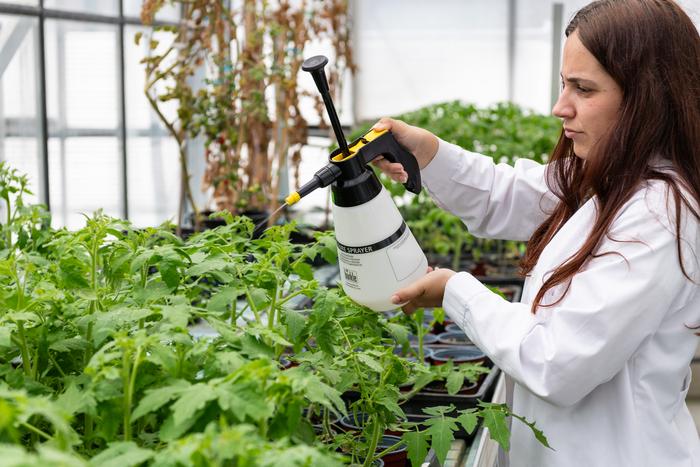
An IBMCP (UPV-CSIC) team discovers a new compound to protect tomatoes from bacteria and drought.

Credit: UPV

In a recent study published on the cover of the Plant Physiology journal, the IBMCP team has identified a new volatile compound – alpha-terpineol- that effectively protects plants from Pseudomonas syringae. This pathogenic bacterium causes severe damage to various crops. This finding could improve crop protection treatments by providing natural and highly effective plant protection.

Julia Pérez-Pérez, a PhD student at the UPV and co-author of the study, explains that, as in human interaction, plants have their own way of communication and defence. “They emit volatile compounds to alert their neighbours to danger and use their sense of smell to perceive the message”.

To illustrate, Pérez-Pérez adds: Imagine a field of tomatoes where the bacteria penetrate the leaves of a plant through the stomata. As it spreads, the plant defends itself from attack by releasing volatiles such as terpene. Other parts of the plant itself and neighbouring plants ‘smell’ this chemical message and quickly close their stomata, preventing the entry of the pathogen and thus protecting the crop.

The same IBMCP team has already patented and licensed another volatile compound, HB, which also protects plants, with the company Meristem. Now, with the discovery of terpineol, they have a new method to strengthen the resistance of the crops. “Both compounds are part of what we call the aroma of resistance, which symbolises the smell of survival for tomato plants,” Pérez-Pérez adds.

It is a very simple, cheap and environmentally friendly application.

According to the IBMCP team, applying terpineol and HB would be very straighforwardand versatile: they can be sprayed directly on the plants or applied by diffuser devices. In fact, through a project conducted in collaboration with the company Meristem and with CDTI funding, they are exploring possible synergies between these and other volatile compounds to activate the defensive response of plants efficiently and very cheaply.

“The use of these compounds offers the agricultural sector a new economic, fast and highly effective alternative to improve the yield of such an important crop as tomato,” adds Purificación Lisón, IBMCP researcher and lecturer in the Biotechnology Department of the School of Agricultural Engineering and Environment (ETSIAMN) and co-author of the study.

In addition, applying these compounds in agricultural treatments would also reduce the use of chemical compounds. “This is not only beneficial for the environment but also promotes more sustainable agriculture,” adds Mª Pilar López Gresa, an IBMCP researcher and senior lecturer at ETSIAMN.

And also, against the drought

According to the researchers, this natural strategy could serve as a protective barrier against bacteria and other infections and even protect plants from the effects of drought.

This IBMCP discovery represents a significant breakthrough in crop protection, offering a natural, effective and environmentally friendly solution to today’s agricultural challenges,” conclude the IBMCP researchers.


Journal

PLANT PHYSIOLOGY

DOI

10.1093/plphys/kiae148.

Method of Research

Experimental study

Article Title

Metabolic crosstalk between hydroxylated monoterpenes and salicylic acid in tomato defense response against bacteria

Article Publication Date

1-Jul-2024

Subject of Research: Agriculture

Article Title: The aroma of tomato resistance

Article References: Original research article

Image Credits: AI Generated

DOI: Not provided

Keywords: Not provided

Cite Scienmag News

Alan Morgan. (July 24, 2024). The aroma of tomato resistance. Scienmag. https://scienmag.com/the-aroma-of-tomato-resistance/

Alan Morgan. "The aroma of tomato resistance." Scienmag, 24 July 2024, https://scienmag.com/the-aroma-of-tomato-resistance/. Accessed 4 September 2026.

Alan Morgan. "The aroma of tomato resistance." Scienmag. July 24, 2024. https://scienmag.com/the-aroma-of-tomato-resistance/

Share26Tweet17
Previous Post

Prevalence and impact of the KIT M541L variant in patients with mastocytosis

Next Post

Preventing brain damage in preterm babies

Related Posts

Invasive plant growth shaped by soil microbes and local leaf inputs
Agriculture

Invasive plant growth shaped by soil microbes and local leaf inputs

September 4, 2026
Scientists uncover genes controlling grain yield in harsh growing conditions
Agriculture

Scientists uncover genes controlling grain yield in harsh growing conditions

September 3, 2026
BraABCB transporter genes shed light on hormone responses in Chinese flowering cabbage
Agriculture

BraABCB transporter genes shed light on hormone responses in Chinese flowering cabbage

September 3, 2026
Dietary Polyphenols Modulate NF-κB Signaling in Inflammation-Driven Diseases Including Cancer
Agriculture

Dietary Polyphenols Modulate NF-κB Signaling in Inflammation-Driven Diseases Including Cancer

September 3, 2026
Infrared Thermometry Reveals Water Stress in Medicinal Plants Before the Eye Can See
Agriculture

Infrared Thermometry Reveals Water Stress in Medicinal Plants Before the Eye Can See

September 3, 2026
FIMBRIN2 Drives ABA-Induced Stomatal Closure via Actin Remodeling in Guard Cells
Agriculture

FIMBRIN2 Drives ABA-Induced Stomatal Closure via Actin Remodeling in Guard Cells

September 3, 2026
Next Post
Preventing brain damage in preterm babies

Preventing brain damage in preterm babies

  • Mothers who receive childcare support from maternal grandparents show more optimized

    Mothers who receive childcare support from maternal grandparents show more parental warmth, finds NTU Singapore study

    27656 shares
    Share 11059 Tweet 6912
  • University of Seville Breaks 120-Year-Old Mystery, Revises a Key Einstein Concept

    1061 shares
    Share 424 Tweet 265
  • Bee body mass, pathogens and local climate influence heat tolerance

    682 shares
    Share 273 Tweet 171
  • Researchers record first-ever images and data of a shark experiencing a boat strike

    546 shares
    Share 218 Tweet 137
  • Groundbreaking Clinical Trial Reveals Lubiprostone Enhances Kidney Function

    531 shares
    Share 212 Tweet 133
Science

Embark on a thrilling journey of discovery with Scienmag.com—your ultimate source for cutting-edge breakthroughs. Immerse yourself in a world where curiosity knows no limits and tomorrow’s possibilities become today’s reality!

RECENT NEWS

  • Kindergarten Teachers Reflect on Parent Thank-You Letters and Relationships
  • Disney Plus Cartoons Still Depict Domestic Labor Through a Gendered Lens
  • Study Explores Moral Choices, Machiavellianism, and Social Cognition in Autism
  • Adolescent male and female mice show distinct social stress responses

Categories

  • Agriculture
  • Anthropology
  • Archaeology
  • Athmospheric
  • Biology
  • Biotechnology
  • Blog
  • Bussines
  • Cancer
  • Chemistry
  • Climate
  • Earth Science
  • Editorial Policy
  • Marine
  • Mathematics
  • Medicine
  • Pediatry
  • Policy
  • Psychology & Psychiatry
  • Science Education
  • Social Science
  • Space
  • Technology and Engineering

Subscribe to Blog via Email

Enter your email address to subscribe to this blog and receive notifications of new posts by email.

Join 5,151 other subscribers

© 2025 Scienmag - Science Magazine

Welcome Back!

Login to your account below

Forgotten Password?

Retrieve your password

Please enter your username or email address to reset your password.

Log In
No Result
View All Result
  • HOME
  • SCIENCE NEWS
  • CONTACT US

© 2025 Scienmag - Science Magazine

Discover more from Science

Subscribe now to keep reading and get access to the full archive.

Continue reading