


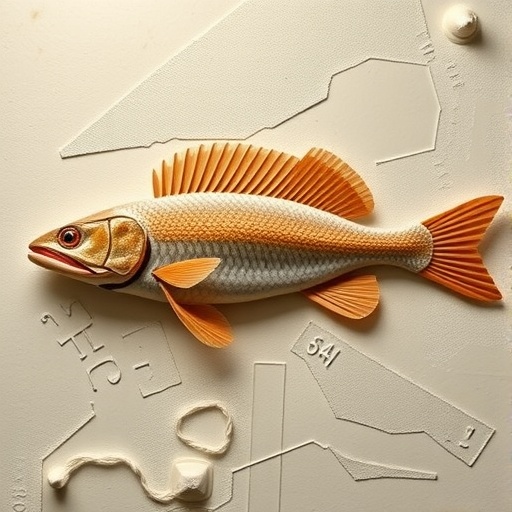
A remarkable scientific breakthrough has emerged from the depths of the Natural History Museum in London, where a species of coelacanth was identified from a fossil that had remained unexamined for 150 years. This discovery, made by Jack L. Norton, a former palaeontology student at the University of Portsmouth, illuminates an enigmatic period in the evolutionary history of coelacanths, creatures famously dubbed ‘living fossils’ due to their persistence through mass extinction events that wiped out the dinosaurs.
The specimen belongs to the Latimeriidae family—the lineage of coelacanths that includes the extant species still found in the deep waters of the Indian Ocean today. Dating back to the Lower Cretaceous period and originating from the Gault Formation in southern England, the fossil represents the oldest known member of its genus and fills a crucial 50-million-year gap in the fossil record. This temporal hiatus had long impeded scientists’ understanding of the evolutionary trajectory that led to modern coelacanth species.
Norton’s discovery was facilitated by cutting-edge technology, specifically X-ray computed tomography (XCT), which allowed for an unprecedented, non-destructive exploration of the fossil’s internal anatomy. The application of XCT revealed internal cranial features that had never been documented before in such ancient coelacanth specimens. This kind of detailed virtual dissection opens new avenues in paleontological research, unlocking information that traditional methods of fossil analysis, like mechanical preparation, cannot provide without risking damage.
Coelacanths have occupied a unique evolutionary niche due to their extraordinary morphological stasis; their overall body plan has changed relatively little for hundreds of millions of years. Yet, despite this seeming evolutionary conservatism, certain structural aspects—particularly related to cranial biology—have remained elusive in the fossil record. The new specimen, named Macropoma gombessae, elucidates these mysteries by providing a link between derived features seen in extant species and their ancient ancestors. Its name pays homage to the local Malagasy term “Gombessa,” a nod to the coelacanth’s cultural and scientific significance.
Dr. Samuel Cooper, Norton’s former supervisor, underscored the specimen’s importance, noting how museum collections can harbor specimens of immense scientific value, patiently awaiting re-examination under new technological paradigms. This revelation elevates the role of natural history museums as repositories not just of preserved biodiversity, but as dynamic archives essential for deciphering life’s evolutionary past. The capacity to reinterpret century-old specimens through advanced imaging techniques highlights a revolution in paleontological methodologies.
The identification process was neither instantaneous nor straightforward. It required rigorous analysis of intricate cranial morphology, including suture patterns and neurocranial structures, which are critical for understanding phylogenetic relationships among coelacanth species. The 3D digital models generated through XCT scans allowed researchers to manipulate views and conduct morphometric assessments, enhancing the precision of their taxonomic classifications.
Furthermore, the discovery resonates beyond taxonomy and systematics. It provides critical insights into the paleoecology of the Cretaceous seas, revealing adaptations that may have contributed to the survival and evolutionary success of coelacanths through tumultuous geological epochs. Understanding these evolutionary mechanisms enriches our broader comprehension of vertebrate resilience and adaptation.
The Natural History Museum’s scientific team, including fossil fish curator Emma Bernard, emphasized the exciting potential embedded in such discoveries. They pointed to the forthcoming exhibition, “Jurassic Oceans: Monsters of the Deep,” which aims to leverage the museum’s unparalleled collection to educate and inspire the public about marine biodiversity evolution. This exhibition will utilize specimens like Macropoma gombessae to bridge scientific research and public engagement.
The University of Portsmouth, where Norton honed his expertise, boasts the United Kingdom’s largest undergraduate palaeontology program. The university’s unique proximity to fossil-rich sites—famously termed “Dinosaur Island” for its prolific Jurassic remains—provides students with invaluable field experience, reinforcing the importance of combining theoretical knowledge with hands-on investigation. The discovery underscores the importance of robust academic training in paleontological sciences.
The published research appears in Papers in Palaeontology, further cementing the academic rigor and scientific significance of this breakthrough. Its implications extend into the realms of evolutionary biology, paleoecology, and paleobiogeography, encouraging interdisciplinary collaboration that could yield fresh perspectives on ancient marine ecosystems.
Historically, coelacanths were presumed extinct until the astonishing finding of a living specimen off the coast of South Africa in 1938 radically altered scientific dogma. The newly described Macropoma gombessae enriches that narrative by extending the fossil record and clarifying the lineage’s evolutionary path. As modern imaging and analytical technologies continue to evolve, further treasures hidden within museum archives are sure to find their way into the light of scientific scrutiny.
In summation, Jack L. Norton’s identification of Macropoma gombessae bridges a half-century evolutionary gap and showcases the transformative power of modern technology to unlock secrets stored in ancient fossils. It is a testament to the enduring scientific value of museum collections, the necessity of cross-generational scientific inquiry, and the untapped potential still lying within earth’s geological archives.
News Publication Date: 25 March 2026.
Web References:
- Natural History Museum London: https://www.nhm.ac.uk/
- University of Portsmouth: https://www.port.ac.uk/
- Papers in Palaeontology DOI: http://dx.doi.org/10.1002/spp2.70076
Cite Scienmag News
Gavin Prescott. (April 21, 2026). 150-Year-Old Museum Specimen Unveiled as Crucial Missing Link in Ancient Fish Evolution. Scienmag. https://scienmag.com/150-year-old-museum-specimen-unveiled-as-crucial-missing-link-in-ancient-fish-evolution/
Gavin Prescott. "150-Year-Old Museum Specimen Unveiled as Crucial Missing Link in Ancient Fish Evolution." Scienmag, 21 April 2026, https://scienmag.com/150-year-old-museum-specimen-unveiled-as-crucial-missing-link-in-ancient-fish-evolution/. Accessed 3 September 2026.
Gavin Prescott. "150-Year-Old Museum Specimen Unveiled as Crucial Missing Link in Ancient Fish Evolution." Scienmag. April 21, 2026. https://scienmag.com/150-year-old-museum-specimen-unveiled-as-crucial-missing-link-in-ancient-fish-evolution/


