


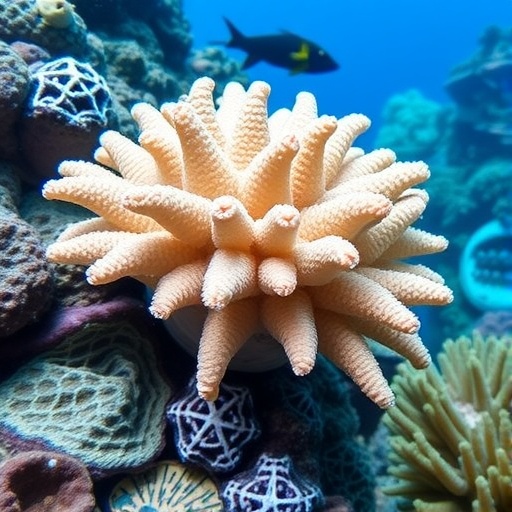
In the relentless battle against coral reef degradation, a groundbreaking study has emerged, promising a potential lifeline for the world’s vulnerable marine ecosystems. Ruszczyk, Rodriguez, Tuen, and their colleagues have unveiled a novel method that could revolutionize coral restoration efforts by leveraging alkalinity-enhanced artificial substrates. Their research, published in Communications Earth & Environment in 2026, reveals how these specially designed surfaces can locally modulate pH levels, significantly boosting the survival rates of early-stage coral recruits—an advancement that could reshape the future of coral conservation.
Coral reefs, often hailed as the rainforests of the sea, are under unprecedented threat due to climate change, ocean acidification, and human activities. One of the greatest challenges facing marine biologists is ensuring the successful settlement and growth of coral larvae or recruits, which are notoriously sensitive to environmental conditions, especially pH fluctuations. The novel approach by this research team focuses on creating a controlled microenvironment at the substrate level, effectively providing young corals with a more hospitable setting to thrive in the face of acidifying oceans.
Artificial substrates have long been utilized in coral restoration initiatives, serving as anchors for coral larvae to attach and develop. However, traditional substrates lack the capacity to influence the immediate chemical environment, leaving recruits vulnerable to the deleterious effects of lowered pH. The innovative aspect of this study lies in the enhancement of these substrates with alkaline compounds, altering local physicochemical parameters to mitigate acidification impact. Such a strategy aims to circumvent one of the fundamental barriers to coral recovery by directly addressing the microhabitat conditions crucial in the earliest stages of coral life.
To elucidate the effects of these alkalinity-enhanced substrates, the researchers conducted a series of meticulously designed laboratory and field experiments. They synthesized substrates embedded with specific alkaline minerals capable of gradually releasing buffering ions into the surrounding seawater. Through in situ measurements, it was demonstrated that these substrates elevated the pH microenvironment around the coral recruits compared to control surfaces. This localized pH modulation represents a powerful means of counteracting the adverse effects of ocean acidification without necessitating broader, ecosystem-wide chemical alterations.
Beyond mere pH modulation, the study carefully documented the biological outcomes associated with these chemical manipulations. The survival rates of coral recruits placed on the alkalinity-enhanced substrates were markedly higher than those on unmodified controls. This enhanced survivability is attributable to a more stable carbonate chemistry environment, facilitating optimal calcification processes essential for coral skeletal development. The findings highlight the direct link between local chemical conditions and the physiological resilience of early-stage corals, knowledge that could inform more effective reef restoration protocols.
Moreover, the substrates were designed with durability and ecological compatibility in mind, ensuring that their deployment in marine environments would not introduce harmful materials or interfere with natural processes. The adoption of biocompatible alkaline minerals allows for a gradual and sustained release of alkalinity, avoiding abrupt chemical shocks to the surrounding biota. This balance between efficacy and environmental safety underscores the potential scalability of the approach, paving the way for its integration into large-scale coral rehabilitation programs globally.
The implications of this research resonate far beyond isolated restoration sites. Coral reefs, by their nature, are essential to maintaining marine biodiversity, supporting fisheries, and protecting shorelines from erosion and storm surges. Interventions that enhance the establishment and growth of coral populations can thus have cascading positive effects on entire coastal ecosystems. In an era where reefs face accelerated decline, technologies that improve early life stage survival are invaluable tools in the conservation arsenal.
Significantly, this work also contributes to a growing body of literature exploring microenvironment engineering as a mitigation strategy against climate-induced ocean changes. By shifting focus to the immediate conditions experienced by coral recruits rather than attempting to alter large-scale ocean chemistry, the research offers a practical, targeted solution adaptable to various reef systems. This level of precision in ecological intervention represents a paradigm shift, emphasizing localized control mechanisms in habitat restoration.
Furthermore, the integration of chemical engineering principles into marine biology elucidates complex interactions between abiotic and biotic factors shaping coral development. By tuning substrate properties to influence ion availability and pH, the researchers demonstrate a sophisticated approach to enhancing organismal resilience. This multidisciplinary angle expands the toolkit available to ecologists, fostering collaboration between chemists, materials scientists, and marine biologists to tackle ecosystem challenges holistically.
Critically, the study acknowledges that while alkalinity-enhanced substrates improve recruit survivorship, comprehensive reef recovery will demand multifaceted strategies addressing pollution, overfishing, and climate change mitigation. Restoration efforts incorporating these substrates should be complemented by broader environmental protections to ensure sustained reef health. This nuanced understanding reinforces the importance of integrated conservation frameworks that combine innovative technology with policy and community engagement.
Looking ahead, the authors propose further research to optimize substrate formulations and deployment techniques, tailoring them to species-specific requirements and varying environmental contexts. Such customization could amplify efficacy, allowing restoration practitioners to adapt interventions to the unique challenges of different reef ecosystems worldwide. Additionally, long-term monitoring of restored populations will be vital to assess the durability of benefits conferred by the alkalinity-enhanced substrates and to refine their application.
In essence, this pioneering study opens new avenues for resilience-building within coral communities threatened by ocean acidification. By ingeniously modifying the physical and chemical interface where life begins for corals, these artificial substrates embody an innovative intersection of environmental science and engineering. Their capacity to create microenvironments conducive to calcification and growth offers a beacon of hope in the daunting effort to preserve coral reefs for future generations.
The broader scientific and conservation community has taken keen interest in these findings, as they present a tool that not only enhances biological performance but also integrates seamlessly into existing restoration methodologies. The potential for widespread adoption of alkalinity-enhanced substrates could expedite recovery timelines and increase the efficiency of coral propagation efforts, a crucial factor given the accelerating pace of reef degradation globally.
Moreover, by addressing one of the most vulnerable stages of coral development—the fragile period immediately post-settlement—this technology confronts a bottleneck in coral population dynamics. Improving early-stage survivorship can fundamentally alter recruitment success rates, strengthening population resilience and ecosystem stability. This biological leverage point could prove pivotal in reversing declining trends in coral abundance.
Ultimately, the promise of alkalinity-enhanced artificial substrates lies in their capacity to harmonize human innovation with natural processes, providing young corals with the chemical environment necessary to withstand adversity while maintaining ecological integrity. As reef ecosystems worldwide face unprecedented pressures, such cutting-edge interventions may illuminate pathways toward sustaining biodiversity and ecosystem services in a changing ocean.
As conservationists, policymakers, and communities seek urgent solutions to coral reef collapse, the insights garnered from this study emphasize the importance of incorporating chemical microenvironmental management into restoration strategies. The work of Ruszczyk and colleagues thus stands as a testament to the power of targeted, science-driven interventions capable of forging resilience amidst global environmental change. Their research invites a hopeful narrative—one where adaptive technologies bolster the natural regenerative capacity of reefs and pave the way toward their enduring survival.
Cite Scienmag News
Violet Maxwell. (April 20, 2026). Alkalinity-Boosted Substrates Boost Coral Recruit Survival. Scienmag. https://scienmag.com/alkalinity-boosted-substrates-boost-coral-recruit-survival/
Violet Maxwell. "Alkalinity-Boosted Substrates Boost Coral Recruit Survival." Scienmag, 20 April 2026, https://scienmag.com/alkalinity-boosted-substrates-boost-coral-recruit-survival/. Accessed 3 September 2026.
Violet Maxwell. "Alkalinity-Boosted Substrates Boost Coral Recruit Survival." Scienmag. April 20, 2026. https://scienmag.com/alkalinity-boosted-substrates-boost-coral-recruit-survival/


