


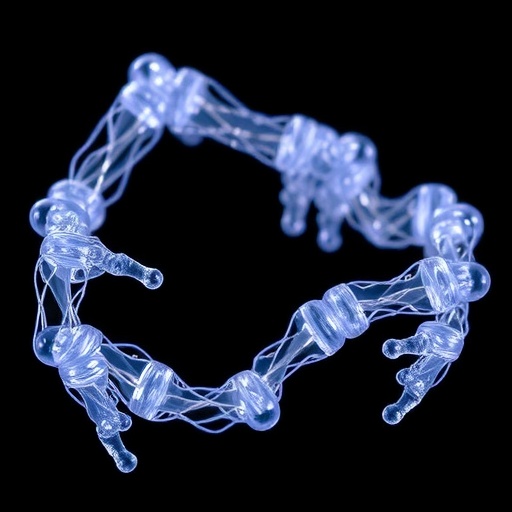
In a groundbreaking technological leap, researchers at Seoul National University have unveiled a next-generation artificial muscle capable of real-time, reconfigurable actuation, self-recovery, and environmental sustainability. Traditional soft robotic systems have long been constrained by static electrode patterns fixed during fabrication, restricting their ability to adapt to multifaceted tasks or recover from damage. This pioneering study shatters those limitations by introducing a phase-transitional ferrofluid (PTF)-based dielectric elastomer actuator (DEA) that fundamentally redefines the concept of soft robotic muscles.
At the core of this innovation lies the phase-transitional ferrofluid electrode, a slime-like material whose dual nature allows it to behave as a solid at standard conditions and transform into a highly flexible liquid upon exposure to thermal or magnetic stimuli. This unique property enables the electrodes to be dynamically reconfigured during operation, granting the soft actuators unprecedented functional versatility and adaptability. The ability to morph electrode shapes on the fly mirrors a biological muscle’s capacity to undertake diverse motion patterns, a feat previously unattainable in soft robotics.
The seamless interplay of materials science and mechanical engineering paved the way for this advancement. By meticulously designing a nanoparticle-polymer composite, the team achieved a stable yet flexible electrode structure capable of reversible solid-liquid phase transitions. This architectural flexibility empowers the soft actuator not only to change its motion profile dynamically—from bending to expansion and beyond—but also to heal itself from mechanical ruptures or electrical failures. In scenarios where electrodes suffer damages such as severing or breakdown under high voltages, localized re-melting and reconfiguration of the electrode restore complete functionality, thus elevating the reliability of soft robotic systems to new heights.
The implications of this technology extend beyond adaptive actuation. The phase-transitional ferrofluid’s recyclability offers solutions to long-standing sustainability challenges in the robotics industry. Unlike conventional devices disposed of after a single lifecycle, these electrodes can be extracted in liquid form and reused multiple times without significant degradation in performance—retaining around a 91% recovery rate across cycles. This fosters a circular resource economy, reducing electronic waste and encouraging the development of environmentally responsible robotic technologies.
Functionally, the PTF electrodes exhibit an extraordinary degree of freedom. They can be magnetically manipulated in three-dimensional space, allowing for split, merged, or spatially complex electrode formations both in-plane and out-of-plane. This ability to autonomously bridge gaps in circuits or create new conduction pathways enables robots endowed with these muscles to execute a broad spectrum of motions, adapt to novel object geometries, or adjust swiftly to changing environmental demands. As a result, a single robotic platform equipped with these actuators can effectively “learn” new functional behaviors during operation, transcending the traditionally rigid design paradigms of soft robotics.
The revolutionary potential extends to various applications including next-generation soft robotic grippers capable of delicately handling fragile items, adaptive form-factor displays that change shape in real time, and even smart robots that actively repair themselves under harsh industrial conditions. By integrating self-healing electrodes, these systems can maintain continuous operation amidst physical assaults or electrical failures, dramatically enhancing their utility and lifespan in practical scenarios.
The interdisciplinary research team led by Professors Jeong-Yun Sun and Ho-Young Kim emphasized that this breakthrough is a testament to the convergence of advanced particle design, polymer chemistry, and mechanical engineering principles. Their work demonstrates that the path toward robots with human-muscle-like versatility involves not only material innovation but also the meticulous design of mechanical systems capable of exploiting these properties to their fullest. The “living, programmable” nature of these electrodes is poised to catalyze a paradigm shift in how robotic actuation and reconfiguration are approached in the years ahead.
Moreover, this novel approach challenges the prevailing norms of soft robotic manufacturing by eliminating the necessity of designing and fabricating a custom electrode pattern for each unique task or shape. Instead, the reconfigurable ferrofluid electrodes provide an adaptive platform that dramatically reduces development time, cost, and complexity, potentially accelerating commercialization and wider adoption of multifunctional soft robots in industry and daily life.
A notable aspect lies in the recoverable and reusable nature of the PTF electrode, contributing a sustainable dimension to the traditionally disposable robotic components. The research team’s demonstration of repeated reuse cycles without loss of performance underscores the practical viability of long-term recycling, aligning with global efforts toward greener and more responsible technological development.
Looking forward, the implications of this technology are vast. It ushers in a new era of “smart” artificial muscles capable of multi-degree-of-freedom movements as found in biological systems, thus bridging a crucial gap between human-like dexterity and soft robotic adaptability. The prospect of dynamic, self-healing, and reconfigurable soft robotics opens doors to transformative applications in healthcare, manufacturing, consumer electronics, and beyond.
The publication of this work in Science Advances marks a significant milestone in soft robotics and material science research. Supported by the Ministry of Science and ICT and the National Research Foundation of Korea, these findings were achieved through a collaborative synthesis of expertise spanning materials science, mechanical engineering, and polymer chemistry. The project reflects a forward-thinking approach to tackling pressing challenges related to robotic versatility, sustainability, and resilience.
As society moves toward increasingly complex and interactive robotic systems, the ability for robots to modify their function and repair themselves autonomously will be paramount. This innovation heralds a future where soft robots can not only mimic but surpass the dynamic capabilities of biological muscles, enabling unprecedented freedom in design, function, and sustainability.
Keywords
Artificial muscles, soft robotics, dielectric elastomer actuators, phase-transitional ferrofluid, reconfigurable electrodes, self-healing materials, soft actuators, sustainable robotics, nanoparticle-polymer composites, multifunctional soft robots, magnetic actuation, adaptive robotics
Cite Scienmag News
Bethany Barker. (April 17, 2026). Sci-Fi Slime Robots Made Real: SNU Scientists Create Next-Gen Artificial Muscle with Dynamic Reconfiguration and Self-Healing Abilities. Scienmag. https://scienmag.com/sci-fi-slime-robots-made-real-snu-scientists-create-next-gen-artificial-muscle-with-dynamic-reconfiguration-and-self-healing-abilities/
Bethany Barker. "Sci-Fi Slime Robots Made Real: SNU Scientists Create Next-Gen Artificial Muscle with Dynamic Reconfiguration and Self-Healing Abilities." Scienmag, 17 April 2026, https://scienmag.com/sci-fi-slime-robots-made-real-snu-scientists-create-next-gen-artificial-muscle-with-dynamic-reconfiguration-and-self-healing-abilities/. Accessed 4 September 2026.
Bethany Barker. "Sci-Fi Slime Robots Made Real: SNU Scientists Create Next-Gen Artificial Muscle with Dynamic Reconfiguration and Self-Healing Abilities." Scienmag. April 17, 2026. https://scienmag.com/sci-fi-slime-robots-made-real-snu-scientists-create-next-gen-artificial-muscle-with-dynamic-reconfiguration-and-self-healing-abilities/


