


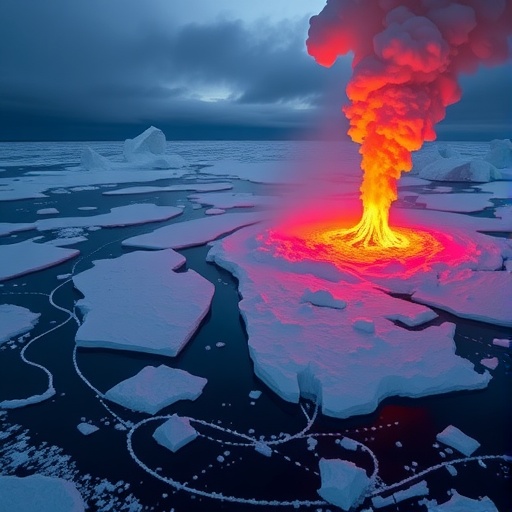
In a groundbreaking discovery that promises to reshape our understanding of Antarctic ice dynamics and climate interactions, researchers have unveiled an unprecedented convergence of oceanic and volcanic heat sources nestled deep within the subglacial channels of the Kamb Ice Stream in West Antarctica. This extraordinary finding sheds new light on the complex thermal processes occurring beneath the ice sheet and offers crucial insights into how hidden geothermal forces could influence ice behavior, stability, and ultimately global sea level rise.
The Kamb Ice Stream, a sprawling, sluggish river of ice, has long intrigued glaciologists due to its peculiar flow patterns and enigmatic subglacial environment. Previously, it was assumed that the ice stream’s sluggishness was driven primarily by mechanical and hydrostatic factors, yet this novel study reveals that subterranean heat inputs from multiple origins intimately interact within a narrow channel beneath the ice, generating localized meltwater and changing the basal sliding dynamics in ways previously unimagined. Drawing from integrated geophysical surveys, subglacial radar reflections, and temperature measurements, the international team has pieced together a vivid portrait of the thermal architecture hidden beneath the ice.
At the heart of this research lies the remarkable interaction between oceanic heat transported inland beneath the grounded ice and the geothermal heat emitted by volcanic activity far below the Earth’s crust. Oceanic intrusions, carried by saline water currents within sub-ice cavities, provide a persistent flow of heat that gradually erodes the base of the ice sheet. Simultaneously, heat emanating from volcanic features beneath the West Antarctic Rift System contributes vital thermal energy to these subglacial environments. These two heat sources, once thought to act independently, are now shown to combine forces within discrete subglacial channels, forging conditions favorable for basal melting and dynamic ice flow alteration.
One of the most compelling aspects of this research is the precise identification of a subglacial conduit where these two heat sources intersect. Employing a combination of seismic imaging and borehole temperature profiling, the researchers managed to map the geometry of the channel and measure anomalously high temperatures indicative of both ocean-driven and magmatic heating. This channel acts as a thermal hotspot underneath the Kamb Ice Stream, fostering a locally enhanced supply of meltwater that lubricates the ice-bed interface, potentially accelerating ice stream movement and influencing its overall stability.
This finding is particularly timely given the urgency to understand Antarctic ice sheet vulnerability under future climate scenarios. The role of basal melting in ice stream dynamics is critical because it modifies the frictional resistance at the ice-bed interface, which can either hasten or retard ice flow into the Southern Ocean. The integration of oceanic and volcanic heat sources within a confined subglacial channel suggests that basal melt rates may be higher and more spatially variable than previously believed, which could have profound implications for ice sheet models predicting mass loss and sea level contributions.
Moreover, the volcanic heat emanating from the West Antarctic Rift System appears to be spatially heterogeneous, with localized magma intrusions and geothermal anomalies supplying uneven thermal input beneath the ice streams. This patchy distribution of geothermal heat may explain the irregular velocity patterns observed in such ice streams and prompts a reevaluation of how basal conditions are parametrized in ice sheet simulations. Recognizing that volcanic activity beneath ice sheets is not static but modulated by tectonic processes could enhance predictive capabilities regarding ice sheet responses to environmental changes.
In tandem with oceanic heat influx, the study emphasizes the importance of subglacial hydrological networks in transporting heat and meltwater beneath the ice sheet. The presence of this subglacial channel acts as a conduit for relatively warm ocean water to penetrate deeply into the grounded ice, creating a feedback loop in which heat-induced melting enlarges the channel and facilitates even greater water flow. This recursive mechanism highlights a dynamic interplay between ice mechanics, water transport, and geothermal forcing that controls ice stream behavior on decadal to centennial timescales.
The data was meticulously gathered during multiple expeditions involving advanced geophysical instruments capable of penetrating kilometers of ice and capturing low-frequency seismic signals generated by subglacial processes. High-resolution radar mapping provided unprecedented clarity about the ice bed’s topography and the geometry of the subglacial channel, while boreholes drilled into the ice allowed direct measurement of temperature gradients and water chemistry. These multidisciplinary approaches underscore the technological advances enabling scientists to explore once-inaccessible cryospheric realms.
Further analysis suggests that similar heat convergence zones might be widespread beneath other Antarctic ice streams, implying that the interplay between oceanic and volcanic heat sources is a fundamental characteristic rather than a local curiosity. Such zones could serve as critical tipping points in ice sheet dynamics, where incremental changes in geothermal activity or ocean temperature could trigger disproportionately large responses in ice flow velocity and stability.
Beyond implications for ice flow and sea level rise, the discovery holds relevance for understanding subglacial ecosystems that potentially exist in these geothermal hotspots. The mingling of heat and meltwater could create habitable niches for microbial life adapted to extreme conditions, offering a natural laboratory for astrobiological studies and insights into life’s resilience in cold, dark, and high-pressure environments.
This study also challenges existing paradigms regarding the heat budget of ice sheets, which often neglected or underestimated the role of volcanic heat due to limited observational evidence. By quantifying the combined influence of ocean and volcanic heat, scientists now have a more comprehensive framework for assessing ice sheet thermal regimes, coupling geophysical, oceanographic, and geological processes in an integrated model.
Critically, the researchers caution that ongoing climate warming may amplify these processes by increasing ocean temperatures and circulation patterns that transport warm water beneath ice shelves and grounded ice. Enhanced oceanic heat delivery, compounded by persistent or intensifying volcanic activity linked to tectonic stresses, could accelerate mitigation efforts needed to address Antarctic ice mass loss and its global climate repercussions.
Looking ahead, the research team advocates for expanded monitoring of geothermal activity beneath ice sheets using remote sensing and autonomous subglacial observatories capable of continuous measurement. Such efforts would improve temporal resolution of heat flux changes and provide early warning signals of destabilization pathways within vulnerable ice margins.
In the broader context of Earth system science, this work exemplifies the necessity of interdisciplinary collaboration, leveraging expertise from glaciology, volcanology, oceanography, and geophysics to untangle the multifaceted drivers of ice sheet behavior. It also underscores the intrinsic interconnectedness of Earth’s spheres — solid Earth activity shapes cryospheric dynamics, which feedback into oceanic and atmospheric systems influencing planetary climate equilibria.
As the polar regions remain sentinel environments for global environmental change, the revelation of converging oceanic and volcanic heat in the Kamb Ice Stream is a striking reminder that beneath the vast ice sheets lie dynamic, energetic processes that are integral to shaping the future of Earth’s climate and sea level trajectories. This pioneering study marks a pivotal milestone in Antarctic research and opens new frontiers for understanding the deep Earth-cryosphere interface with profound scientific and societal significance.
Washam, P., Schmidt, B.E., Loose, B. et al. Oceanic and volcanic heat converge in a subglacial channel of the Kamb Ice Stream in West Antarctica. Commun Earth Environ (2026). https://doi.org/10.1038/s43247-026-03508-w
Cite Scienmag News
Violet Maxwell. (April 17, 2026). Oceanic, Volcanic Heat Merge Beneath West Antarctic Ice. Scienmag. https://scienmag.com/oceanic-volcanic-heat-merge-beneath-west-antarctic-ice/
Violet Maxwell. "Oceanic, Volcanic Heat Merge Beneath West Antarctic Ice." Scienmag, 17 April 2026, https://scienmag.com/oceanic-volcanic-heat-merge-beneath-west-antarctic-ice/. Accessed 3 September 2026.
Violet Maxwell. "Oceanic, Volcanic Heat Merge Beneath West Antarctic Ice." Scienmag. April 17, 2026. https://scienmag.com/oceanic-volcanic-heat-merge-beneath-west-antarctic-ice/


