


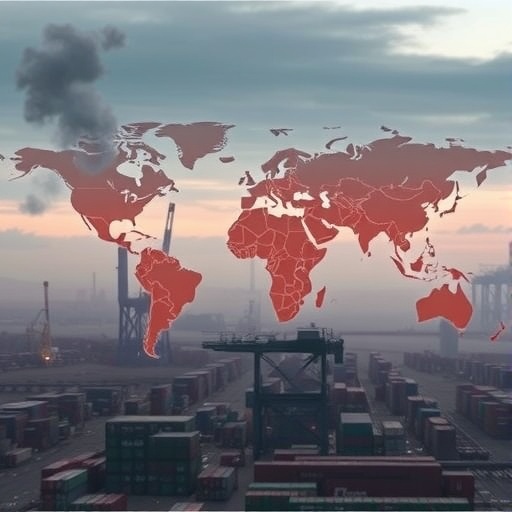
In a groundbreaking study published in Nature Communications, researchers have unveiled the profound impact international trade exerts on global air quality and related mortality rates. As economies become increasingly interwoven through trade networks, the environmental consequences extend far beyond national borders, often invisibly influencing air pollution and human health worldwide. This pioneering research quantitatively traces how the goods and services exchanged across countries affect air pollution levels, significantly reshaping the narrative around global commerce and environmental responsibility.
International trade, while a cornerstone of modern economic growth, has long been suspected of contributing to environmental degradation, but precisely how it influences air pollution and subsequent mortality has remained elusive until now. The team utilized advanced atmospheric models combined with global economic data, integrating emissions inventories related to trade flows. This comprehensive approach allowed the researchers to attribute air quality impacts and associated deaths to specific international trade activities, revealing disturbing trends that challenge current policy frameworks.
The analytical framework deployed hinges on quantifying emissions generated not only in a country’s production processes but also those indirectly caused by its consumption through imports. By tracing supply chains, the study mapped the journey of pollutants embodied in traded goods, essentially showing how a consumer in one country can inadvertently cause air pollution and health problems in another. This cross-border causality highlights the interconnectedness of economies and environments and introduces the uncomfortable truth that national air quality cannot be assessed in isolation.
One of the most striking insights from the research is that wealthier nations, often outsourcing their polluting industries to developing countries, effectively export air quality-related mortality abroad. These transfers mean that wealthier economies enjoy cleaner air while poorer regions disproportionately bear the health burdens caused by manufacturing activities. The data indicated that a significant fraction of premature deaths related to fine particulate matter (PM2.5) exposure arises from emissions induced by international trade, underscoring ethical considerations in consumption patterns.
The study’s refined modeling techniques leveraged state-of-the-art atmospheric chemistry models coupled with high-resolution economic input-output data. This synthesis enabled the isolation of pollution produced explicitly for export, identifying how emissions are embedded in the production of traded goods over complex global supply chains. The results emphasize the necessity of adopting consumption-based accounting for environmental impacts, as traditional production-based metrics underestimate the real footprint of a nation’s consumption on air pollution and health.
Moreover, the research addresses the role of specific pollutants, with fine particulate matter (PM2.5) and ozone precursors receiving particular focus due to their well-documented harmful effects on human health. The results reveal that emissions linked to international trade contribute substantially to elevated ambient concentrations of these pollutants, leading to millions of premature deaths annually. These findings push the scientific community and policymakers to reconsider transboundary pollution control strategies in light of the globalized economy.
Importantly, the study highlights regional disparities in the trade-pollution-mortality nexus. East Asia, South Asia, and parts of Africa emerge as hotspots where high volumes of export-oriented industrial production coincide with elevated emissions and subsequent health impacts. Meanwhile, many affluent nations alleviate their domestic pollution by importing goods manufactured under less stringent environmental regulations elsewhere, thereby shifting pollution and health burdens transnationally.
The implications of these findings extend into global environmental governance, suggesting that international cooperation and shared responsibility frameworks must evolve. Current air quality regulations are primarily designed and enforced at national or regional levels, insufficiently addressing the complexities introduced by global trade. Effective mitigation strategies will require integrating economic policies with environmental health considerations across borders, balancing trade benefits and pollution reduction.
Furthermore, the study explores potential mitigation scenarios, examining how adjustments in consumption patterns, cleaner production technologies, and stricter enforcement of environmental standards along value chains could drastically reduce trade-induced air pollution mortality. Implementing such measures could align global economic activities with the sustainable development goals, notably those relating to health, industry, and climate action, reinforcing the interconnectedness of these targets.
This research pioneers a shift in policy framing by providing empirical evidence for consumption-based accountability in global air pollution management. It challenges nations to look beyond their territorial boundaries and consider the health consequences of their consumption habits globally. The comprehensive mortality assessment linked to trade-associated pollution sets a new precedent in environmental epidemiology, illuminating pathways for transnational intervention.
The integration of atmospheric science and economics presented in this study also offers a novel template for investigating other environmental impacts of global trade, such as greenhouse gas emissions and biodiversity loss. By applying similar methodologies, policymakers and researchers can create holistic strategies addressing multifaceted ecological challenges posed by globalization.
Critically, the study’s robustness relies on extensive datasets and interdisciplinary collaboration encompassing atmospheric chemistry, environmental epidemiology, and international trade economics. This cross-cutting approach allowed the authors to construct a nuanced understanding of pollution transmission mechanisms and their health outcomes, offering a model for future research on the environmental externalities of commerce.
In conclusion, the findings of this study call for a paradigm shift in how international trade’s environmental consequences are addressed in policy and practice. Ensuring equitable health outcomes requires coordinated global efforts to manage pollution beyond political boundaries, incorporating consumption-based emissions accounting and emphasizing cleaner economic practices worldwide. As the world steps deeper into the era of globalization, such insights provide a crucial roadmap for harmonizing economic development with protecting human health and the environment.
As policymakers grapple with environmental justice, climate change, and economic recovery challenges, this research highlights the urgency of integrating international trade considerations in environmental health policies. The lessons learned from air pollution mortality associated with trade underscore the broader theme that sustainable development must be uncompromising and universally inclusive to protect the planet and its inhabitants.
Cite Scienmag News
Russell Cooper. (April 17, 2026). Global Trade’s Impact on Air Pollution Deaths. Scienmag. https://scienmag.com/global-trades-impact-on-air-pollution-deaths/
Russell Cooper. "Global Trade’s Impact on Air Pollution Deaths." Scienmag, 17 April 2026, https://scienmag.com/global-trades-impact-on-air-pollution-deaths/. Accessed 5 September 2026.
Russell Cooper. "Global Trade’s Impact on Air Pollution Deaths." Scienmag. April 17, 2026. https://scienmag.com/global-trades-impact-on-air-pollution-deaths/


