


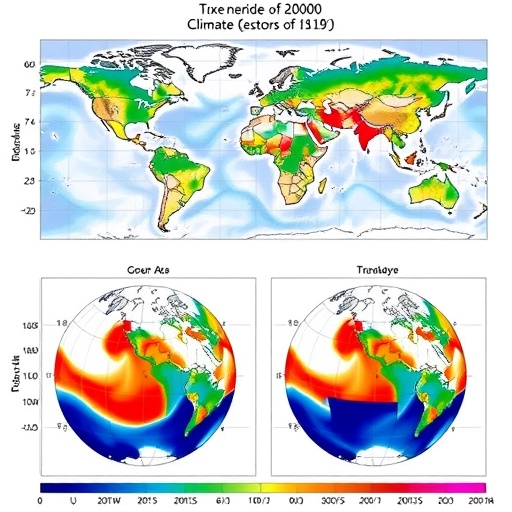
Over the past three decades, climate scientists have pushed the frontiers of our understanding by employing coupled global climate models (CGCMs) to simulate temperature patterns across the planet. A new study, spearheaded by Brunner, Ghosh, Haimberger, and colleagues, presents an unprecedented synthesis of 30 years’ worth of data from these sophisticated models. This monumental work, recently published in Communications Earth & Environment, offers fresh perspectives on how our global climate has evolved and is projected to evolve in the coming decades, revealing intricate details about climate variability and anthropogenic influences that are critical to future policy and scientific inquiry.
Coupled global climate models have long been the backbone of climate research, integrating the complex interplay of atmospheric, oceanic, cryospheric, and terrestrial systems. These models operate by mathematically encoding physical laws and empirical data, allowing them to simulate interactions that drive temperature fluctuations at both regional and global scales. The present study stands out due to its longitudinal scope and the rigorous validation processes employed, encompassing simulations from multiple generations of CGCMs developed since the early 1990s.
One of the key breakthroughs embedded in this research is the improved parameterization of various feedback mechanisms within the Earth system, such as cloud dynamics and ocean heat uptake. Clouds, in particular, have remained a challenging component due to their highly variable and localized nature. The team’s innovative approach integrates satellite-based observational data with novel machine learning techniques, enhancing the accuracy of cloud-related feedback estimations and reducing uncertainties that had historically hindered precise temperature projections.
Oceanic processes, notably the role of the thermohaline circulation and heat absorption in the upper and deep ocean layers, have been meticulously modeled in this research. The results highlight how subtle shifts in ocean currents can amplify or moderate temperature changes globally. By assimilating decades of ocean buoy data and Argo float measurements, the models in this study have captured the dynamic coupling between ocean heat content and atmospheric temperatures with remarkable fidelity.
Another compelling dimension of the study is its exploration of transient climate response (TCR) and equilibrium climate sensitivity (ECS), two pivotal metrics that articulate the climate system’s reaction to increasing greenhouse gas concentrations. The researchers demonstrate how refined physical representations and updated emission scenarios have narrowed the range of TCR and ECS estimates, bolstering confidence in projections of temperature rise under various mitigation pathways.
Importantly, the study also accounts for natural climate variability phenomena, such as El Niño-Southern Oscillation (ENSO) and volcanic aerosols, which can temporarily mask or exacerbate long-term warming trends. By capturing these oscillations with enhanced temporal resolution, the team underscores how short-term climate perturbations overlay the broader anthropogenic warming signal, a vital insight for interpreting observational data and informing policy decisions.
Regional temperature patterns emerge as another focal point, with the models revealing pronounced heterogeneity in warming rates across different latitudes and continents. These disparities underscore the critical need for localized climate adaptation strategies. For example, Arctic amplification—the phenomenon by which polar regions warm at a rate faster than the global average—is elucidated with unprecedented clarity, illuminating the feedback loops involving sea ice melt, atmospheric circulation changes, and albedo effects.
The legacy of three decades of CGCM development is visible not only in the enhanced spatial and temporal resolution of climate projections but also in the integration of biogeochemical cycles. The study integrates carbon and nitrogen cycle dynamics to evaluate how terrestrial ecosystems may modulate atmospheric greenhouse gas concentrations, revealing emerging feedback loops that could either buffer or accelerate warming trends depending on land use and vegetation responses.
An equally significant contribution lies in the study’s attention to uncertainty quantification. Leveraging ensemble simulations from multiple model generations and comparing them against updated observational datasets has enabled the researchers to rigorously assess the robustness of their temperature projections. This comprehensive uncertainty framework fortifies the scientific community’s ability to interpret model outputs and prioritize areas for further refinement.
The study’s implications extend well beyond academic circles. It fundamentally enriches the toolbox available to policymakers and international climate frameworks, who rely on such robust simulations to craft emission reduction targets consistent with the Paris Agreement goals. The enhanced fidelity of CGCMs equips decision-makers with actionable intelligence about future warming trajectories under varying socio-economic pathways, enabling more nuanced risk assessments and adaptation planning.
It is also worth noting the technological leaps that have underpinned these advancements, including the exponential growth in supercomputing power and the proliferation of interdisciplinary collaboration. The fusion of climate physics, data science, and environmental monitoring techniques exemplified in this research illustrates how modern climate science transcends traditional boundaries to tackle one of humanity’s most pressing existential challenges.
Looking forward, the study identifies several avenues for future research, such as the need to better resolve extreme weather event simulation and the interaction between anthropogenic aerosols and cloud microphysics. These areas pose some of the most formidable challenges but are crucial for refining predictions about climate impacts on human health, agriculture, and infrastructure.
The study also highlights a paradigm shift toward coupling climate models with socio-economic models to explore integrated assessment scenarios. This approach aims to bridge the gap between physical climate risk projections and their economic and societal ramifications, fostering holistic climate resilience strategies.
In conclusion, the work by Brunner and colleagues not only chronicles the technological and scientific strides in climate modeling over the last three decades but also lays a robust foundation for future research and action. It reaffirms the critical role of coupled global climate models as indispensable instruments in deciphering the Earth’s climate system and steering humanity toward a sustainable future.
The rigor, depth, and breadth of this study resonate profoundly in the context of accelerating climate change. As global temperatures continue to rise with profound implications for ecosystems and societies, such comprehensive modeling efforts are invaluable. They provide the detailed, reliable insights essential to inform mitigation efforts and stave off the most catastrophic outcomes of a warming world.
This landmark publication stands as a testament to the enduring value of integrating observation, computation, and theory in climate science. It is a clarion call for sustained investment in climate research to sharpen our predictive capabilities, ultimately empowering humanity to navigate the challenges and uncertainties of a rapidly changing climate landscape.
Cite Scienmag News
Jonathan Martin. (April 16, 2026). Three Decades of Coupled Global Climate Modeling. Scienmag. https://scienmag.com/three-decades-of-coupled-global-climate-modeling/
Jonathan Martin. "Three Decades of Coupled Global Climate Modeling." Scienmag, 16 April 2026, https://scienmag.com/three-decades-of-coupled-global-climate-modeling/. Accessed 4 September 2026.
Jonathan Martin. "Three Decades of Coupled Global Climate Modeling." Scienmag. April 16, 2026. https://scienmag.com/three-decades-of-coupled-global-climate-modeling/


