


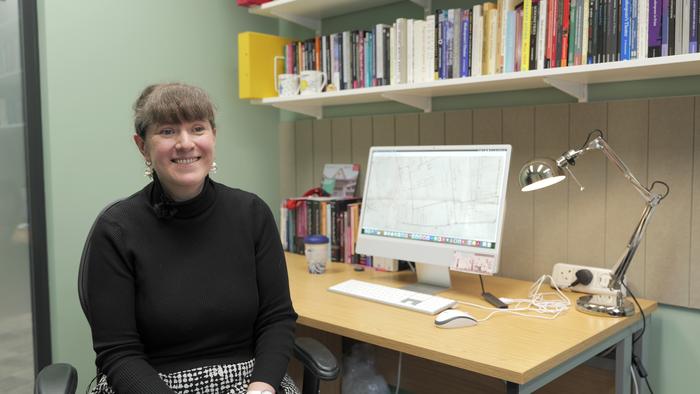
The precise location of William Shakespeare’s singular London property has finally been identified with remarkable accuracy, ushering in a new era of understanding about the famed playwright’s urban life. This pivotal revelation comes courtesy of a floorplan unearthed by Professor Lucy Munro, an esteemed expert on Shakespeare and Early Modern Literature at King’s College London. Her meticulous research not only locates Shakespeare’s London home within a serene street in Blackfriars but also offers fresh insights into its architectural layout and size, changing long-held assumptions about Shakespeare’s final years.
For centuries, historians and literary scholars have speculated about Shakespeare’s London residence, known to be purchased in 1613, but its exact whereabouts remained elusive. Traditionally, the property was believed to be part of the “Great Gate” of the Blackfriars precinct, an entrance to a 13th-century Dominican friary that dominated the area centuries earlier. The ambiguity about the property’s exact location was succinctly acknowledged by a City of London plaque on a discreet building at 5 St Andrew’s Hill, which stated Shakespeare had purchased lodgings “near this site,” underscoring the mystery still surrounding the precise spot.
Professor Munro’s discovery is grounded in the identification of three critical historical documents sourced from The London Archives and The National Archives. These documents illuminate the property’s dimensions, architectural footprint, and historical transactions, clarifying Shakespeare’s ties to Blackfriars with unprecedented precision. Among these, a plan drafted in 1668, shortly after the Great Fire of London, emerges as especially revelatory by mapping the extents of the property.
The floorplan reveals that while the segment of the property spanning over the Blackfriars gate itself no longer had a foundation at the time of the post-fire survey, a substantial portion remained, measuring approximately 45 feet east to west, along with variable widths of 15 feet and 13 feet across its northern and southern ends respectively. Although the internal layout is not depicted, evidence points toward the house being divided into two separate dwellings by 1645, indicating a sizeable domestic space rather than a mere investment property.
This newfound knowledge reshapes narratives about Shakespeare’s later years. Contrary to the common perception that he retired soon after acquiring the Blackfriars house and withdrew entirely to Stratford-upon-Avon, it is now plausible that Shakespeare retained a significant presence in London. Proximity to the Blackfriars Theatre, where he was actively involved as a playwright and shareholder, could have encouraged extensive use of the property, potentially facilitating the creation of later works such as “Two Noble Kinsmen,” co-authored with John Fletcher in 1613.
The discovery invites vivid speculation about Shakespeare’s daily life in the city. Perhaps he frequented the neighboring tavern publicly known as the ‘Sign of the Cock’ or enjoyed views of the converted friary structures from his residence’s windows, integrating the sights and sounds of London into his creative milieu. The identification of the property’s boundaries also confirms that the current blue plaque at 5 St Andrew’s Hill stands not just near, but a true marker on the exact location of Shakespeare’s house.
Additional documents highlight the property’s subsequent history, detailing how it became a family asset passed down to Shakespeare’s granddaughter, Elizabeth Hall Nash Barnard. Her sale of the property in 1665, just one year before the Great Fire decimated much of London, marks a poignant closure to the family’s direct connection with the site. The contextualization of these transactions deepens the understanding of Shakespeare’s familial legacy and the fate of his London holdings.
Professor Munro reflects on the breadth of the find, emphasizing its impact on Shakespearean scholarship and urban history alike. In a statement, she expressed astonishment upon uncovering the floorplan, which was previously presumed lost or non-existent. Her research revitalizes a subject that has lain dormant, offering scholars and enthusiasts a firm grasp on Shakespeare’s physical environment within London and its implications for his lifestyle and work during his late career.
This detailed archaeological and archival investigation not only reconstructs an important piece of the Elizabethan and Jacobean urban tapestry but also symbolizes the enduring dialogue between literature and place. Envisioning Shakespeare’s life in London through this spatial lens enriches appreciation of the interplay between the man’s creative genius and his dynamic setting in one of history’s most vibrant cultural capitals.
The importance of this discovery resonates beyond academic circles, capturing the imagination of the public and cultural institutions alike. Dr. Will Tosh, Director of Education at Shakespeare’s Globe, praised Professor Munro’s dedication, highlighting how archival diligence can yield transformative insights that deepen our connection to Shakespeare as both a London city dweller and a foundational figure in literary history. This work underscores the significance of the Shakespeare Centre London’s mission to support such groundbreaking scholarship.
The uncovered property once encompassed what is now the eastern end of Ireland Yard, the base of Burgon Street, and parts of late nineteenth-century buildings at 5 Burgon Street and 5 St Andrew’s Hill. Historically, this locale has hosted a diverse array of occupants, including printers, manufacturers of printing inks, carpet wholesalers, and, more recently, professionals in investment management and residential tenants, layering centuries of urban life atop the original foundations of Shakespeare’s residence.
In sum, Professor Munro’s research presents a definitive advancement in unraveling the complex material history of one of the most iconic literary figures. This discovery not only solves a lingering historical puzzle but also reinvigorates discussion about Shakespeare’s connection to London, enhancing understanding of how place and creative work intersected in his life, and providing fertile ground for future scholarly inquiry.
News Publication Date:
17 April (Year not specified; context suggests 2020s)
Web References:
https://www.eurekalert.org/multimedia/1125440
Cite Scienmag News
Courtney Benton. (April 15, 2026). New Discovery Maps Shakespeare’s ‘Missing’ London House: Unlocking Historical Secrets. Scienmag. https://scienmag.com/new-discovery-maps-shakespeares-missing-london-house-unlocking-historical-secrets/
Courtney Benton. "New Discovery Maps Shakespeare’s ‘Missing’ London House: Unlocking Historical Secrets." Scienmag, 15 April 2026, https://scienmag.com/new-discovery-maps-shakespeares-missing-london-house-unlocking-historical-secrets/. Accessed 3 September 2026.
Courtney Benton. "New Discovery Maps Shakespeare’s ‘Missing’ London House: Unlocking Historical Secrets." Scienmag. April 15, 2026. https://scienmag.com/new-discovery-maps-shakespeares-missing-london-house-unlocking-historical-secrets/


