


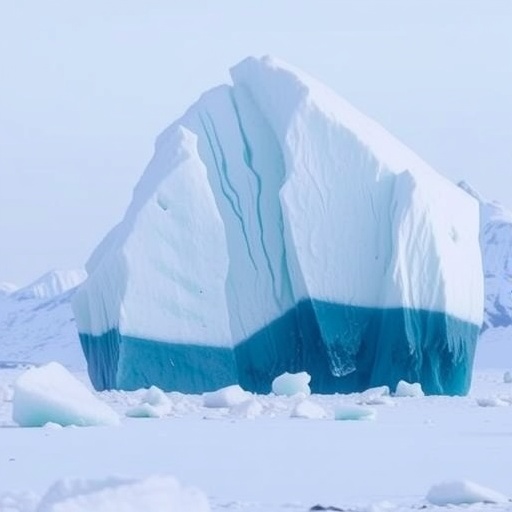
Sea ice may appear to be a simple, solid mass of frozen water, but beneath its seemingly uniform surface lies an intricate network of microscopic channels filled with liquid brine. This complex internal structure plays a critical role in regulating the movement of seawater, nutrients, and gases through the ice, impacting both its physical properties and the ecosystem it supports. Decades of pioneering research by University of Utah mathematician Ken Golden have shed light on these permeable pathways, revealing that the microscopic arrangement of sea ice determines the extent and efficiency of fluid transport within the polar environment.
Golden’s latest study shifts focus to a specific type of sea ice known as granular ice, which is characterized by a random, small-grain crystal orientation. This form of ice is becoming increasingly prevalent across the polar regions—a sign of the planet’s warming climate and changing sea ice dynamics. The question at the heart of this research is to determine the critical threshold at which granular ice becomes sufficiently porous to allow vertical fluid flow, a property that holds profound implications for marine microorganisms and larger-scale geophysical phenomena.
Whereas traditional columnar sea ice features orderly crystal growth with brine pathways becoming connected at around 5% of the ice’s volume, the new findings indicate that granular ice requires nearly double that brine volume to achieve similar fluid connectivity. The percolation threshold for granular ice was identified as approximately 10%, meaning the brine pockets remain largely isolated until reaching this higher concentration. This discovery highlights a fundamental difference in permeability between the two dominant sea ice types.
Understanding the difference between the 5% threshold in columnar ice and the 10% in granular ice is vital for ecological studies. The microbial communities that inhabit these briny channels rely on fluid flow to supply essential nutrients and gases needed for their survival. In more granular ice, these nutrients become less accessible, leading to altered living conditions for a host of organisms, including algae, bacteria, viruses, and nematodes. The repercussion is an ecosystem operating under distinct constraints in different ice conditions.
Golden, along with electrical and computer engineering professor Cynthia Furse, undertook extensive field research involving Arctic and Antarctic sea ice. Their work involved precise measurements of ice permeability and brine distribution, conducted aboard research vessels navigating some of the planet’s most extreme environments. Their collaboration culminated in a comprehensive experimental study now published in Scientific Reports, establishing new benchmarks for understanding the vertical transport of fluids through granular sea ice.
Sea ice is not merely a frozen compound but a composite material whose microstructure is crucial in determining its physical behavior. Like bone, which combines mineral and porous components, sea ice consists primarily of pure ice with inclusions of brine. The geometry and connectivity of these brine inclusions fluctuate with temperature and depend heavily on whether the ice formed in calm conditions—resulting in columnar ice—or turbulent waters contributing to a granular structure.
The formation environment decisively influences how brine channels intersect and ultimately control fluid movement. Turbulent zones, which are prevalent around the Antarctic, promote the granular ice structure. As global temperatures climb, the proportion of granular ice is expected to grow, which means the permeability characteristics of the polar ice cover are shifting, carrying implications far beyond local ecosystems.
Several geophysical processes depend critically on the permeability of sea ice, including nutrient cycling, snow-to-ice transformation in the Antarctic, and the development and drainage of melt ponds in the Arctic. These processes influence broader climate dynamics by regulating the heat exchange between the ocean and the atmosphere and by modulating sea ice mass balance. The study underscores the urgency of incorporating the varying permeabilities of granular versus columnar ice into climate models to improve predictions related to ice melt and ocean-ice interactions.
Previously, Golden introduced the “Rule of Fives,” a concept derived from percolation theory, indicating that columnar sea ice becomes permeable to vertical fluid flow once the brine volume reached 5%. This became a cornerstone in understanding how temperature and salinity influence the onset of permeability in the ice. The new work builds on this foundation by validating that granular ice demands nearly twice the brine volume fraction before reaching comparable permeability, hence delineating two distinct regimes for sea ice fluid transport.
The ramifications of a higher percolation threshold in granular ice extend to global biogeochemical cycles, particularly regarding gas exchanges such as CO2 transfer between the ocean and atmosphere. The more disconnected brine pockets in granular ice impede the vertical movement of gases, potentially altering regional and global carbon budgets. Additionally, meltwater drainage during seasonal thawing behaviors is similarly affected, threatening to modify the reflective properties of sea ice by influencing the coverage and size of melt ponds and thus its albedo effect.
Surface albedo is a crucial factor in sea ice energy balance, determining how much solar radiation is absorbed or reflected back into the atmosphere. Granular ice, with its impaired drainage capabilities, may sustain larger melt ponds and reduce overall reflectivity. Smaller albedo values mean higher absorption of solar heat, promoting faster melting and consequently accelerating the decline of ice cover under warming conditions.
This nuanced understanding of how microstructural variations in sea ice influence planetary-scale feedbacks underscores the interconnectedness of small-scale physical properties and large-scale environmental outcomes. Golden’s research provides a critical roadmap for scientists seeking to refine climate models and unravel the complexities of polar ice dynamics amidst a warming planet.
Published on April 7, 2026, in Scientific Reports, the study titled “Percolation threshold for vertical fluid flow through granular sea ice” represents a significant advance in the field of applied mathematics and geophysical science. Supported by funding from the U.S. National Science Foundation and the Office of Naval Research, the research team also included mathematicians Adam Gully and Delaney Mosier of the University of Utah, as well as Jean-Louis Tison from Université Libre de Bruxelles in Belgium.
The insights gained from this work emphasize that not all sea ice should be treated identically in scientific assessments. The growing dominance of granular ice reflects a shifting Arctic and Antarctic landscape, where microscopic permeability translates directly into ecological viability and climate system responses. As warming trends continue, researchers and policymakers alike must account for these subtle yet profound changes to accurately address the future of Earth’s cryosphere.
Cite Scienmag News
Russell Cooper. (April 15, 2026). Polar Ice Transforms, Bringing New Rules in Its Wake. Scienmag. https://scienmag.com/polar-ice-transforms-bringing-new-rules-in-its-wake/
Russell Cooper. "Polar Ice Transforms, Bringing New Rules in Its Wake." Scienmag, 15 April 2026, https://scienmag.com/polar-ice-transforms-bringing-new-rules-in-its-wake/. Accessed 4 September 2026.
Russell Cooper. "Polar Ice Transforms, Bringing New Rules in Its Wake." Scienmag. April 15, 2026. https://scienmag.com/polar-ice-transforms-bringing-new-rules-in-its-wake/


