


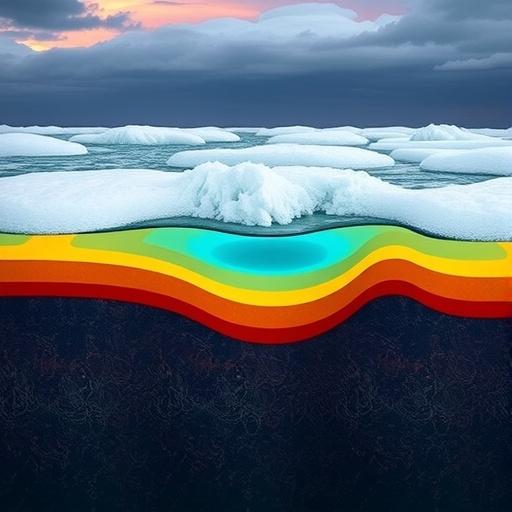
In the relentless progression of global warming, ocean currents—those vast rivers of seawater that traverse the planet’s surface—are revealing unexpected behavior. A groundbreaking study now illuminates the role of “eddying,” the swirling, chaotic movement within these currents, which is intensifying and reshaping oceanic dynamics in profound ways. This phenomenon is not just a localized curiosity; it is a crucial piece of the puzzle in understanding how climate change is altering marine environments worldwide, particularly in subtropical western boundary currents like the Agulhas Current.
The Agulhas Current, a powerful western boundary current off the southeast coast of Africa, is a natural laboratory for these transformative processes. Recent research spearheaded by Gunn and Beal illustrates how increased eddy activity in this current dramatically enhances vertical stratification, resulting in the surface layers of the ocean warming at rates three to four times faster than the surrounding mean ocean temperature. This surface warming effect is accompanied by a paradoxical cooling in deeper ocean layers beneath the current.
This dualistic temperature trend stemming from eddies carries significant implications. Enhanced stratification effectively traps heat in the upper ocean, reducing vertical mixing and preventing the dissipation of warmth to deeper waters. At the same time, intensified eddies foster stronger upwelling near the coastline, particularly inshore of the Agulhas Current. This process brings cooler, nutrient-rich waters from the depths closer to the surface, thereby invigorating the adjacent shelf sea ecosystems. The cooling of these shelf seas amid broader surface warming exemplifies the complex and sometimes counterintuitive nature of ocean-climate interactions.
Eddying’s influence extends beyond thermal effects alone. The study reveals that even as surface waters rapidly warm downstream within the Agulhas system—a phenomenon correlated with increased continental rainfall events in South Africa—there exists a simultaneous reduction in total heat flux to higher latitudes. This counterbalancing act highlights an important nuance. Despite these transformative thermal shifts, the volume transport, or the total flow rate, of the Agulhas Current itself remains remarkably stable, challenging assumptions that climate-induced flow shifts would dominate ocean-circulation changes.
Such revelations prompt a profound reconsideration of how scientists measure and interpret dynamical oceanic changes in a changing climate. Traditionally, metrics such as volume transport and overturning circulation have dominated assessments of ocean health and behavior. Yet in subtropical western boundary currents—where complex dynamical processes govern exchanges between the continental shelves and the open ocean—eddy fluxes may provide a more accurate barometer of climate impacts. Eddy activities encode subtle but critical information about heat distribution, nutrient cycling, and physical oceanography, making them indispensable for future research frameworks.
These insights, while rooted in observations of the Agulhas Current, have broad global implications. The researchers argue that the intensification of eddying and its resultant effects are not unique to the Agulhas; rather, they are a universal characteristic of subtropical western boundary currents worldwide. Whether eddies manifest as swirling vortices, traveling waves, or persistent shifts in mean flow structures, they fundamentally alter coastal and open-ocean dynamics, contributing to phenomena such as the warming, expansion, or shifting of currents observed from the Gulf Stream in the Atlantic to the Kuroshio Current in the Pacific.
Dynamical theory underpins much of these predictions, suggesting that increased eddy activity will universally drive enhanced hidden upwelling inshore of all subtropical western boundary currents. This key mechanism occurs regardless of local wind patterns or regional overturning circulation trends, underscoring the primacy of small- to mesoscale turbulence in climate-scale ocean changes. Such universal applicability offers a powerful framework for reconciling diverse regional observations and predicting future oceanic responses to ongoing climate perturbations.
A critical implication emerging from this work involves coastal ecosystems, which stand at the intersection of oceanographic shifts and human vulnerability. Upwelling driven by eddy dynamics enriches shelf seas with nutrients, potentially boosting coastal productivity and fisheries over time. This nutrient influx could become an unexpected resilience factor for marine food webs facing warming surface waters—a stark reminder that climate change’s impacts are multifaceted and sometimes paradoxical.
Yet, the intensification of surface warming over the Agulhas system also drives profound environmental transformations. Rapidly warming surface waters influence atmospheric processes, contributing to increased rainfall on adjacent continents, such as South Africa. These coastal climate feedbacks create a tightly coupled ocean-atmosphere system influenced heavily by changes in the eddy field, linking ocean physics with terrestrial climatic and socioeconomic outcomes in a rapidly warming world.
While the volume transport of the Agulhas Current holds steady, the nuanced interplay of eddy activity, stratification, and heat flux reshapes our understanding of climate-driven ocean change. This challenges prevailing climate models and calls for an enhanced observational focus on eddy fluxes, which might better capture evolving ocean dynamics than bulk transport metrics alone. Long-term monitoring efforts aimed at eddy variability will be crucial for advancing predictive oceanography.
Technological advancements in satellite remote sensing, autonomous underwater vehicles, and high-resolution ocean models are pivotal in tracking these energetic eddy structures. Fine-scale observations, cross-validated with theory and simulations, will deepen understanding of how eddy-induced stratification effects translate across diverse ocean regimes. Bridging these scales—from turbulent swirls to basin-scale circulation—remains one of the most compelling frontiers of contemporary climate-ocean science.
The revelations about the Agulhas Current also compel reconsideration of how scientists interpret broad-scale ocean warming patterns. Rapid surface warming in localized western boundary current systems contrasts with deceleration or cooling trends documented elsewhere, illustrating a complex mosaic of thermal responses shaped by eddy-enhanced mixing and stratification processes. Climate projections must integrate these heterogeneous mechanisms to refine future scenarios.
Furthermore, eddy intensification influences sea level trends along continental margins. Enhanced stratification modifies thermal expansion profiles in coastal waters, altering regional sea level rise patterns that affect coastal communities. Understanding these eddy-driven oceanographic processes is vital for accurate coastal risk assessments, infrastructure planning, and resilient adaptation strategies in the face of climate stressors.
The findings urge a paradigm shift in ocean climate diagnostics—from primarily monitoring large-scale circulation metrics to incorporating mesoscale eddy fluxes as key indicators of oceanic response to global warming. This transition promises to uncover subtler but potent dynamics that govern heat, nutrient, and carbon budgets within the ocean, ultimately refining predictions of climate feedbacks and informing sustainable ocean stewardship.
In sum, this research reshapes our comprehension of oceanic changes under warming by revealing eddy activity as a fundamental driver of stratification, coastal cooling, and altered productivity within subtropical western boundary currents. It underscores that understanding climate change impacts requires delving into the energetic complexities of ocean turbulence and its intricate coupling with larger-scale environmental processes. As climate variability intensifies, the ‘hidden’ eddy ocean may well emerge as a central focus for oceanographers and climate scientists alike.
Cite Scienmag News
Sloane Callahan. (April 15, 2026). Stronger Currents Boost Stratification, Cool Shelf Seas. Scienmag. https://scienmag.com/stronger-currents-boost-stratification-cool-shelf-seas/
Sloane Callahan. "Stronger Currents Boost Stratification, Cool Shelf Seas." Scienmag, 15 April 2026, https://scienmag.com/stronger-currents-boost-stratification-cool-shelf-seas/. Accessed 4 September 2026.
Sloane Callahan. "Stronger Currents Boost Stratification, Cool Shelf Seas." Scienmag. April 15, 2026. https://scienmag.com/stronger-currents-boost-stratification-cool-shelf-seas/


