


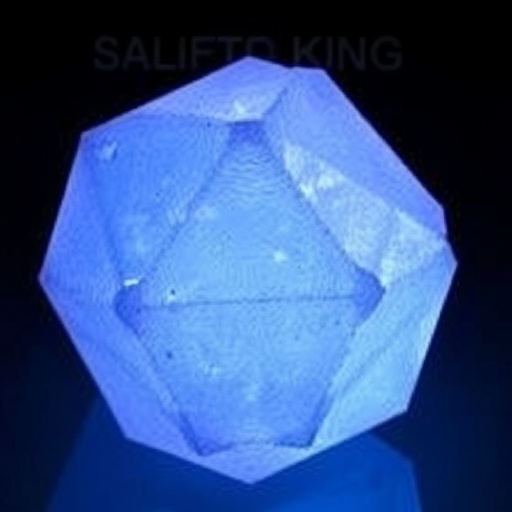
In a groundbreaking development that promises to reshape the world of optoelectronics and smart materials, researchers have unveiled a novel form of mechanoluminescence (ML) in a deceptively simple oxide: aluminum oxide doped with chromium ions (Al2O3:Cr). This discovery, recently published in Light: Science & Applications, demonstrates not only the generation of light under mechanical stress but also a remarkable capability for self-recovery, setting a new benchmark for the durability and functionality of mechanoluminescent materials.
Mechanoluminescence, the phenomenon whereby certain materials emit light when subjected to mechanical forces such as friction, pressure, or deformation, has long intrigued scientists due to its potential applications in stress sensing, display technologies, and biomedical imaging. Traditional mechanoluminescent materials, however, often suffer from rapid degradation under repeated mechanical stimulation, limiting their practical utility. The study led by Fang, Pan, and Zhang introduces a simple oxide system that circumvents these challenges by exhibiting a self-recoverable behavior, meaning the material can restore its luminescent capabilities autonomously after stress-induced exhaustion.
At the heart of this discovery lies Al2O3:Cr, a material system historically known for its robust optical properties and widespread industrial applications. By doping aluminum oxide with trivalent chromium ions, the team harnessed defect states and energy traps that facilitate the conversion of mechanical energy into visible light. What sets their work apart is the unique defect engineering approach, which strategically controls intrinsic vacancies and electronic traps within the crystal lattice, fostering a stable and reusable luminescence mechanism rarely observed in simple oxide materials.
The research dives deeply into the microscopic processes underpinning this self-recoverable mechanoluminescence. When mechanical stress is applied, the distortion creates localized electric fields within the lattice, leading to the excitation of chromium ions. These excited ions release photons as they return to their ground state, producing the characteristic light emission. Notably, repeated application of mechanical stimuli typically depletes available energy traps, leading to diminished light output. However, in the Al2O3:Cr system, an intrinsic recovery process recharges these traps over time without any external intervention, effectively resetting the luminescence capability.
This self-healing trait is attributed to the dynamic migration of oxygen vacancies and electron retrapping phenomena. The researchers observed that, following mechanical excitation, oxygen vacancies within the lattice can diffuse and recombine with trapped electrons, restoring the electron reservoir necessary for subsequent mechanoluminescent cycles. Such a self-sufficient regeneration mechanism ensures prolonged operational lifespans, making Al2O3:Cr highly attractive for applications requiring repetitive mechanical stress detection over extended periods.
The implications for real-world applications are broad and exciting. The durable mechanoluminescence response of Al2O3:Cr opens new avenues for designing stress sensors in structural health monitoring, where materials are routinely subjected to mechanical forces. For instance, incorporating such oxides into aircraft wings, bridges, or pipelines could enable real-time, light-based detection of cracks and stress accumulation without the need for complex electronics or external power sources.
Furthermore, the biocompatibility and chemical stability of aluminum oxide enhance the prospects for biomedical applications. Devices utilizing Al2O3:Cr could be integrated into smart implants or wearable sensors that harness body movements to generate light signals indicating stress or damage states. The self-recovery feature eliminates the necessity for frequent replacements or recharging, significantly improving the reliability and lifespan of such devices.
On a fundamental level, this discovery enriches the understanding of solid-state physics, particularly the interplay between lattice defects, dopant ions, and mechanical stimuli in light emission processes. It challenges the notion that complex oxides or engineered nanostructures are prerequisites for efficient mechanoluminescence, instead highlighting how carefully tuned simple oxides can exhibit sophisticated functional behaviors.
Experimentally, the team employed state-of-the-art spectroscopic techniques and stress application methodologies to quantify the luminescence intensity, emission spectra, and recovery kinetics. Their results reveal robust emission centered in the near-infrared region, corresponding to known transitions in chromium ions, alongside a rapid luminescence rise time and a recovery period spanning several minutes to hours depending on environmental conditions. These parameters suggest that the luminescence can be modulated via mechanical input frequency and ambient factors, adding versatility to potential device designs.
Critically, the material’s performance was stable under diverse mechanical regimes, including compression, tension, and bending, indicating resilience across various deformation modes. Such versatility implies that Al2O3:Cr-based sensors or displays could be tailored to specific application environments without significant material modifications.
The researchers also addressed potential challenges and future directions, noting that optimizing the doping concentration and defect configurations could further enhance the luminescence efficiency and recovery speed. Moreover, integrating Al2O3:Cr into composite materials or flexible substrates might expand its practical utility, allowing for conformal coatings or embedment into soft robotic components where mechanoluminescent feedback is desirable.
As the field of mechanoluminescence advances, this work stands out by demonstrating how classical materials science principles combined with modern defect engineering can unlock new functionalities in well-studied systems. The self-recoverable ML in Al2O3:Cr not only promises technological breakthroughs but also inspires new lines of inquiry into energy conversion mechanisms activated by mechanical forces.
Industry stakeholders are likely to take keen interest in this development, especially those focused on sensor technology, nondestructive testing, and optoelectronic devices. The cost-effectiveness and scalability of aluminum oxide fabrication, coupled with chromium doping procedures already established in industrial contexts, facilitate smoother technology translation pathways.
Looking ahead, interdisciplinary collaborations integrating materials scientists, engineers, and device physicists could accelerate the development of mechanoluminescent devices based on Al2O3:Cr. Exploring combinations with other dopants or multilayer architectures might unlock multi-color emission or tunable luminescence properties, expanding the scope of applications into areas such as dynamic displays or interactive surfaces.
In conclusion, the pioneering discovery of self-recoverable mechanoluminescence in Al2O3:Cr marks a seminal moment in functional material research. It encapsulates a triumph of simplicity and innovation, demonstrating that even the most foundational oxide matrices can be engineered for advanced light-emitting responses activated by mechanical information. As mechanoluminescent technologies continue to mature, such discoveries will undoubtedly illuminate new technological frontiers and redefine how light and mechanics intertwine in material systems.
Cite Scienmag News
Denise Maddox. (April 15, 2026). Self-Healing Glow in Simple Oxide Crystals. Scienmag. https://scienmag.com/self-healing-glow-in-simple-oxide-crystals/
Denise Maddox. "Self-Healing Glow in Simple Oxide Crystals." Scienmag, 15 April 2026, https://scienmag.com/self-healing-glow-in-simple-oxide-crystals/. Accessed 3 September 2026.
Denise Maddox. "Self-Healing Glow in Simple Oxide Crystals." Scienmag. April 15, 2026. https://scienmag.com/self-healing-glow-in-simple-oxide-crystals/


